

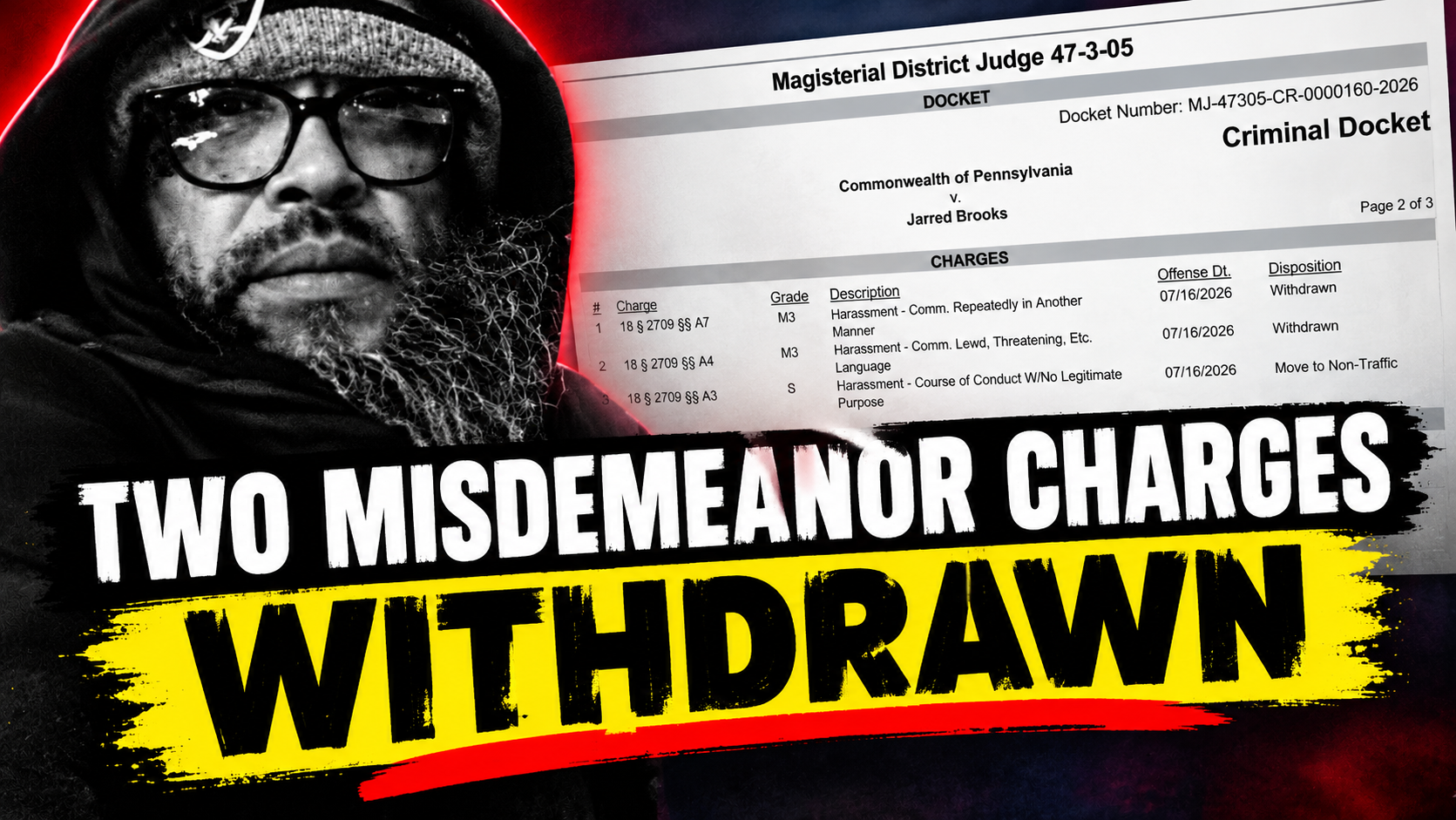
Jarred Brooks faced two misdemeanor counts over on-air remarks about a Pennsylvania woman. Both were withdrawn the day of his hearing. He pleaded guilty instead to a summary offense filed the same day as the original complaint, a resolution that leaves him with a far easier path to erasing his record than either original charge would have.
HASTINGS, Pa. — In mid-July, a woman in Northern Cambria, Pennsylvania, called police to report that a YouTube commentator who goes by “Krackhead Kenny” had spent months describing her online as a pedophile, comparing her to a convicted sex offender, and, she told officers, saying he wanted a restraining order against her so he could obtain her real name and expose it.
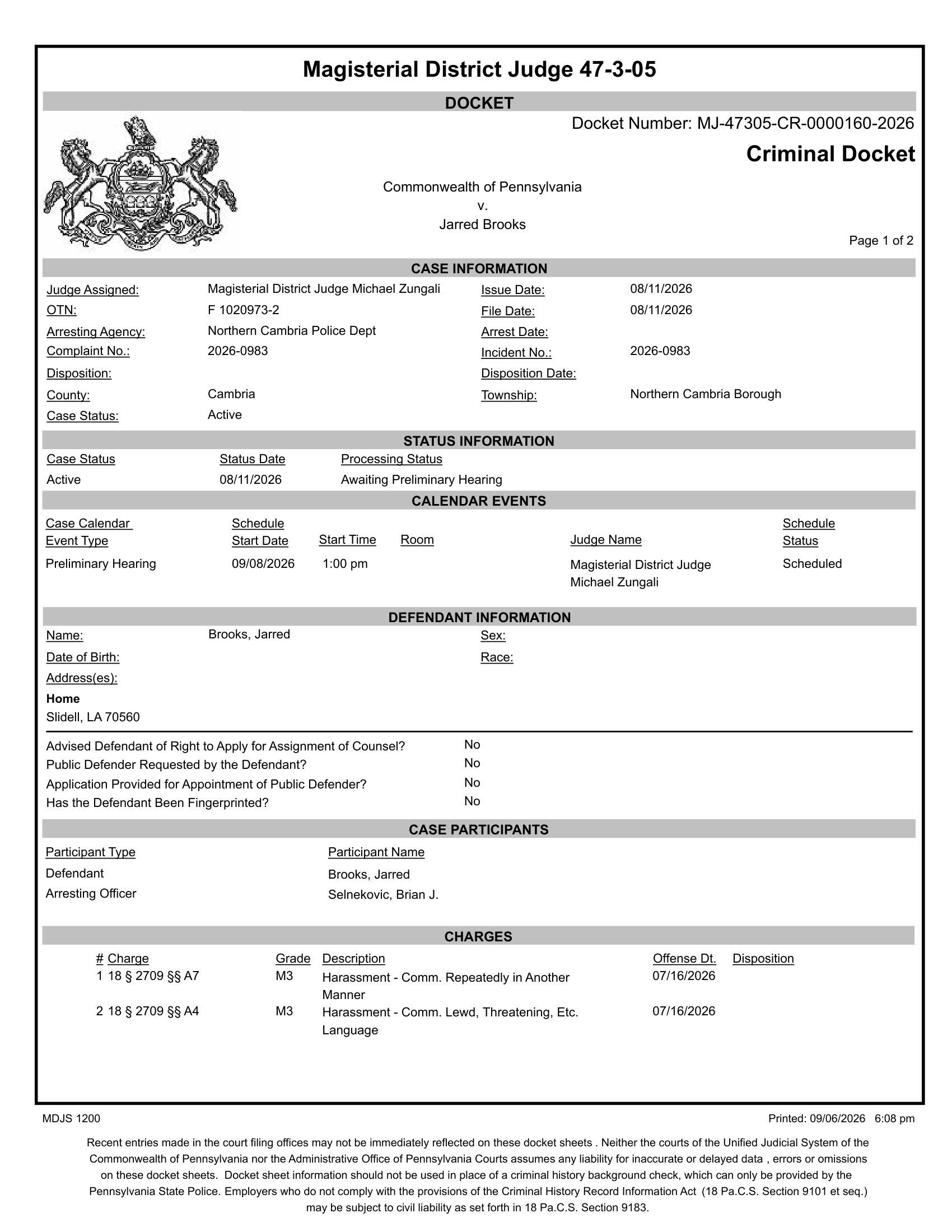
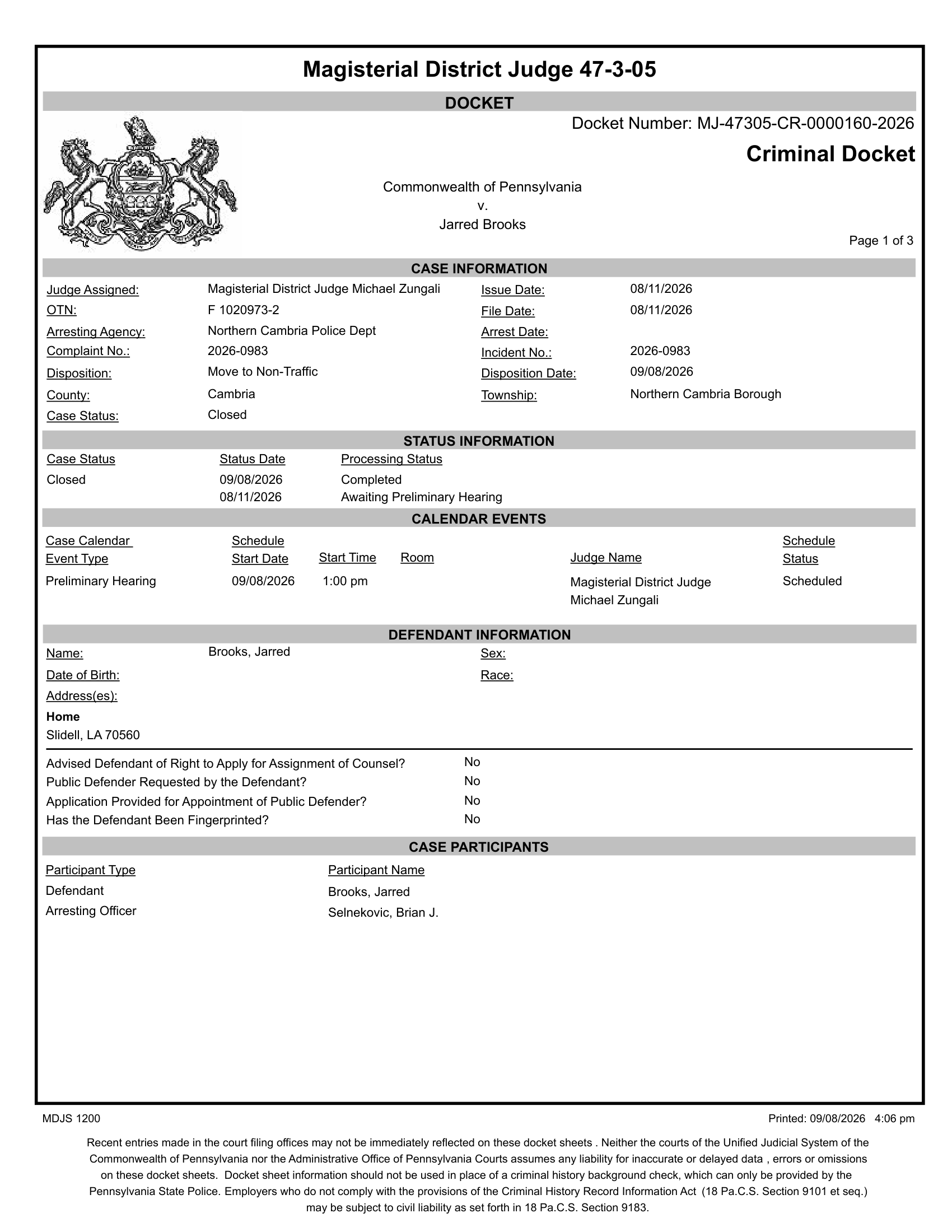
Three and a half weeks later, prosecutors charged Jarred Brooks, of Slidell, Louisiana, with two misdemeanor counts of harassment.
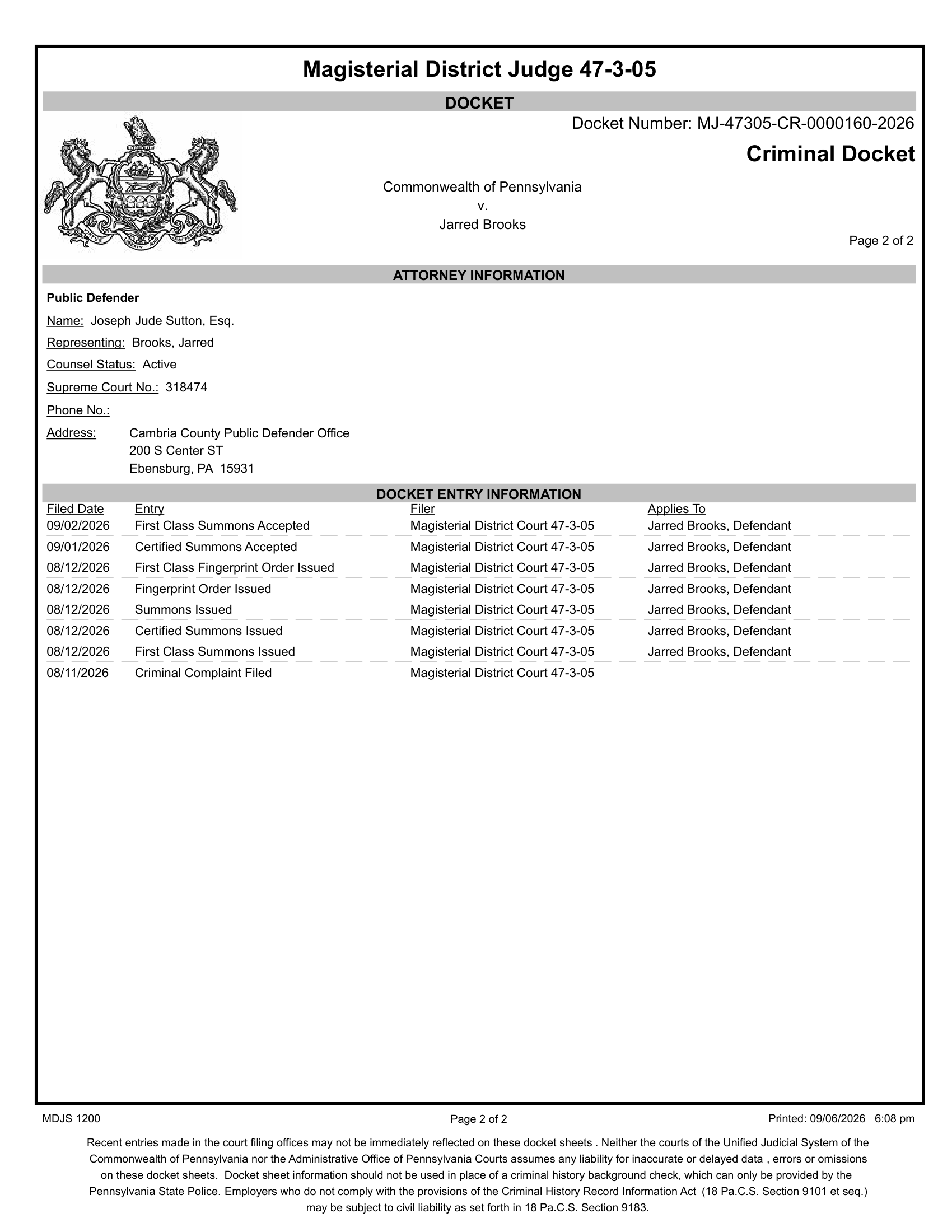
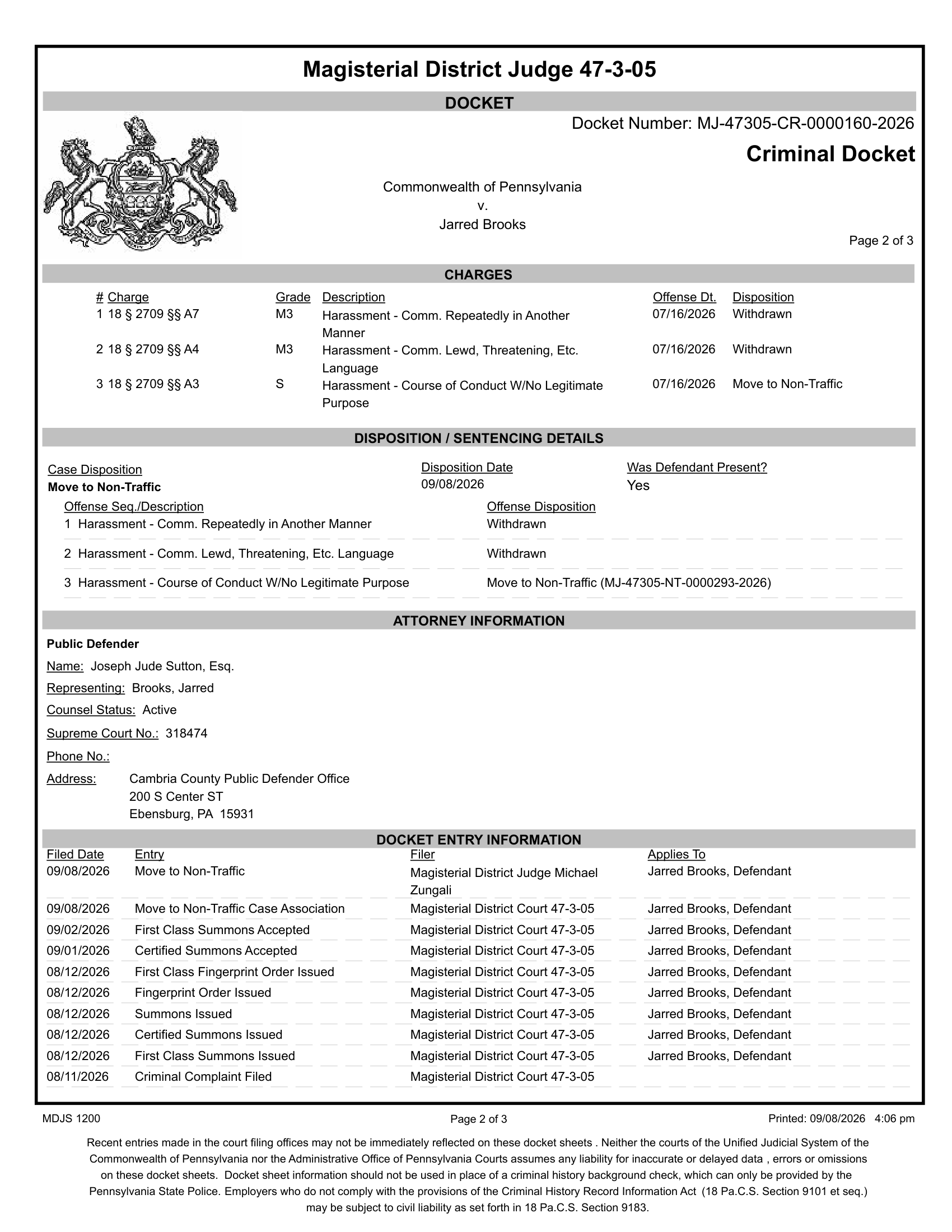
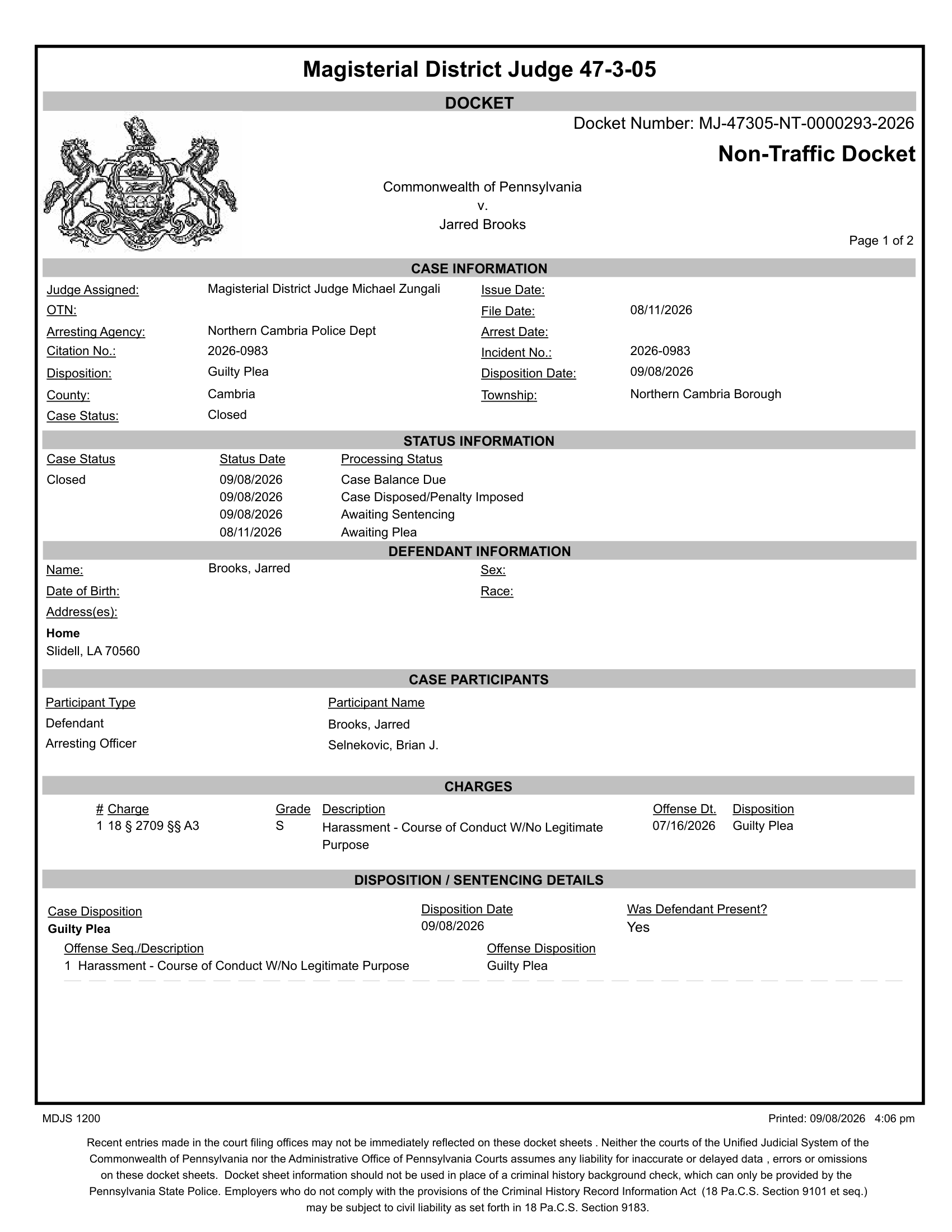
On September 8, the day of his preliminary hearing, both counts were withdrawn. In their place, Brooks pleaded guilty to a single summary offense, a charge that had been sitting on a separate docket since the day of the original complaint, and was ordered to pay $287.56.
The case had looked, on paper, like it might test a question that has divided courts nationally for more than a decade: when does public commentary about a real person, however vile, cross from protected speech into criminal harassment? That test never happened. The two counts built to reach the content of Brooks’s remarks were dropped without being admitted, contested, or proven. What he pleaded guilty to requires proving none of it.
The charges
The criminal complaint, filed by Patrolman Brian Selnekovic of the Northern Cambria Borough Police Department, charged Brooks under Pennsylvania’s harassment statute, 18 Pa.C.S. § 2709, with communicating “repeatedly” in a manner meant to harass, annoy, or alarm the woman, name redacted in the public court records, and separately with communicating “to or about” her using language the statute defines as lewd, lascivious, threatening, or obscene. Both counts were graded as third-degree misdemeanors, the lowest tier of misdemeanor in Pennsylvania, each carrying up to a year in jail.
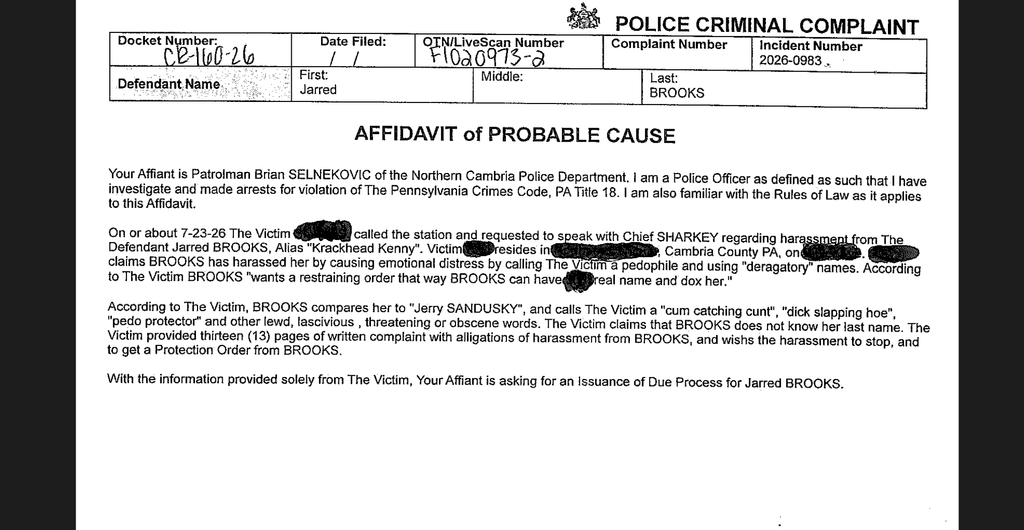
According to the supporting affidavit, Brooks called the woman a pedophile, compared her to Jerry Sandusky, the convicted former Penn State assistant coach, and directed a string of vulgar epithets at her on his channel. The affidavit also attributes to her an account that Brooks wanted a restraining order against her specifically to obtain her legal name and expose it, a claim sourced to what she told the responding officer, not to anything in Brooks’s own words. It states he does not know her last name. She separately gave police a 13-page written complaint describing the alleged pattern, which was never filed with the court.
The free speech question
Brooks’s remarks, as described in the affidavit, were reportedly made on his own YouTube channel. That distinction of public communication vs private communication has divided courts elsewhere. In 2011, a federal judge in Maryland dismissed a stalking case built on a defendant’s repeated public Twitter and blog posts about a religious leader, ruling that posts a person has to seek out resemble public commentary more than criminal harassment. North Carolina’s Supreme Court struck down a similar state cyberbullying law in 2016 on related grounds. Texas’s highest criminal court went the other way in 2022, upholding a comparable statute over a dissent that argued it plainly reached protected speech.
Pennsylvania’s own appellate courts have already confronted this argument for this specific statute, and rejected it. In a 1999 ruling, reaffirmed in 2023, the state’s courts held that Section 2709 regulates the manner of communication rather than its content or its audience, and declined to adopt a “captive audience” standard that would treat public commentary differently from direct contact. Brooks’s case never reached the point of testing that precedent against his own facts.
The most serious accusation was not the name calling, but the threat to dox her. We searched hours of transcripts and could not find anything related to obtaining a restraining order or intent to dox, however, she could have reported this based on a pattern seen in prior complaints against Brooks.
How the case ended
Court records show what happened underneath the withdrawal. Both misdemeanor counts were marked withdrawn as of September 8. In their place, Brooks pleaded guilty to a reduced single summary offense under Section 2709(a)(3): engaging in “a course of conduct” that “serves no legitimate purpose.” That provision doesn’t require proving specific vulgar content or repeated communications, the elements at the center of the original counts. It is the statute’s most generic form.
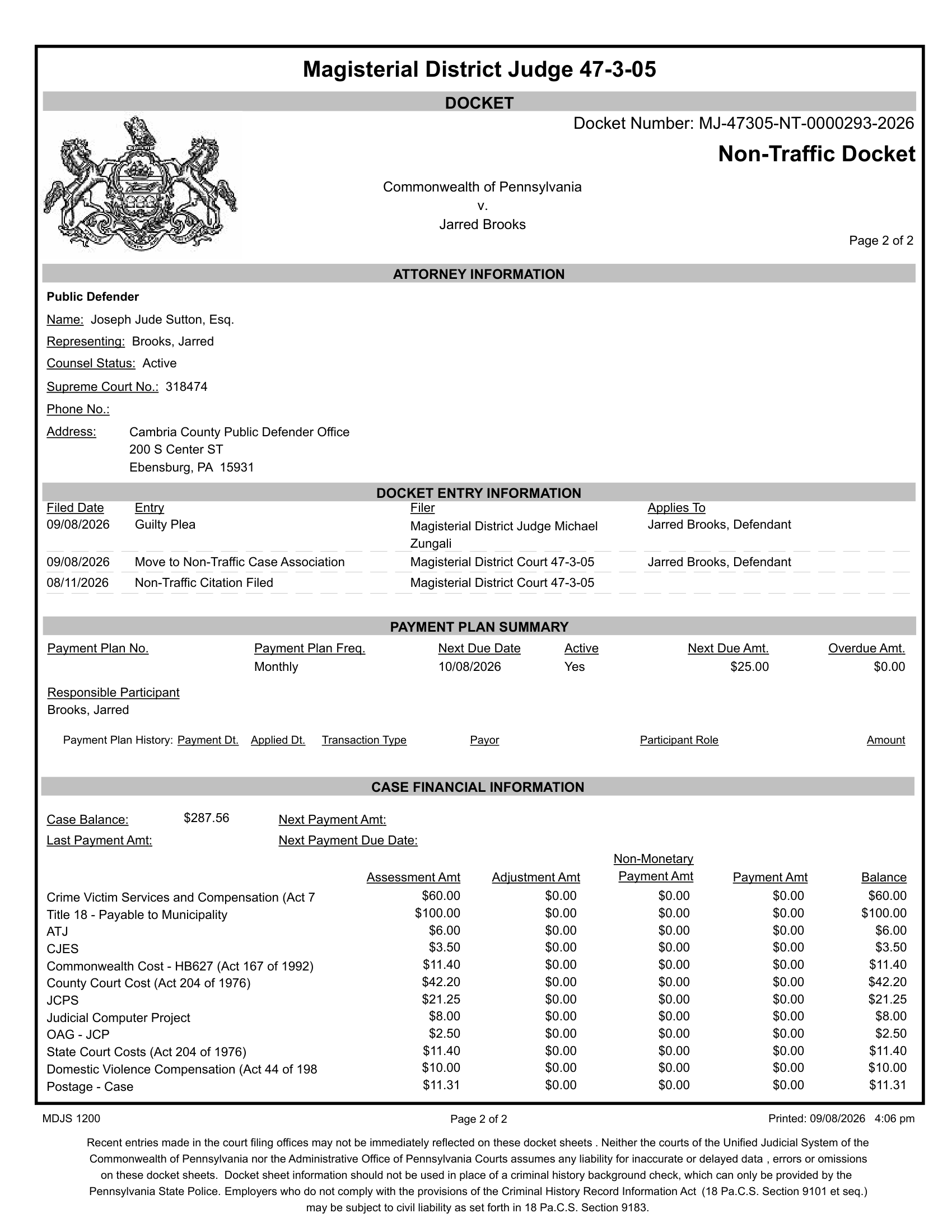
Brooks was ordered to pay $287.56: a $100 fine payable to Northern Cambria Borough, $60 to the state’s Crime Victim Services and Compensation fund, $10 to a domestic violence compensation fund, and the remainder in standard court costs.
What the reduction means
The dollar figure understates what changed. A third-degree misdemeanor, what both original counts were graded as, carries up to a year in jail and, if not resolved earlier, would send the case to the Court of Common Pleas for a jury trial. Summary charges are minor violations handled quickly through a magisterial district judge rather than a major jury trial. They typically begin with a non-traffic citation handed out by an officer or sent in the mail. Typical summary offenses range from disorderly conduct, public intoxication, and shoplifting to misuse of a shopping cart, or keeping a library book. A summary offense caps out at 90 days, never leaves the magisterial district judge, and carries no jury component. Brooks resolved his entire case in one afternoon in front of the same judge assigned to it from the start.
The larger difference is in what happens to the record. Under Pennsylvania’s Clean Slate law, most misdemeanor convictions can never be truly expunged, short of the person turning 70 or receiving a governor’s pardon. The only available relief is automatic sealing, which hides a conviction from most background checks after seven years but leaves it fully visible to law enforcement, courts, and certain licensing bodies indefinitely. A summary conviction is treated far more leniently: it can be sealed automatically after five years, and separately expunged outright, the record destroyed, by petition on the same five-year timeline. Pleading down from misdemeanor to summary moved Brooks from a record he would likely have carried, hidden but permanent, for the rest of his life, to one with a real, foreseeable path to no longer existing at all.
A case mischaracterized online
The case had already drawn commentary before it resolved. Anthony D’Amato, who broadcasts as ZeroDarkTony and covered Brooks on his channel, told his audience in a September 3 livestream that the charges could carry up to seven years in prison and described the grading as still undetermined between a felony and a misdemeanor. Court records show both original counts were graded as third-degree misdemeanors from the outset; no felony version of these charges exists under Pennsylvania law. D’Amato also called Brooks a “paranoid schizophrenic stalker,” a characterization with no support in the record: nothing in the charging documents contains a mental health diagnosis, and Brooks was never charged under Pennsylvania’s separate stalking statute.
Brooks pleaded guilty to one summary offense, 18 Pa.C.S. § 2709(a)(3). The two misdemeanor counts described above, including the allegations underlying them, were withdrawn. They were never admitted by Brooks, tested at a hearing, or otherwise resolved on their merits.
Have information about this case? Contact HNZ via Telegram at @hnznetwork.