

What it took for Mindy Willens to secure protection—and what it cost
For more than a year, one year and one day to be exact, Mindy Willens waited for a decision in a case that was never supposed to take this long. Willens filed a request for a restraining order on March 24, 2025, and entered into an agreement that effectively dismissed the case on March 25, 2026.
Civil harassment restraining orders in California are designed to move quickly. They exist for a reason. When someone is being targeted in a sustained, escalating way, the harm does not pause while the court process plays out. If anything, delay makes it worse.
But in Willens v. D’Amato, time stretched while the harm did not stop.
At the center of the case is Anthony Robert D’Amato Jr., known online as “ZeroDarkTony,” and a pattern of conduct that, according to court filings, went far beyond criticism or commentary. In her original request for a restraining order, Willens described repeated livestream targeting and escalating threats. She cited broadcasts that lasted for hours, sometimes across multiple sessions in a single day. Among the statements she attributed to D’Amato were: “I’m warning you, don’t push me because the next round is gonna be so f**ing nasty… you’re gonna wanna leave the earth girl,” “I dare you take me to court. I fucking dare you,” and “I will do such scathing roasts, you won’t be able to process it and neither will your mom.” (Request for TRO – 7a(3))
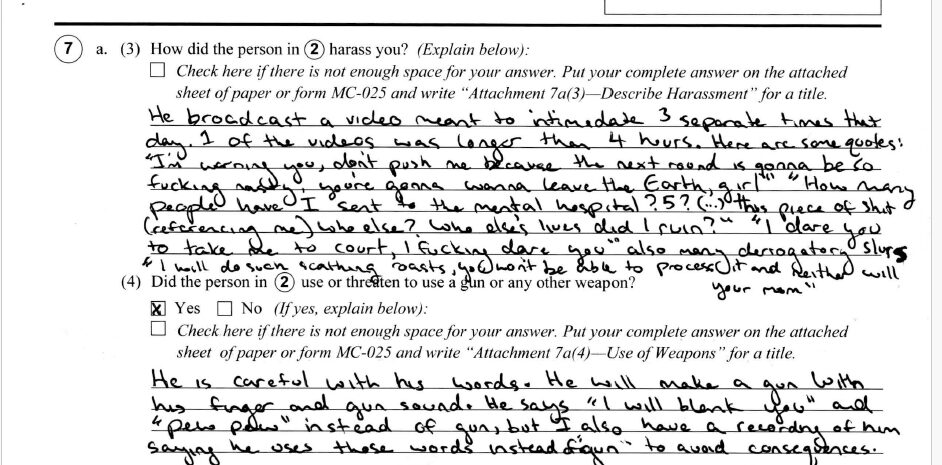
The filings also describe language that blurred the line between intimidation and implied violence. Willens wrote that D’Amato was often “careful with his words,” but still referenced weapons in coded ways, using phrases such as “I will blank you” while, she said, conveying the same threat. (Request for TRO – 7a(4))
In another section of the request, she cited statements warning her against seeking court protection at all: “Mindy, I f**ing dare you to get a RO on me” and “People get murdered when you get restraining orders out on them. I mean that’s what happens.” (Request for TRO – 11)
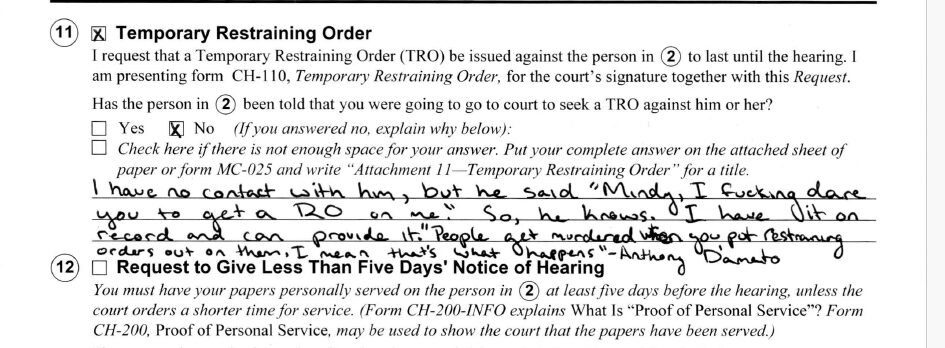
Taken together, the filings do not describe a single outburst or isolated incident. They describe a pattern. It was repeated, public, and escalating. This is exactly the kind of conduct civil harassment orders are meant to address. Not disagreement. Not criticism. Conduct that causes real fear.
And yet, instead of a swift resolution, the case became something else.
Hearings multiplied. What began as a focused request for protection grew into a broader legal fight, shaped in large part by D’Amato’s repeated delays. Court records show a pattern familiar to those who have followed his other cases. Proceedings were pushed back through a series of continuance requests and procedural obstacles. There were claims of issues with service, newly retained counsel, and last-minute requests for more time. At one point, attorney Scott Spindel appeared to inform the court that Steven Tamer had now been retained, and another continuance followed. Later, Tamer sought an additional delay due to travel.
Individually, those requests fall within the bounds of legal procedure. Taken together, they had a cumulative effect. A case designed to move quickly stretched well beyond a year.
At times, the court itself appeared to recognize the problem. When Tamer later issued subpoenas seeking data from several private accounts he claimed were relevant to identifying witnesses, Judge Repecka raised concerns about relevance and good faith. She sanctioned Tamer in the amount of $2,000, though payment was later stayed to allow a motion for reconsideration. All of this amounted to further delay. But by that point, something else had become clear. The process itself had become a burden.
For Willens, that burden was deeply personal. The filings describe attacks that did not stay contained to her. They reached into the most private parts of her life. They used her deceased sister in degrading, sexualized ways. They targeted her mother by identifying her publicly, directing harassment toward her workplace, and making cruel remarks tied to her illness. Over time, the burden of responding began to mirror the harm itself.
Still, she kept going. She kept filing, documenting, and showing up through a process that was never quick and never easy.
That is the quiet tension at the heart of cases like this. Delay does not simply postpone an outcome. It extends the conditions that made the case necessary in the first place.
There is a broader question D’Amato has often claimed: 1st Amendment protected speech. Thy court system often grapples with how to separate free speech from targeted harassment in an online world where repetition, amplification, and audience can turn one person’s conduct into something much harder to ignore. D’Amato has framed his actions publicly as justified, even inevitable. Inside the courtroom, those claims are tested under a different standard. The question is not what someone believes they are entitled to do. The question is what the law actually permits, and what it protects against.
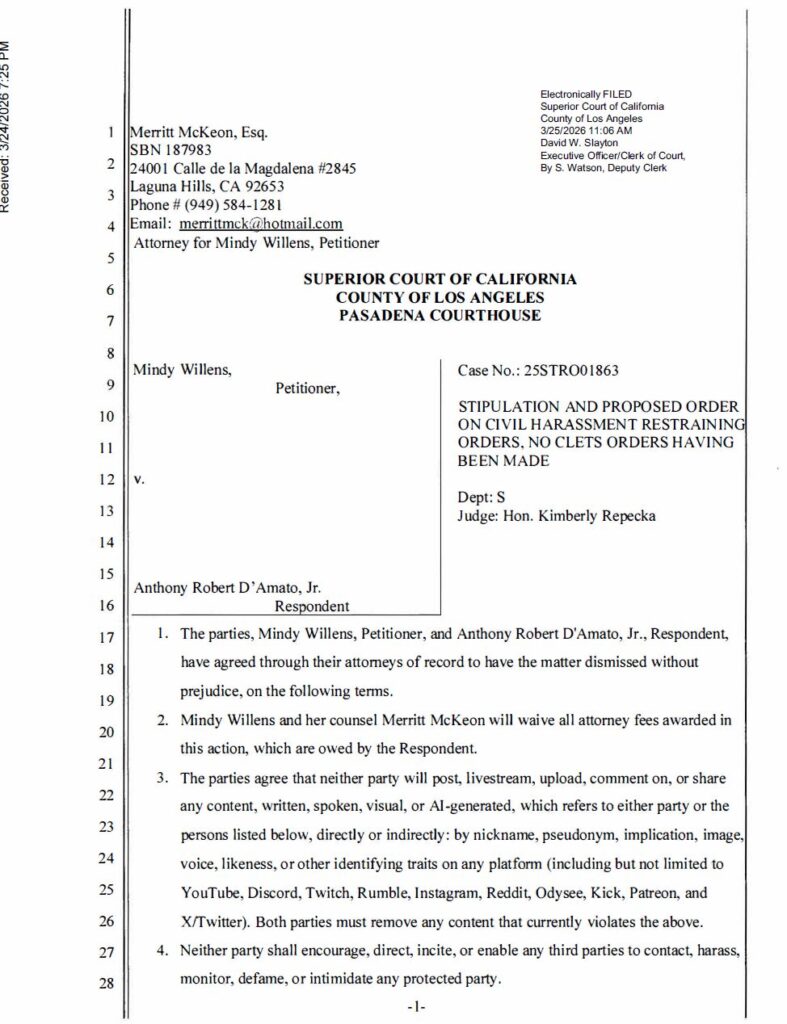
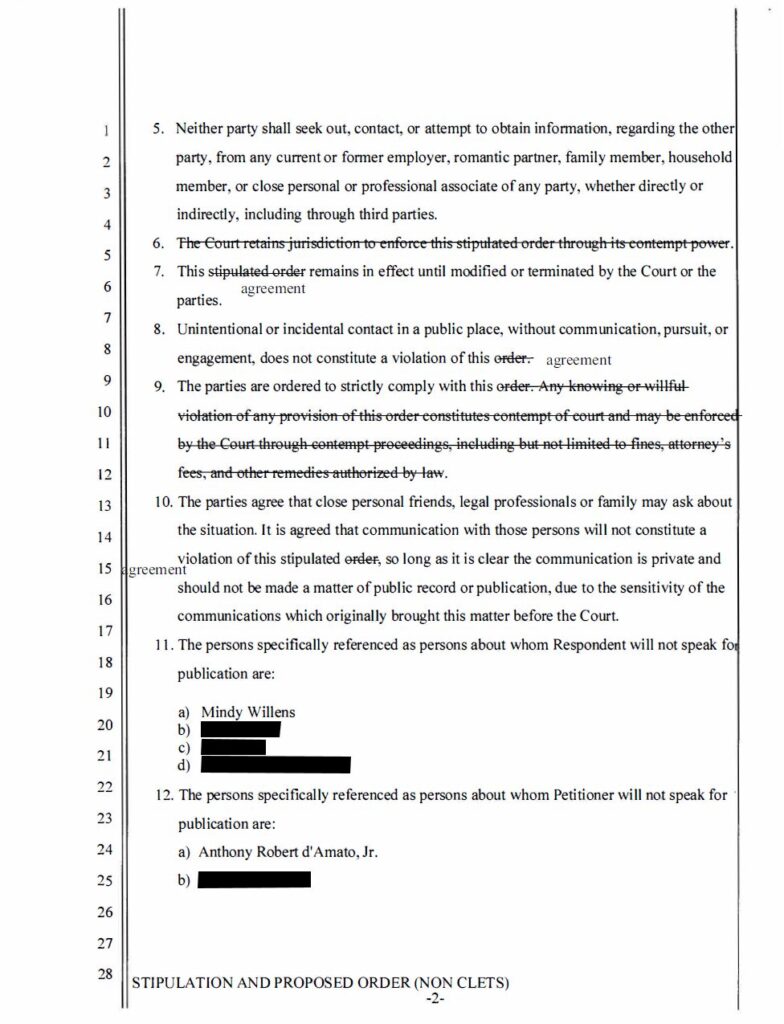
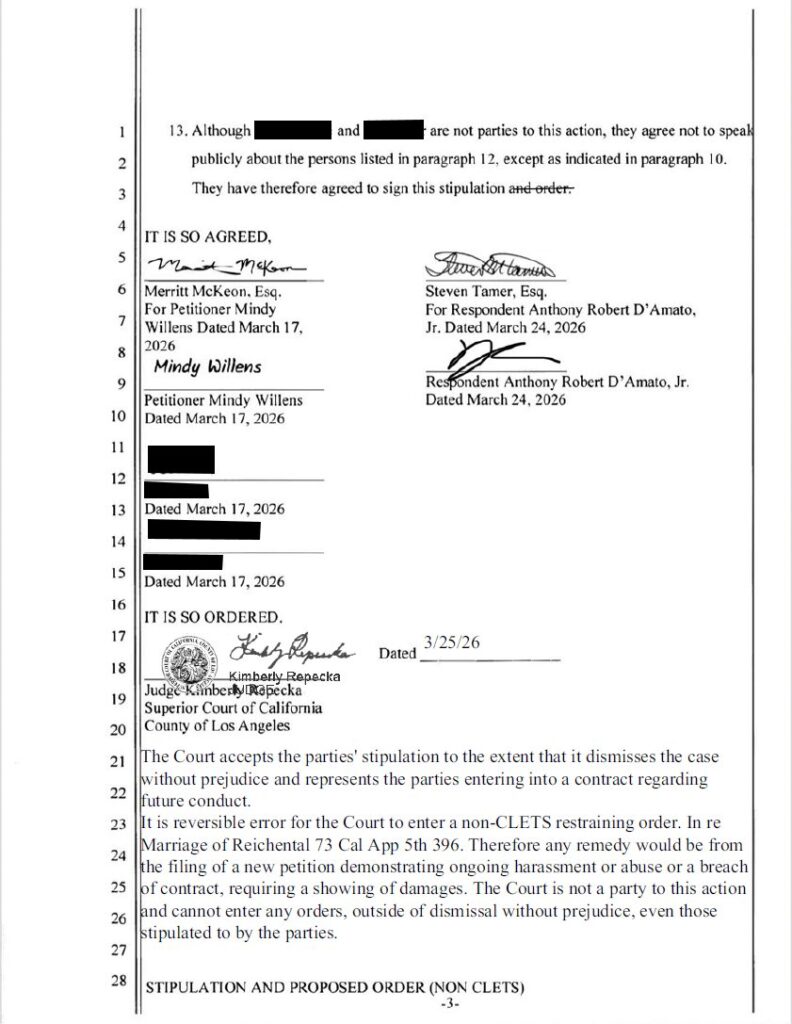
After a year, the case did not end with a ruling from the court. It ended with an agreement. In a stipulated resolution filed by the parties, Mindy Willens secured protections for herself and her family without waiting any longer for a judicial decision. The agreement places limits on D’Amato’s conduct and is meant to bring an end to the pattern that led her to seek protection in the first place.
But it came at a cost.
As part of the resolution, Willens also agreed to restrictions on her own speech and conduct. Those conditions would not have existed had the court issued a unilateral ruling in her favor. She and her attorney also walked away from the sanctions, closing the door on further financial penalties tied to the earlier subpoena disputes in the case, which could have covered at least a small portion of the legal fees incurred. It is a compromise that reflects a difficult reality. When cases stretch on long enough, even the party seeking protection may have to give something up just to bring the process to an end.
In that sense, the outcome is both a win and a concession. It is a win because, after a year and a day, Willens no longer has to wait on a delayed court process to secure some measure of safety for herself and her family. It is a concession because the protections she obtained are not the product of a clear judicial finding. They are the product of an agreement that limits both sides.
And there is one more unresolved piece. If the agreement is violated, enforcement does not happen automatically. Willens would have to return to court, refile, and ask the same system to do what it never fully did the first time.
For now, the case is over. Whether the burden of the case is over is a different question.
Consider joining as a member to support purchase of court files like those shared here.