
A Los Angeles livestreamer returns to the same jurisdictional battlefield that destroyed his first case – this time with a lawyer. It may not be enough.
This is part one in an ongoing series.
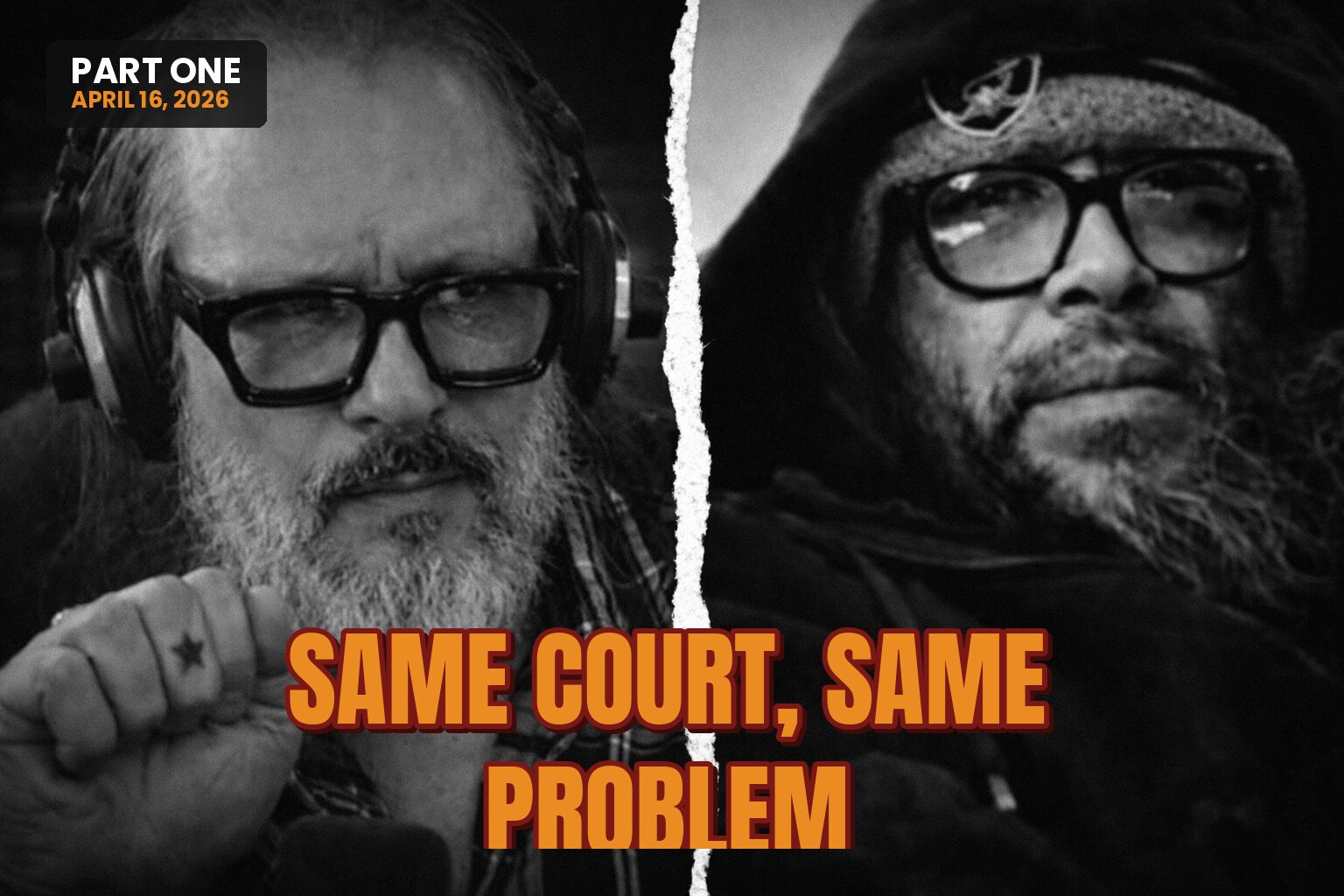
On the morning of April 17, 2026, a courtroom in the Metropolitan Courthouse in Los Angeles will host the latest chapter in one of the internet’s stranger legal feuds. On one side: Anthony Robert D’Amato Jr., 55, a Rumble and YouTube personality known as “ZeroDarkTony” who styles himself an investigative creator and who is currently serving three years of summary probation following a no-contest plea on harassment-related charges. On the other: Jared Brooks, 46, a Louisiana-based streamer known online as “Krackhead Kenny,” a resident of Slidell who has never lived in California, never worked in California, and, critically, has never set foot in California.
The hearing concerns Case No. 26STRO01932, D’Amato’s second civil harassment restraining order (CHRO) petition against Brooks. The first, Case No. 25CHRO01789, ended on October 28, 2025, in total defeat: dismissed for lack of jurisdiction, all temporary restraining orders dissolved, the case thrown out by Commissioner Caitlin Crary Taylor in Van Nuys. It was a textbook application of California Code of Civil Procedure Section 395(a) and the 2021 appellate decision Williams v. Superior Court, which together form an essentially impenetrable wall against civil harassment proceedings brought in California against out-of-state residents who have no physical presence in the state.
Now D’Amato is back, this time with an attorney, Christopher Edwin Chaney of the Law Offices of Christopher Chaney in Encino. The petition was filed March 27, 2026. Brooks, appearing in pro per from Slidell, filed his Motion to Quash on April 9, 2026, and the hearing is set for tomorrow. On his livestream, D’Amato has teased a “surprise.” The surprises available to him in this case are, as a matter of procedural law, rather limited.
Round One: Failure
On September 12, 2025, D’Amato filed his initial petition at the North Valley District courthouse in Chatsworth, representing himself. A temporary restraining order was issued the same day by Judge Sonia B. Dujan; a not-uncommon outcome in ex parte TRO proceedings, where the court hears only one side. The TRO required Brooks to stay 100 yards away from D’Amato, his 77-year-old mother, and his 16-year-old daughter. It prohibited all contact and ordered Brooks to surrender any firearms.
There was one significant problem: He checked the box indicating that Brooks “lives in this county.” He does not. He lives in Slidell, Louisiana at an address D’Amato correctly stated on page one of the same form. In his second petition’s declaration, D’Amato attributed the error to the self-help center that assisted him with the paperwork, describing the checkbox as accidentally checked.
Brooks’ “special appearance” was a legally precise move preserving his jurisdictional challenge. He filed a Motion to Quash in September 2025. The motion was heard on October 28. Commissioner Taylor granted it. The reasoning was straightforward: under CCP Section 395(a), a California court’s proper venue for a civil action is the county where the defendant resides. Brooks resides in Louisiana. He had no minimum contacts with California. The case was dismissed.
Round Two: Same Facts, Different Packaging
The second petition, filed by attorney Chaney on March 27, 2026, makes clear that D’Amato understands the error of the first filing. He no longer claims Brooks lives in Los Angeles. On the venue section of the new CH-100 form, he checks only Box B: “I was harassed by the person in this county.” He describes the relationship: “Another creator online. Met by his threats.” His declaration attaches a detailed account of alarming incidents spanning from January 2025 through March 2026.
The declaration itself is extensive. D’Amato alleges that on August 21, 2025, Brooks revealed the name of his neighborhood, made threats including “I’m coming for you bitch, you better be prepared,” and referenced his minor daughter by name during a livestream. He alleges Brooks threatened that his son would shoot D’Amato and that Brooks would “put a butcher knife in my chest” on February 26, 2026 – the same day D’Amato says he reported the threats to the LAPD, where they were assigned to Detective Rachel Evans and forwarded to the District Attorney. He describes multiple other incidents: doxing of his mother’s address, sexual commentary about his daughter and mother, alleged gang affiliation, and a photograph he says Brooks posted while standing in front of D’Amato’s apartment building.
These allegations, if true, describe a sustained and potentially frightening course of online conduct. The legal question, however, is not whether the conduct occurred. It is whether a California court has the power to act.
The attorney filed a request to change venue on March 30, which seeks to move the hearing from the Metropolitan Courthouse in downtown Los Angeles to the Van Nuys East Courthouse, citing D’Amato’s “medical issues that make it difficult for him to travel to Downtown.”
This motion misses the point of the law. It doesn’t matter which courtroom is more convenient for a petitioner. What matters is which courtroom has authority over the Respondent.
Why “Box B” Doesn’t Matter
Brooks’s Motion to Quash, filed April 9, is targeted. It argues, as before, that the court lacks personal jurisdiction under the Due Process Clause of the Fourteenth Amendment and CCP Section 418.10 – no minimum contacts, no general jurisdiction, no specific jurisdiction. It further raises a procedural objection that D’Amato’s declaration appears to contain pages without the new case number, creating the appearance that documents from the dismissed Case No. 25CHRO01789 were recycled without proper renumbering. Brooks characterizes this as an abuse of process and invokes the doctrine of res judicata as to the dismissed matter. This doctrine prevents the same parties from relitigating a matter that has already been decided by a court, and that the court’s last prior ruling should be final.
But the most formidable obstacle is not procedural – it is the 2021 First District Court of Appeal decision in Williams v. Superior Court of Contra Costa County (A163389), a published, binding precedent that addresses almost precisely the situation before the court.
In Williams, a general contractor named Fautt filed a civil harassment action in Contra Costa County against Williams, a homeowner who had sent him hostile emails and phone calls from either Alameda County or Stanislaus County. Fautt claimed the harassment caused him emotional distress and aggravated a pre-existing heart condition, and that he had received the harassing communications in Contra Costa County. He relied on the same “Box B” option, “I was harassed in this county,” as his basis for venue. The trial court agreed. The Court of Appeal reversed.
The appellate decision rests on a long line of California Supreme Court precedent establishing that “injury to person” under CCP Section 395(a), the only exception that could allow venue somewhere other than the defendant’s county of residence, refers exclusively to physical injury. It means “physical lesions,” as the Supreme Court described in a 1917 decision, or physical incapacity, or death. It does not mean emotional distress. It does not mean the stress of reading threatening emails. It does not mean the “brooding over wrongs” that occurs wherever a plaintiff happens to be sitting when they receive a disturbing message.
The Williams court stated that digital harassment has no “definite situs” or a specific, physical location. Because the plaintiff could have received the messages, and therefore suffered the emotional impact in any county in the state, the location of that impact cannot determine venue. Otherwise, this would effectively make every county in California a proper venue for any online dispute, allowing anyone to drag an out-of-state critic into the most inconvenient possible forum. The general rule remains mandatory: venue is proper in the county of the defendant’s residence, which here is not anywhere in California.
D’Amato’s allegation that Brooks physically appeared in front of his apartment building in Los Angeles is the one element that could, in theory, pierce this analysis. If a defendant commits a physical act of harassment on California soil, the situs problem dissolves: there is a definite, physical location. D’Amato’s declaration states Brooks “posted a photo of himself in front of my apartment building in Los Angeles.” Whether this constitutes a physical presence sufficient to establish specific jurisdiction and whether it amounts to a physical act of harassment under CCP Section 527.6 rather than merely a digital posting may be the central legal dispute tomorrow.
That allegation, however, carries a significant evidentiary problem. The image appears to be a manipulated AI or photoshopped image. A photograph that is altered or fabricated cannot establish physical presence, and the case collapses.
Brooks, in his Motion to Quash, declares under penalty of perjury that he has never been present in California and has no relevant ties to the state. He characterizes D’Amato’s claims as false and asserts that any suggestion he was physically present is fictitious. If confronted with the photograph, the obvious response would be to challenge it as a fabrication rather than evidence of actual presence.
Even setting authenticity aside, the legal theory is pretty thin. A photograph posted online with a building’s exterior, does not clearly establish purposeful availment of the forum state. Under Asahi Metal Industry Co. v. Superior Court (1987), specific jurisdiction requires conduct deliberately directed at the forum that creates a meaningful connection. A static image, standing alone, is not the same as physically entering the state and engaging in harassing conduct. That “static image” must be directly tied to a physical act of harassment that occurred at that exact time and place.
The jurisdictional burden rests with D’Amato. If the photograph cannot reliably establish that Brooks was physically present in California, then the case remains governed by Williams: online conduct, no fixed situs, and no basis for venue in this state.
Threats, Jurisdiction, and What the Law Can Actually Do
The U.S. Supreme Court has recognized that courts may, in some circumstances, exercise jurisdiction over out-of-state defendants who direct harmful conduct toward a “forum.” In Calder v. Jones (1984), the Court held that jurisdiction can be proper where a defendant intentionally targets a forum state and causes harm there. That principle, however, has been narrowed by Walden v. Fiore (2014), which makes clear that the relevant connection must be with the state itself, not just with a person who resides there.
That framework can produce a counterintuitive result. A person can direct threats at someone in California, even threaten harm, without automatically becoming subject to a California court’s authority in a civil harassment proceeding.
D’Amato’s petition describes statements that, if true, could be understood as expressing intent to travel to California and cause harm. Allegations of that kind might support a harassment claim on the merits and may justify emergency action. Courts are authorized to issue temporary restraining orders on an ex parte basis, and law enforcement may investigate credible threats regardless of where they originate. In appropriate cases, criminal statutes addressing threats or stalking may apply, and authorities can coordinate across jurisdictions.
But those procedures operate independently from the rules governing personal jurisdiction. Even accepting the allegations as true for purposes of analysis, statements about coming to California, without corresponding conduct in the state, generally do not establish the kind of forum-based connection required under Walden. The law requires something more than words: a concrete link between the defendant and the forum.
That distinction, between alleged threatening conduct and jurisdictional reach, defines the limits of this case. The question is not whether the allegations are serious. It is whether they place the case in California.
The Petitioner’s Credibility Problem
Courts assessing applications for emergency injunctive relief rely heavily on the credibility of the petitioner, and here D’Amato’s record presents complications that any judge will likely notice.
In December 2025, D’Amato entered a no-contest plea to two counts in a Los Angeles criminal case and was sentenced to three years of summary probation. Among the conditions of that probation is a strict prohibition on the use or threatened use of force or violence. The 26 original counts in that criminal case included stalking and what prosecutors characterized as willful cruelty to a child. D’Amato had been arrested on an outstanding warrant in February 2025 when he appeared at the Stanley Mosk Courthouse for an unrelated restraining order hearing, and a $500,000 bench warrant had been issued in October 2025 after prosecutors argued he violated protective orders through veiled references to protected parties on his livestreams.
The same livestream record that D’Amato points to as evidence of Brooks’s threatening behavior also contains D’Amato’s own documented statements, including, on April 8, 2025, a declaration that he would “snap your motherfucking neck if you fucking come up to me,” directed at Brooks. That same day, while broadcasting live, D’Amato called the Slidell Police Department to report Brooks for a marijuana-related drug violation. Officers responded, found Brooks in good health and possessing a valid medical marijuana prescription, and took no action. D’Amato later called the same department and presented himself as “handicapped and afraid.”
On his streams, D’Amato has acknowledged that the conflict with Brooks and other critics generates revenue: “All he’s done is create more content for me. That’s all these people are doing.” This admission that the adversarial relationship is commercially valuable tends to undermine the picture of irreparable harm that a temporary restraining order requires. Judges are trained to recognize behavioral inconsistencies that suggest a litigant’s stated fears may not match their private calculations.
None of this means D’Amato’s allegations are all necessarily false. The conduct described in his declaration, if accurate, is disturbing. A person who names a minor child online and posts images of himself outside someone’s home is concerning. But the civil harassment statutes exist within a legal framework, and that framework does not bend based on whether the behavior is troubling.
The Surprise: Limited Options
D’Amato’s also been teasing a “surprise” for Friday. Based on the documents, the available surprises in this case are narrow.
The most legally plausible gambit would be to introduce evidence: perhaps the apartment photograph, perhaps evidence of Brooks’s alleged connections to individuals in Los Angeles, and argue specific jurisdiction based on purposefully directed physical conduct. If D’Amato can produce witnesses or documentation that Brooks physically appeared in Los Angeles County to conduct surveillance outside his home, that would be a materially different case than the one that was dismissed in October. A physical stalking incident on California soil would have a definite situs, would constitute physical conduct rather than digital harassment, and could satisfy both the Williams standard and the constitutional minimum-contacts test.
A second possible argument could involve using the “long-arm” statute under CCP Section 410.10, which allows California courts to have jurisdiction as permitted by the U.S. Constitution. If D’Amato’s lawyer can show that Brooks intentionally targeted a California resident, made threats to come to California for physical acts, and either traveled to California or has connections with associates in Los Angeles working with him, a case for specific jurisdiction could be made, although it would be challenging.
A third approach would be to argue that the prior dismissal “without prejudice for lack of prosecution” does not bar the current filing as a matter of res judicata, and that the corrected venue theory (Box B only, no claim of California residency) cures the technical deficiencies that doomed the first case. This is legally correct as far as it goes: “without prejudice” means the matter can be re-filed, but it does not resolve the underlying jurisdictional problem, only a procedural one.
Now, The Judicial Council form’s invitation to check Box B (“I was harassed in this county”) does not override statutory law. As the appellate court noted directly, the Judicial Council cannot amend Section 395 through form design; only the Legislature can do that.
What Tomorrow Looks Like
The April 17 hearing is scheduled as a restraining order proceeding. Brooks filed his Motion to Quash on April 10, the week before the already-set hearing. Under standard notice requirements, the motion was formally pushed to a later date, now set for May 26, 2026. On paper, that places the restraining order hearing first, followed by D’Amato’s separate request to change venue on May 17, and after, Brooks’s jurisdictional challenge.
That current scheduling sequence creates a procedural conflict. A Motion to Quash does not address the merits of the case; it challenges the court’s authority to hear the case at all. If the court lacks authority over the respondent, it has no power to issue a binding order.
Brooks has already taken steps to force that issue. In his filing, he designated April 17 as the hearing date for his Motion to Quash, effectively asking the court to address jurisdiction at the outset. He is appearing “specially,” not “generally”- not to argue the facts, but to contest the court’s power. A general appearance where a party argues the facts of the case can accidentally give the court jurisdiction. By appearing specially, Brooks is telling the judge he is only there to argue that the court lacks the power to hear the case. Legally, if a judge attempts to move into the “merits” (the harassment claims) before ruling on the “power” (jurisdiction), the respondent can object that the court is acting without authority.
That distinction is critical. Once jurisdiction is challenged, the burden shifts to the petitioner to establish that the court can proceed.
The court will likely take up that question first, despite the later calendar date. Courts are generally required to resolve questions of authority before reaching the merits, and in the parties’ prior case, the Motion to Quash was heard at the outset of the scheduled hearing and resulted in immediate dismissal. While the calendar suggests a different sequence, judges have discretion to advance and hear threshold motions when they go to the court’s power to act.
In that case, April 17 becomes a jurisdictional hearing. For Jared Brooks, tomorrow’s hearing may be a formality: the same jurisdictional wall, the same arguments, a different judge. For Anthony D’Amato, the surprise, if there is one, had better arrive with a map showing Jared Brooks’s footprints on California soil.
Without it, any lawsuit he files against Brooks in California will hit the same wall.
Court documents reviewed for this article include the original petition (Case No. 25CHRO01789), the October 28, 2025, minute order, the second petition (Case No. 26STRO01932) including D’Amato’s sworn declaration, the FL-300 Request for Order to change hearing location, Brooks’s April 9, 2026 Motion to Quash, and the published appellate decision Williams v. Superior Court of Contra Costa County (2021) A163389.
The hearing in 26STRO01932 is scheduled for April 17, 2026 at 8:30 a.m. in Department Metro 65, 1945 South Hill Street, Los Angeles.