
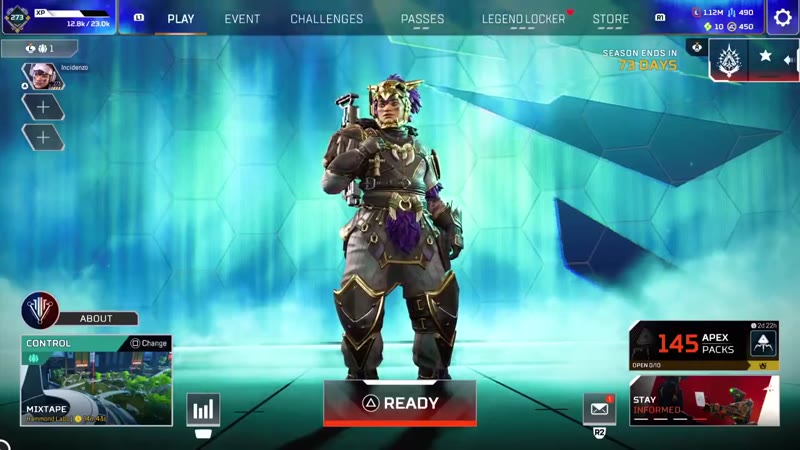
APEX Legends – ZDT COFFEE TALK TABLES BE TURNIN, HOW DOES IT FEEL, FATLOCK [ZeroDarkTony] / August 22, 2026 / YouTube / 9NsqI3wKx-I
D’Amato also invokes California’s Doxing Victims Recourse Act by name and outlines a draft civil filing he says he intends to show an attorney. (The law he is citing is real, and the maximum dollar figure he gives for it is correct. Little else in his account of what it, or the other statutes he lists, actually covers holds up against the text of those laws, or against the record in his own criminal case.)
Anthony R. D’Amato, Jr., also known as ZeroDarkTony, used an August 22, 2026 YouTube livestream to describe ongoing and anticipated court proceedings against a person referred to throughout as “the respondent,” as well as a broader set of individuals he labeled “stalker goons.” D’Amato stated that alleged order violations would be placed on the record at an upcoming hearing, and that subpoenas, additional restraining orders, and criminal charges would follow. He also cited specific California statutes by name and described a draft civil complaint he said he was preparing to file.
The Record Behind the Rhetoric
D’Amato’s legal theory rests on a specific claim: that he has been doxed, defamed, and financially sabotaged by critics who distribute information about him, and that the law entitles him to substantial damages for it. Missing from the livestream is any mention of what that information largely consists of.
D’Amato is a criminal defendant in his own right. In People v. Damato (LASC 24CJCM07073-01), the original charging document listed 26 counts, the majority of them misdemeanor violations of a domestic relations court order under Penal Code § 273.6(a), alongside at least one count of willful cruelty to a child under Penal Code § 273a(b) and a stalking count under Penal Code § 646.9(a). Many of those counts were later dismissed. What survived to a plea, entered December 23, 2025, was two counts under § 273.6(a): violating a restraining order that a minor held against him. Probation on both counts has now been revoked, and setting the violation hearing was calendared for August 27, 2026.
Flyers connected to this dispute have described D’Amato as a danger to a child and a predator. Whatever the language on the flyers themselves, the underlying claim, that D’Amato was charged in connection with a minor and ultimately admitted to violating that minor’s restraining order, is not an invention. It tracks with his behavior, the charging document, and the plea he entered.
That matters for everything that follows, because California’s doxing law and the privacy and defamation-adjacent claims D’Amato raises later in the stream all turn on the same two questions: was the information distributed private, and was it false? Neither the flyers nor the great majority of the reporting D’Amato characterizes as harassment appears to fail on either count, if the underlying claim is his own behavior, and charged and admitted conduct.
This article is not an assessment of whether any specific critic’s conduct against D’Amato was lawful or not. D’Amato doesn’t cite the evidence behind any individual claim, and this piece takes no position on facts it hasn’t seen and reviewed. What follows evaluates whether the legal theories D’Amato describes on stream hold up as he has framed them.
“They Will Rue the Day”
D’Amato framed the stream’s legal commentary around two tracks: an existing court matter involving a named respondent, and a separate anticipated action against individuals he accused of doxxing him and interfering with his YouTube revenue. He stated that anyone who had entered a relevant chat had made a “real dumb” decision, and he addressed at least one individual by the handle “Drone boy” directly. He also named a person referred to as “Jenna” by a derogatory physical description, accusing her of participating in offline harassment involving flyers near his elderly mother. D’Amato said subpoena discovery would surface YouTube metadata, report histories, and chat logs, and characterized that information as evidence of tortious interference with his income.
Exhibit A
D’Amato states that he intends to raise alleged order violations at the next court appearance: “I’m going to put on the record that there have been several violations of the order. And it’s going to be going on the record. Because it has to.” He contrasts that posture with his claimed restraint, saying, “I don’t make videos about them. I barely mention them.”
Timestamps: 00:08:22 – 00:11:34 | Open clip in new tab
D’Amato states that opponents treating the proceedings “like it’s a joke” will “get absolutely wrecked in that courtroom.” He frames his own position as protective rather than aggressive, saying he intends to “put my head down and do what I have to do to protect myself and my privacy.” The clip establishes that D’Amato was aware of an upcoming court date and intended to raise alleged violations at that hearing.
This exhibit concerns a different case entirely from the one described above. “The respondent” here is D’Amato’s opposing party, known as Krackhead Kenny online, in a case where D’Amato is the protected petitioner, distinct from the criminal matter in which he is the defendant.
Exhibit B
D’Amato addresses people he describes as “stalker goons” and states: “Watch what’s happening to the respondent because it’s going to happen to you. Promise. Promise.” He explicitly qualifies his use of legal language, saying, “And it’s not a threat. It’s a promise,” and adds that “squeezing” refers to court action: “We will continue to squeeze where we need to. And of course, I mean in court.”
Timestamps: 00:12:25 – 00:15:42 | Open clip in new tab
D’Amato also states, “There’s going to be no problem with peeling your covers and putting you on the record. It’s going to be easy. Nothing illegal about that.”
The self-correction is notable in its own right. Under Penal Code § 422, California’s criminal threats law, a threat must involve death or serious injury and be intended as such. By quickly clarifying that “squeezing” refers to legal action, D’Amato limits the scope of his words. He often uses language that might seem violent or threatening, then explains he means it in a legal sense: likely a habit formed from all past statements that have landed him in hot water while on probation.
Exhibit C
Addressing someone he calls “Drone boy” by name, D’Amato says: “Drone boy, you’re going to pay dearly in that courtroom. You are going to pay so dearly, friendo, in that courtroom.” He then pivots to subpoena theory, stating, “When those channels are subpoenaed, you get all the metadata. So then we find out how many reports they sent in, how many lies they told to YouTube, things like that. Because that’s called tortious interference. They’re directly interfering with my money.”
Timestamps: 00:16:34 – 00:19:52 | Open clip in new tab
D’Amato claims that targeted individuals “lost the right to anonymity with the harassment that you’ve done,” and states that anonymity will be stripped through the court record rather than any extrajudicial means. The clip identifies “Drone boy” as a specific anticipated litigation target and ties that identification to an alleged doxxing incident.
Tortious interference with prospective economic advantage, under California law (Della Penna v. Toyota Motor Sales, 11 Cal.4th 376), demands more than just an act that happens to cost someone money. The act must be “wrongful by some legal measure other than the fact of interference itself,” a standard courts limit to things like defamation, fraud, trade secret theft, or sham litigation. A platform report made in good faith, believing content violates site policies, doesn’t fit that category, even if the report is mistaken. There’s also a causation issue: YouTube’s choice to demonetize or remove content is its own discretionary decision under its terms of service, making it hard to argue that a report, rather than YouTube’s independent judgment, caused the income loss.
Exhibit D
D’Amato describes a sequenced legal plan on stream: “But when those subpoenas come through, that’s when we do ROs, and that’s when we file criminal charges.” He follows this with a rhetorical aside, referencing Pink Floyd lyrics before returning to characterize opponents as people who “run, rabbit run, dig that hole.”
Timestamps: 00:22:08 – 00:24:21 | Open clip in new tab
The clip establishes D’Amato’s stated sequencing: subpoenas first, then restraining orders, then criminal charges. He frames this as reactive to ongoing conduct rather than preemptive.
The sequence is half accurate. A private citizen can petition for a civil harassment restraining order under Code of Civil Procedure § 527.6 once they’ve identified a defendant, so that step genuinely is his to take. Filing criminal charges is not. That decision belongs to a district attorney or city attorney. A private party can report conduct to police and ask that charges be filed, but the choice of whether to prosecute sits with the government, not with him, a distinction his own criminal docket illustrates from the other side: the City Attorney’s office decides what happens next in his case, not D’Amato, not his adversaries.
Before any of that, the subpoenas themselves face a real obstacle. California follows the standard set in Krinsky v. Doe 6 (159 Cal.App.4th 1154), which requires a plaintiff seeking to unmask an anonymous online speaker to make a prima facie evidentiary showing on every element of the underlying claim, not merely an allegation, before a court will enforce the subpoena over a motion to quash. The California Court of Appeal adopted that standard specifically to prevent subpoenas from being used to identify and pressure critics. Whether “Drone boy” or anyone else clears that bar depends on whether the doxing, false light, and appropriation theories described later in the stream can support a prima facie case at all.
Exhibit E
Referencing an individual who allegedly threatened to distribute a thousand flyers, D’Amato states: “You’re done, dude. You are finished.” He then addresses the anonymity question directly: “Ain’t nobody going to dox you. It’s on the public court record. That’s your own problem. You did this.” He adds, “Those subpoenas are the ticket to them going to jail. And that’s what’s going to happen.”
Timestamps: 00:37:52 – 00:42:44 | Open clip in new tab
D’Amato explicitly disclaims personal doxxing while predicting that court filings will place identifying information in the public record. He states that “they will rue the day” and characterizes the outcome as criminal consequences, not civil ones, though he does not specify charges.
There is a real distinction buried in this passage, though D’Amato does not develop it. Information disclosed through legitimate court filings, once part of the public record, is not “distribution” in the sense California’s doxing statute targets. But that is not the same as saying nothing he does with identity information obtained through a subpoena is exposed. Using it in litigation is one thing. Airing it on a monetized livestream is a different act with a different intent analysis, and it is closer to the conduct the statute described below actually reaches.
Exhibit F
D’Amato returns to the subpoena theme while discussing what he describes as a coordinated campaign of false YouTube reports: “And that’s going to be a big problem when those subpoenas go, go kick it out.” In the same segment, he describes flyers targeting him and his elderly mother, and separately uses a derogatory physical description to insult a “Jenna.” Likely Jenna Miscavige, an ex scientologist who was present at the courthouse when ZeroDarkTony was arraigned.
Timestamps: 00:52:05 – 00:54:03 | Open clip in new tab
These are two separate incidents, run together in the stream but distinct on the record. The flyer campaign is addressed here and in Exhibit E. Jenna is connected instead to a different, in-person incident: Aaron Smith Levin confronted D’Amato directly, after D’Amato’s arraignment, and Jenna was present for that encounter.
Exhibit G
D’Amato describes the civil claims he says he is preparing to file, citing California law by name: “There is something called the Doxing Victims Recourse Act in California, which for the people that doxed me, like the drone one, just for that one thing alone, for them doxing me, in California, they could be sued for up to $30,000 in statutory damages.” He also lists “false light” and “appropriation of name or likeness” as additional theories and states: “I am writing this up to make sure it’s right. And when it’s done, I’m going to show it to an attorney and they’re going to go, oh, you might want to change this, this, and this. And then I’m going to file it.”
Elsewhere in the same segment, D’Amato adds a fourth theory: “My right to privacy is written in the state constitution of California. So make no mistake, one of the things that they are going to be sued for is violation of privacy, is privacy violations.”
Timestamps: 00:59:35 – 01:05:05 | Open clip in new tab
D’Amato states on stream that the civil complaint is still in draft form and has not yet been reviewed by an attorney, which he describes as a planned next step before filing. The clip establishes that he identifies “Drone boy” as a primary target of the anticipated doxxing claim specifically. Across seven clips from the August 22, 2026 stream, D’Amato stated his intent to raise order violations at a pending court hearing, pursue subpoenas against YouTube channels he accuses of targeted reporting, and file a civil complaint invoking California’s Doxing Victims Recourse Act, with the draft not yet in attorney review as of the broadcast.
The dollar figure is the most accurate legal statement D’Amato makes all stream. Civil Code § 1708.89, the Doxing Victims Recourse Act (AB 1979), does authorize statutory damages of $1,500 to $30,000, plus economic and punitive damages and attorney’s fees to a prevailing plaintiff. Everything built on top of that figure is where the theory runs into trouble.
The statute defines “doxes” narrowly. It requires distributing someone’s personal identifying information, without consent, with intent to place them in reasonable fear for their safety, for the purpose of imminently causing unwanted contact, injury, or harassment by a third party. Reporting a channel to YouTube does not fit that definition on its face. More directly, the statute carves out an explicit exemption at subdivision (i)(2): it does not apply to a person who discloses personal information “for the purpose of, or in connection with, the reporting of conduct reasonably believed to be unlawful.” A critic who reports D’Amato’s own recorded statements, or who circulates the contents of his own charging document, is closer to the conduct the legislature exempted than to the conduct it targeted.
There is also a sharper problem sitting underneath the doxing theory specifically. The statute is built around distributing someone’s personal information to invite harassment from strangers. The conduct it describes maps far more closely onto D’Amato’s own history: he has himself publicly shared what he claimed was a target’s home address, on stream and on Twitter. If this theory is ever pleaded out in a real complaint, it hands the opposing side a clean illustration of what the statute is actually for.
False light and appropriation of likeness both carry a threshold problem independent of the merits. False light in California (Jackson v. Mayweather, 10 Cal.App.5th 1240) requires publicity, meaning communication to the public at large or to enough people that it is substantially certain to become public knowledge, plus knowing or reckless falsity, plus a false light that would be highly offensive to a reasonable person. California courts have also generally held false light to the same constitutional constraints as defamation, so if there is no actionable false statement of fact underneath it, there is usually no viable false light claim riding alongside it. A private platform report does not clear the publicity bar, and reporting drawn from his own public behavior and the public record does not clear the falsity requirement.
Appropriation under Civil Code § 3344 requires knowing commercial use of someone’s name or likeness for advertising, selling, or soliciting purchases, without consent. The statute explicitly exempts use “in connection with any news, public affairs, or sports broadcast or account.” Commentary, criticism, parody, or documentation of an active court case, even monetized, sits squarely inside that exemption in the case law addressing it. Absent evidence someone used his image to sell an unrelated product, this claim does not have much room to operate.
The constitutional privacy claim is the hardest to clear. California’s Constitution does enumerate privacy as an inalienable right, and Hill v. NCAA (7 Cal.4th 1) built a three-part test around it: a legally protected privacy interest, a reasonable expectation of privacy, and conduct constituting a serious invasion of that interest. The problem for D’Amato is the second prong. There is generally no reasonable expectation of privacy in one’s own criminal proceedings, which are a matter of public record, or in one’s own livestreamed statements, which he chose to publish himself.
None of this analysis distinguishes between D’Amato’s critics filing reports with YouTube and outlets like this one reporting on his conduct directly, and that distinction matters more than the D’Amato suggests. A platform report and a published article face different legal tests entirely. Coverage built from D’Amato’s own recorded livestreams and from the public criminal and civil dockets in his cases sits close to the core of protected journalism under several separate doctrines at once: the fair-and-true report privilege for judicial proceedings under Civil Code § 47(d), which grants an absolute defense against defamation claims for accurate reporting on court proceedings; the same news and public-affairs exemption under § 3344(d) discussed above; and the basic truth defense, which forecloses false light entirely when the underlying statements are accurate. Quoting a public figure’s own livestream back to him, sourced and timestamped, does not become doxing, interference, or a privacy violation because the coverage is unflattering.
Exhibit H
Later in the stream, D’Amato turns a joke about Reddit’s direct-message feature into a separate legal claim:
“I would imagine that those Reddit DMs could possibly put them in jail for at least a year. Because when two or more people get together and they collude to commit a crime like targeted harassment, that’s a felony enhancement. It’s a felony enhancement. I mean, look it up.”
Timestamp: 00:32:57 – 00:34:53 (transcript only, no clip)
There is no standalone “felony enhancement” in California law that automatically elevates harassment to a felony merely because more than one person is involved. What does exist is conspiracy liability under Penal Code § 182, a separately chargeable offense for agreeing to commit a crime, and specific group-conduct enhancements tied to particular statutes, such as gang enhancements under § 186.22 or hate-crime-in-concert provisions under § 422.75. Those are narrower and more fact-specific than a general rule that group participation converts misdemeanor conduct into a felony, and none of them attach automatically to sending private messages on a platform.
Exhibit I
D’Amato declares a legal conclusion outright:
“And there is no doubt that the threshold of felony criminal harassment has been met. There’s no question. No question at all.”
Timestamp: 00:43:06 – 00:44:04 (transcript only, no clip)
California does not have a single statute called “felony criminal harassment.” The relevant charges, stalking under § 646.9, criminal threats under § 422, or electronic harassment under § 653.2, carry different elements and different felony-versus-misdemeanor thresholds depending on prior convictions, the specificity of any threat, and other case-specific facts. Whether any charging threshold has been met is a determination made by prosecutors and courts, not by a livestreamer announcing it as settled.
Exhibit J
Returning to the respondent’s case, D’Amato claims broad jurisdictional reach:
“Doesn’t matter what state you’re in. Doesn’t matter what country you’re in. As you can see from my recent experience with the respondent, the courts have already found jurisdiction.”
Timestamp: 00:05:25 – 00:06:00 (transcript only, no clip)
A jurisdictional finding in one case does not transfer to a different defendant. Personal jurisdiction is assessed defendant by defendant, based on that individual’s own contacts with California, not on the outcome of a prior, unrelated matter involving a different party. This publication’s prior coverage of D’Amato v. Brooks addressed exactly this question, including the Williams v. Superior Court analysis the court applied there; that finding turned on Brooks’s specific contacts with the state and does not automatically extend to “Drone boy,” “Jenna,” or anyone else D’Amato has not yet sued.
Across the full stream, D’Amato states his intent to raise order violations at a pending court hearing, pursue subpoenas against YouTube channels he accuses of targeted reporting, and file a civil complaint invoking the Doxing Victims Recourse Act, false light, appropriation of likeness, and a state constitutional privacy claim, with the draft not yet in attorney review as of the broadcast. The one figure in the entire stream that survives contact with the actual statute is the $30,000 damages cap. The theories built around it, and the account of his own record that underpins the flyers he describes as harassment, do not hold up as well.
Sources
- Original YouTube Video
- Full SRT Transcript
- Full Text Transcript
- Full Chat Transcript
- Date: 2026-08-22
- Stream ID: YOUTUBE · 9NsqI3wKx-I
-
Court Record: People v. Damato, LASC 24CJCM07073-01
-
Legal Sources: Cal. Civil Code § 1708.89 (Doxing Victims Recourse Act); Cal. Civil Code § 3344; Cal. Civil Code § 47(d); Cal. Penal Code §§ 273.6(a), 273a(b), 646.9(a), 422, 182; Krinsky v. Doe 6 (2008) 159 Cal.App.4th 1154; Della Penna v. Toyota Motor Sales, U.S.A., Inc. (1995) 11 Cal.4th 376; Jackson v. Mayweather (2017) 10 Cal.App.5th 1240; Flatley v. Mauro (2006) 39 Cal.4th 299; Hill v. NCAA (1994) 7 Cal.4th 1