
Federal prosecutions | Updated November 2026
The sentence
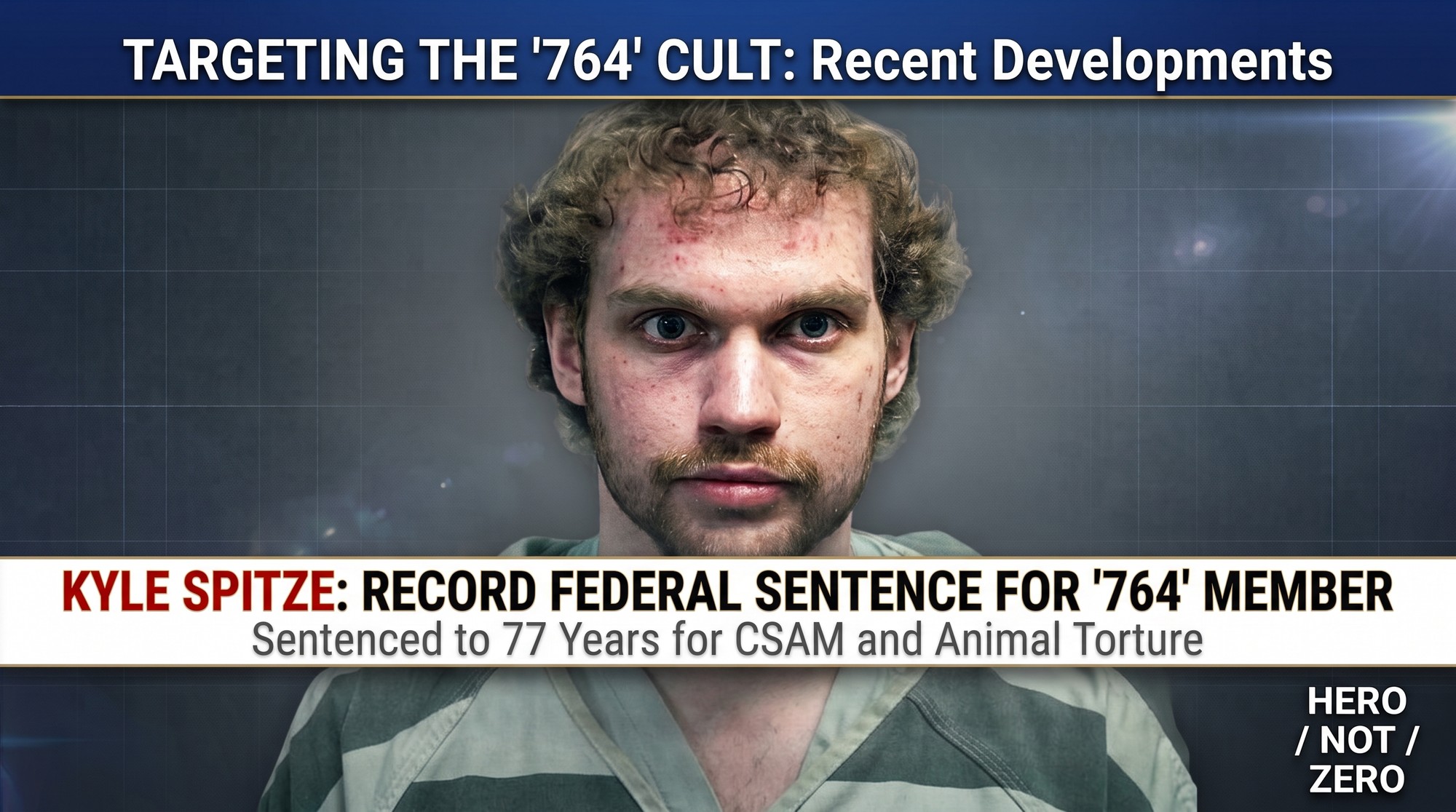
On August 19, 2026, a federal judge in Knoxville, Tennessee sentenced 27-year-old Kyle William Spitze to 77 years in prison. The Justice Department called it the longest federal sentence ever imposed on a “nihilistic violent extremist,” the FBI’s term for members of networks like “764,” the online group Spitze belonged to and one the FBI classifies as a domestic terrorism threat built almost entirely around the exploitation of children.
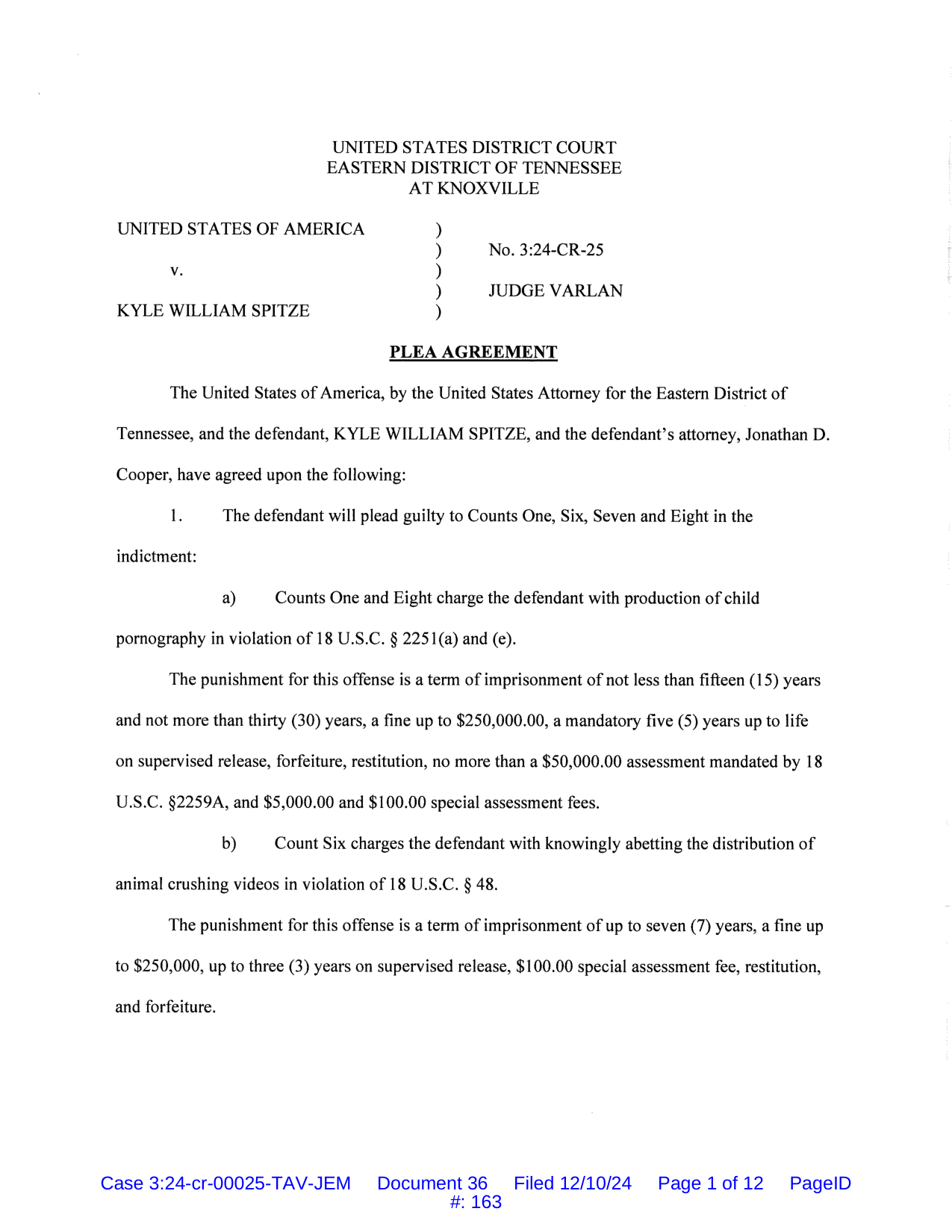
Spitze, of Friendsville, Tennessee, pleaded guilty in December 2024 to producing child sexual abuse material, abetting the distribution of videos showing animals being tortured and killed, and possessing and accessing child sexual abuse material. He will also serve lifetime supervised release and must register as a sex offender.
Assistant Attorney General for National Security John A. Eisenberg said the sentence “sends a strong message that civil society will not tolerate such depravity,” according to the Justice Department’s announcement. Prosecutors said Spitze, who went by “Crimhn,” “Criminal,” and “Criminaloli” online, was one of the original members of 764 and its offshoot Harm Nation, and told investigators he acted with a terrorist motive.

If you’ve never heard of 764, that’s not surprising. It has spread almost entirely inside gaming platforms, Discord servers, and encrypted chat apps, out of view of most adults, even as the FBI now has open investigations tied to it in every one of its field offices nationwide.
What is 764
764 has no address, no bylaws, no dues. It is a decentralized online network, assembled around 2020 and 2021 by a Texas teenager, that the FBI now treats as a Tier One counterterrorism priority under a category the bureau created for it: Nihilistic Violent Extremism.
The name comes from geography, not ideology. According to the Anti-Defamation League, 764 “takes its name from the first three digits of Stephenville’s ZIP codes: 76401 and 76402,” the small Texas town where founder Bradley Cadenhead lived. Cadenhead built the group out of an earlier online subculture called CVLT, itself part of a sprawling cybercrime and harassment ecosystem researchers call “the Com.”
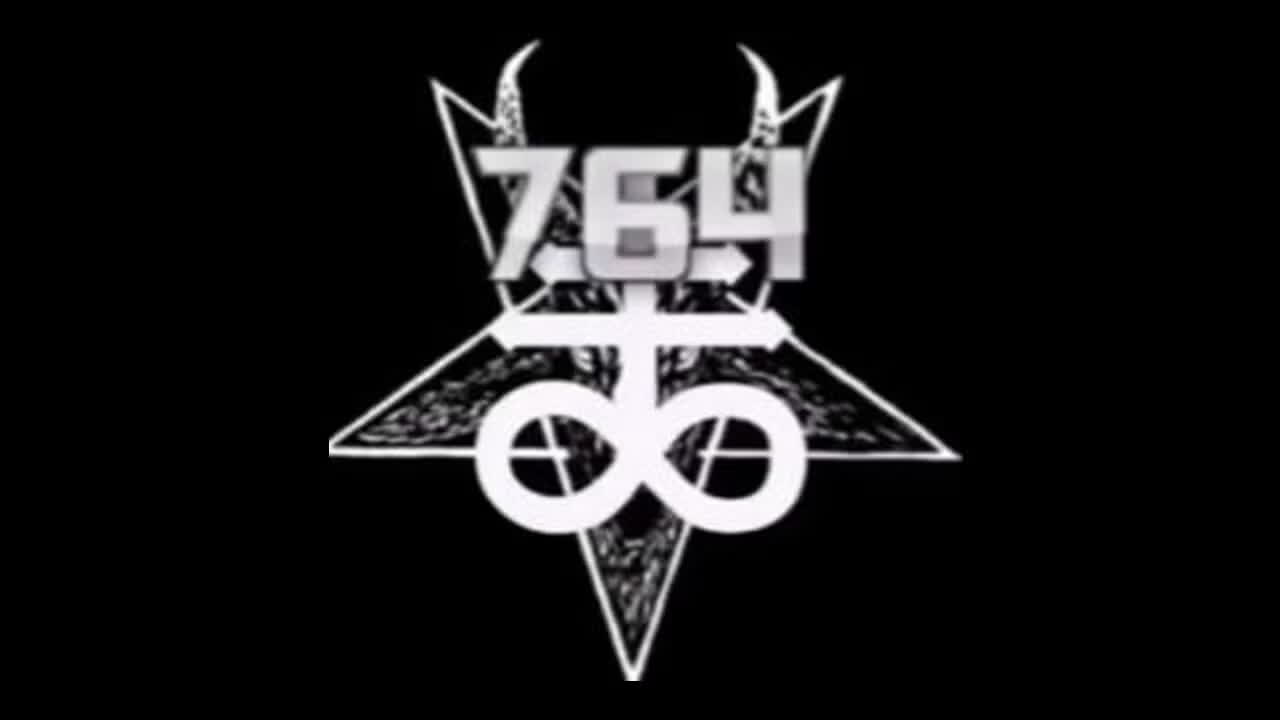
After Cadenhead’s 2021 arrest, 764 didn’t disappear. It splintered. What had been one loosely organized group became a shifting constellation of offshoots operating under different names: Harm Nation, No Lives Matter, CVLTIST, Court of Sacrifice, Kaskar, Leak Society, Maniac Murder Cult, “764 Inferno,” and “8884,” among others. The Institute for Strategic Dialogue, a research group that tracks online extremism, describes these less as a hierarchy than a “brand” that different groups adopt and abandon as members move between chat servers and platforms.

That structure is what makes 764 difficult to police. There is no headquarters to raid, no single leader whose arrest ends the network. FBI Assistant Director David Scott, who heads the bureau’s Counterterrorism Division, told ABC News in a May 2025 interview that the FBI had more than 250 investigations tied to the network underway at the time, spread across all 55 of its field offices. By the time Spitze was sentenced in August 2026, ABC News reported the FBI had more than 450 open cases tied to nihilistic violent extremism, nearly double the number open a year earlier. Scott said the bureau has identified victims as young as nine years old, with an estimated victim pool in the thousands worldwide.
In December 2025, Canada became the first country in the world to formally designate 764 a terrorist entity, listing it alongside Maniac Murder Cult and the Terrorgram Collective, according to the Canadian government’s announcement. FBI Director Kash Patel has described the network’s activity in similarly stark terms, calling it “modern-day terrorism.”
The people involved
Bradley Cadenhead was 15 and living in Stephenville, Texas, when he founded 764 in 2021, according to the Anti-Defamation League, assembling the group from an earlier online subculture called CVLT. He was arrested in August 2021, pleaded guilty in Texas state court, and was sentenced in Erath County in May 2023 to 80 years, the longest term any 764-linked figure has received in any court to date. A federal appeal seeking to reopen his sentencing was denied in February 2026.

No prosecution has drawn more attention than Kyle Spitze’s. Spitze, who used the online names “Crimhn,” “Criminal,” and “Criminaloli,” was among 764’s original members and helped administer Harm Nation, one of its earliest offshoots. He pleaded guilty in December 2024 to producing child sexual abuse material, abetting the distribution of videos showing animals being tortured, and possessing and accessing abuse material. Prosecutors said Spitze claimed online to have groomed more than 2,600 victims in the United States and overseas, ABC News reported; court records detail at least 30 victims worldwide, according to the Washington Examiner. In August 2026 he was sentenced in the Eastern District of Tennessee to 77 years, the longest federal sentence yet imposed on a 764 member. His father, Michael Spitze, was sentenced in May to 70 months in federal prison after admitting he tried to tamper with witnesses while his son was jailed, the Examiner reported.
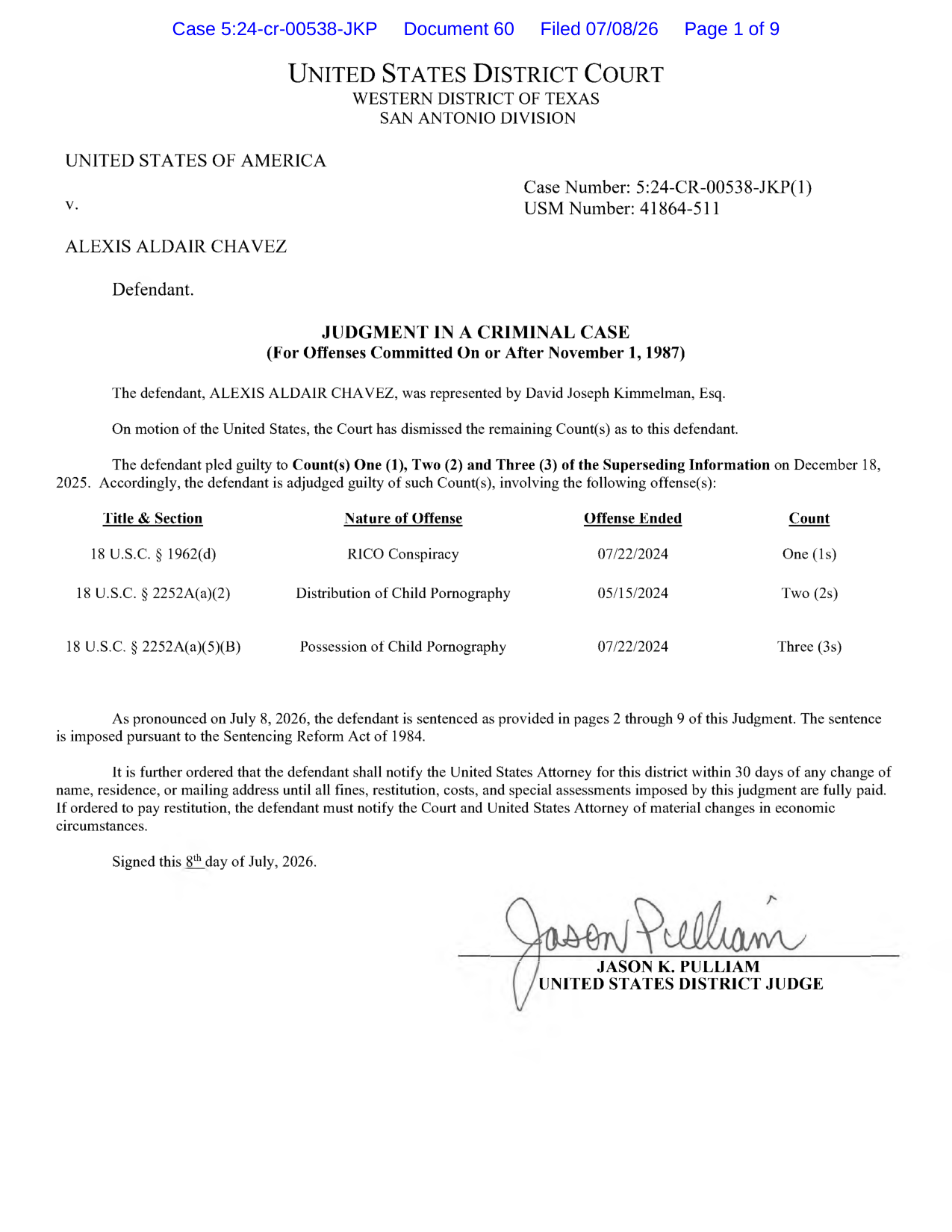
Other cases have moved through federal courts on a similar track. Alexis Chavez, who led the network’s “8884” offshoot under the alias “Zack,” pleaded guilty in December 2025 to racketeering, distributing abuse material, and possessing abuse material, one of the first times prosecutors have used federal racketeering law against an online child exploitation network. He was sentenced in the Western District of Texas in July 2026 to 40 years plus lifetime supervised release. Richard Densmore, who used the alias “Rabid” and built 764’s “Sewer” Discord communities, was sentenced to 30 years in the Western District of Michigan in November 2024. Erik Madison received the same 30-year term, plus lifetime supervision, in the District of Maryland in June 2026, after prosecutors said he exploited at least 10 minor victims and stalked them online.
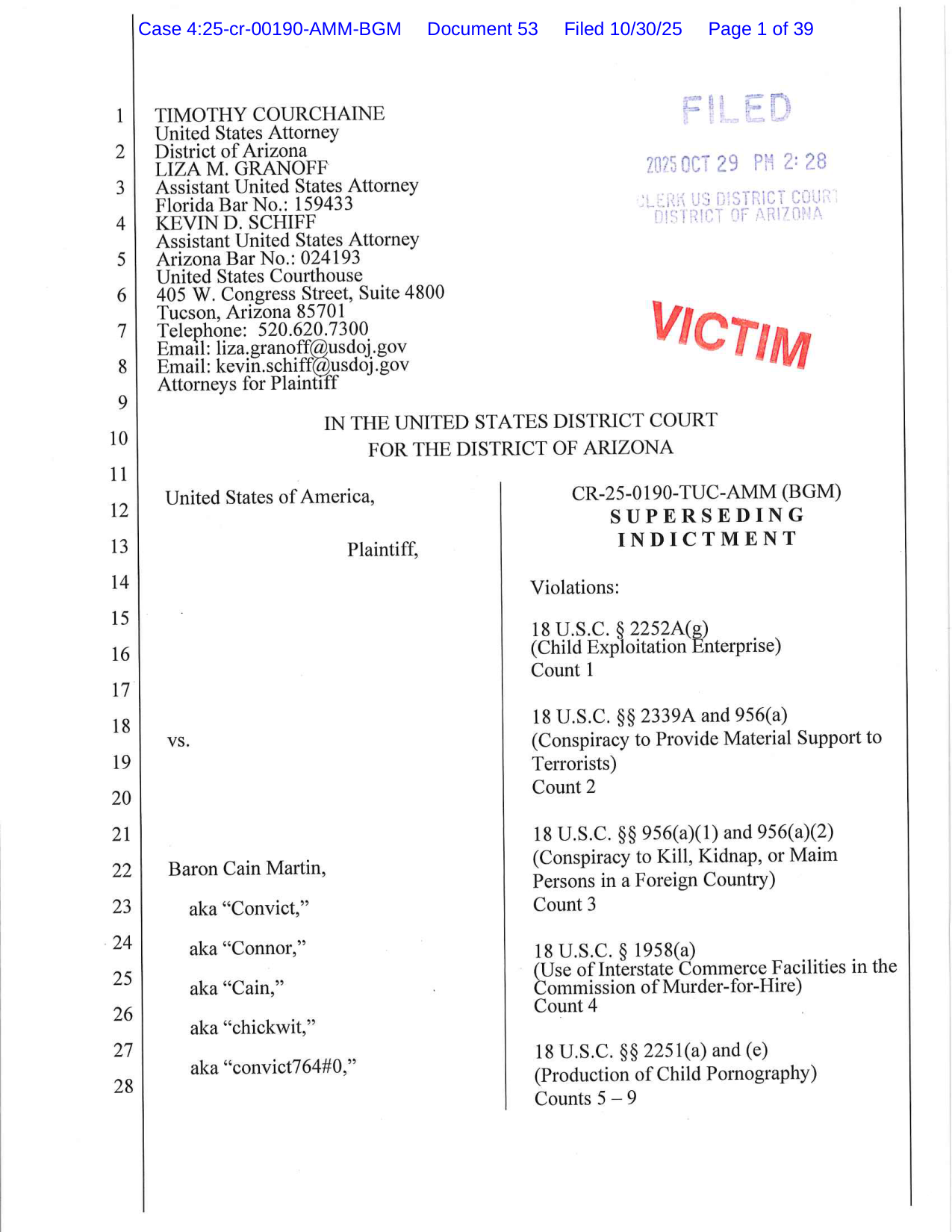
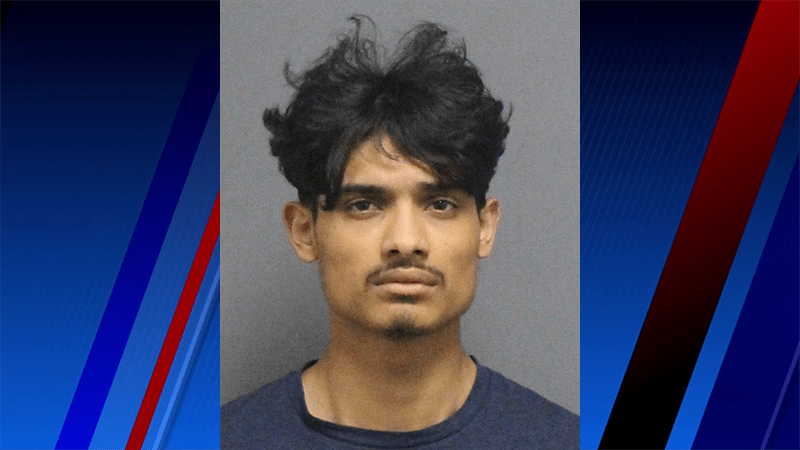
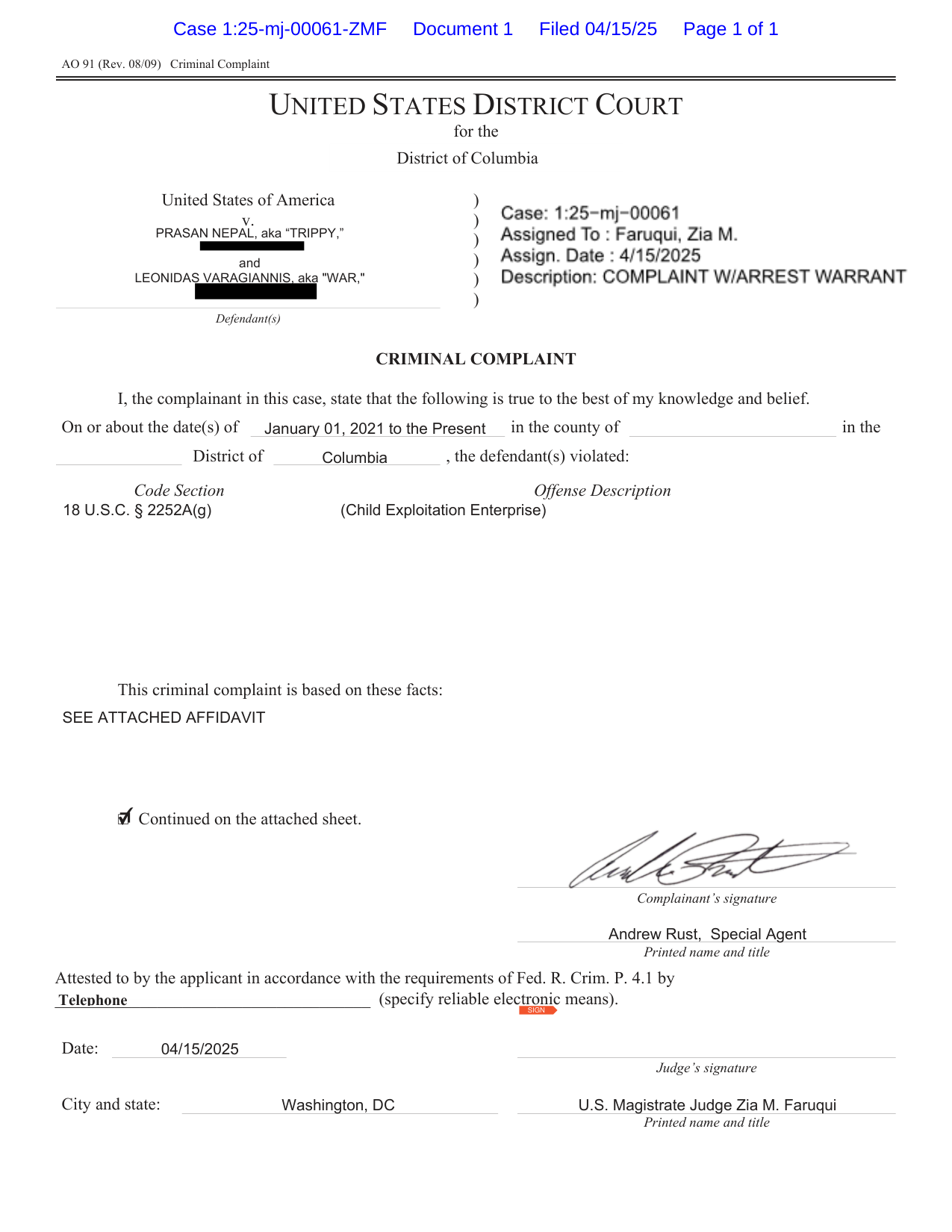
Several cases remain unresolved, and the people charged in them are presumed innocent. Baron Martin, who used the alias “Convict,” faces a 29-count indictment in the District of Arizona that includes the first charge ever brought against a 764 member of providing material support to terrorists. Prasan Nepal and Leonidas Varagiannis, alleged leaders of a subgroup called “764 Inferno,” were arrested in April 2025 in North Carolina and Greece and face charges in the District of Columbia for operating what prosecutors describe as a global child exploitation enterprise. A federal grand jury indicted both men in September 2025, and Nepal pleaded not guilty that October, according to the court docket. Each faces up to life in prison if convicted.

What the Defense Argued
Every one of these prosecutions has produced a plea or an indictment, but few have produced an unchallenged narrative. In each of the cases that have reached sentencing or trial, defense attorneys have pushed back on some combination of the facts, the framing, or both.
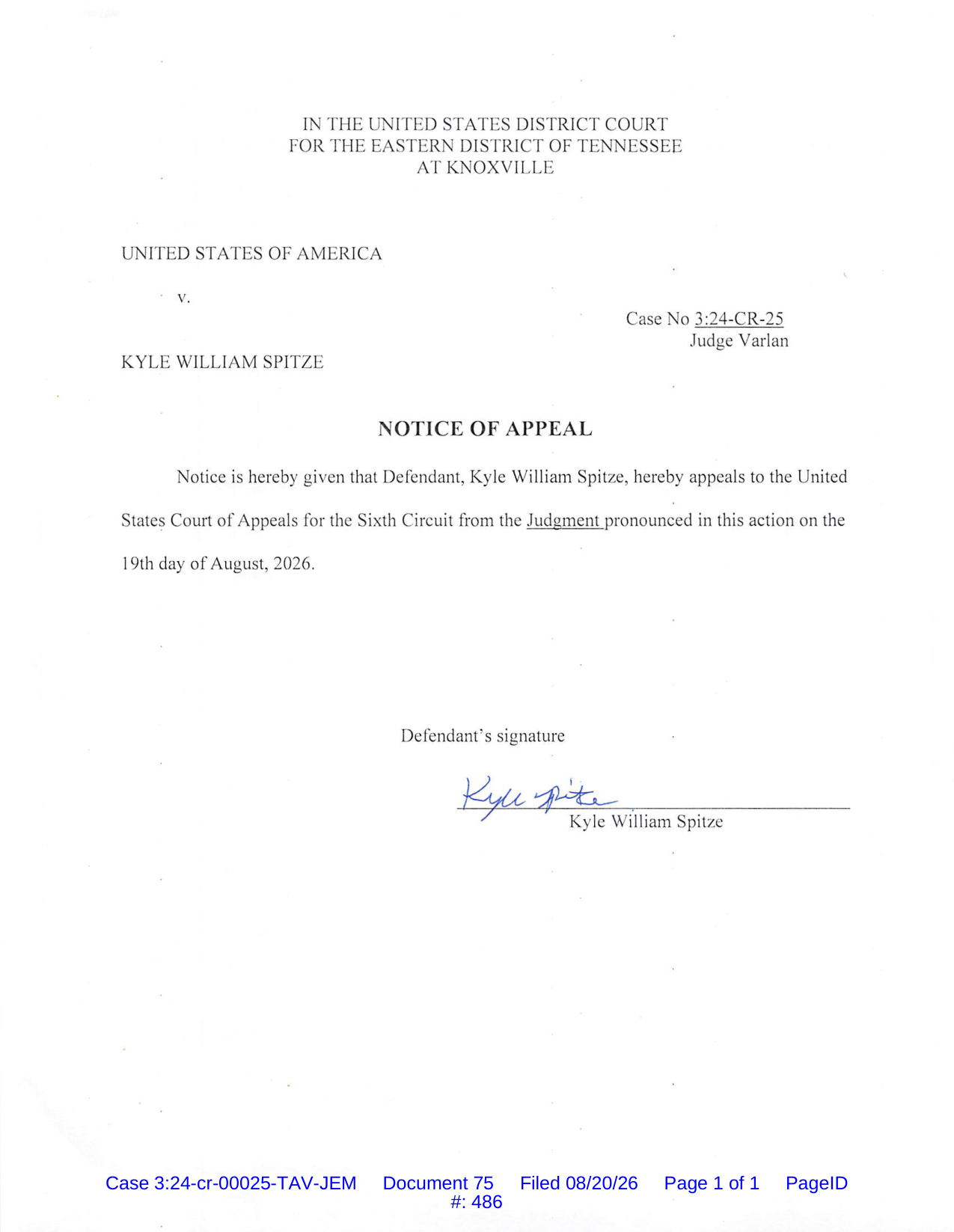
Kyle Spitze’s attorney, Jonathan Cooper, built his sentencing argument around a distinction between conduct and category. Cooper told the Chattanooga Times Free Press that the “nihilistic violent extremist” designation did not exist as a legal term before his client’s case, and argued prosecutors were effectively punishing Spitze for the ideology and conduct of the broader network rather than for what he personally did. “The harm Mr. Spitze caused individually was significant and serious, and he pleaded guilty to this conduct,” Cooper said. “But to increase his punishment based merely on his membership in groups and not on his own conduct is unfair.” The defense separately asked the court to weigh a difficult childhood, mental health struggles, and substance abuse, details filed under seal, and disputed prosecutors’ claim that Spitze had tried to intimidate victims from jail, an allegation that mattered because a witness-tampering enhancement could add decades to his sentence. The judge found the severity of the underlying offenses outweighed the mitigating case. Spitze has since filed notice that he intends to appeal.
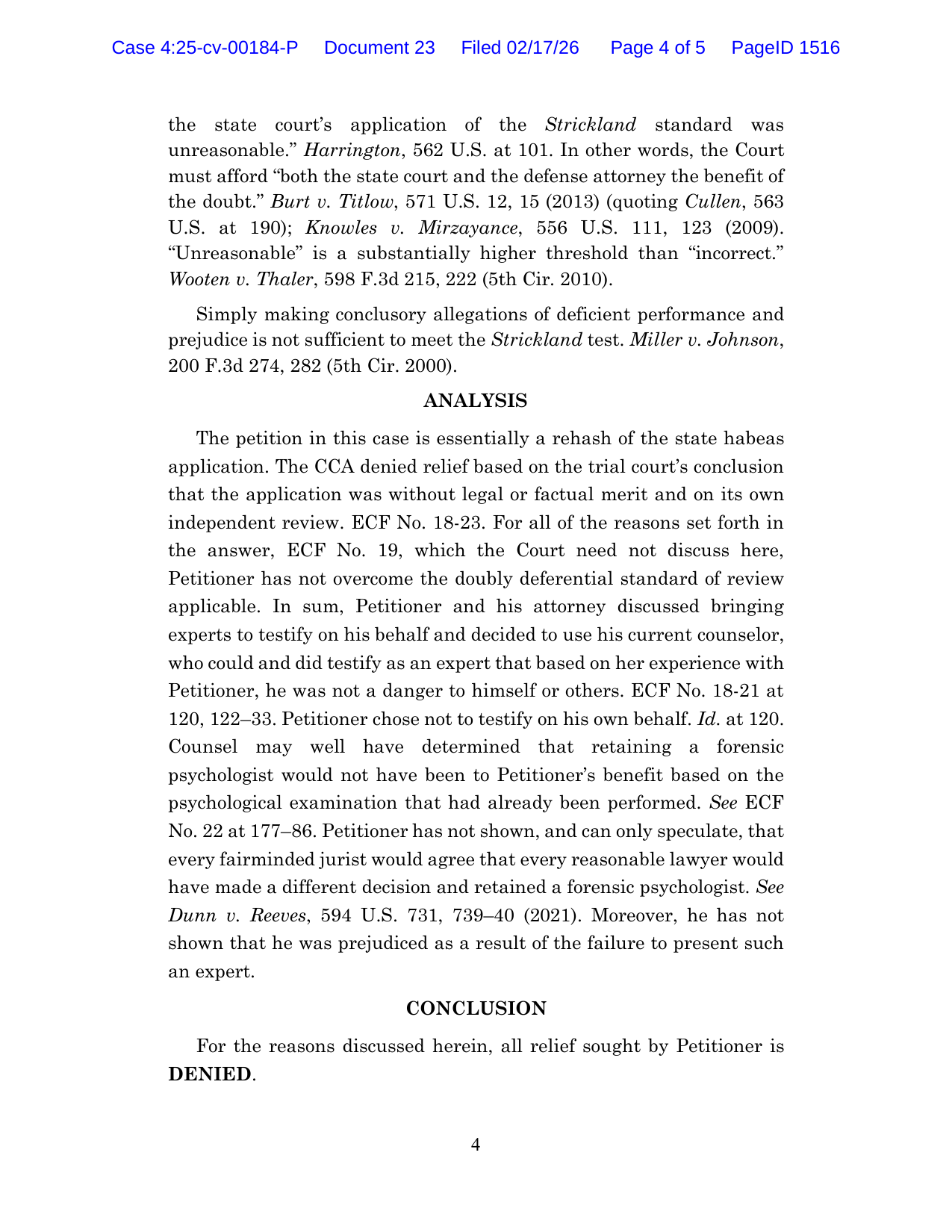
Bradley Cadenhead’s defense has made a related argument in a different form, across two courts and several years. At his 2023 sentencing hearing, his lawyers called a behavioral therapist who testified he needed psychiatric treatment rather than a prison sentence; the presiding judge rejected the argument outright, telling Cadenhead there was “something horribly wrong” with him. Since then, Cadenhead’s attorneys have pursued state and federal habeas corpus petitions arguing his original trial counsel provided ineffective assistance by failing to present him as a traumatized teenager whose behavior could have been explained, and potentially treated, rather than simply punished. Every court to review the claim has rejected it. A federal judge in Fort Worth called the most recent petition, denied in February 2026, a “rehash” of arguments Texas courts had already dismissed.
Not every defendant has reached the point of a sentencing argument. Baron Martin has pleaded not guilty to all 29 counts against him in Arizona, according to ABC News, and his jury trial is set for Jan. 12, 2027, after several delays requested by his lawyer, according to the court docket. Because it remains unresolved, the specific allegations against him, including the first-ever terrorism-support charge brought against a 764-linked defendant, remain allegations rather than established fact.
Why children
Federal officials describe a consistent pattern across 764 cases, even as tactics evolve. Members canvass the platforms where children already spend time, mainstream games, social apps, and messaging services, looking for kids who show signs of isolation, low self-esteem, or mental health struggles. What starts as an apparent friendship or online relationship moves into private messaging, where the manipulation begins.
From there, according to court filings across multiple cases, victims are coerced into producing compromising material. That material then becomes leverage. Perpetrators use it to demand escalating acts: further images, self-harm, harm to animals, and in some cases violence directed at others. The FBI has described this pattern using the term “Sadistic Online Exploitation.”
Researchers and prosecutors say the goal isn’t financial. It’s about status inside the network and, ultimately, ideology. The content produced this way functions as a kind of currency, shared to build a member’s reputation within 764-linked communities and archived as continued leverage over the victim. Some members have used doxxing and swatting to intimidate victims into compliance, according to FBI statements.
What stays consistent across cases, more than any single tactic, is the pattern: recruitment on ordinary platforms, escalating coercion, and content used as leverage. The FBI’s Boston field office has published an open letter to parents laying out warning signs, including unexplained patterns of self-harm, references to being “doxxed” online, unexplained packages or gifts from unknown senders, and increasingly secretive device use.
A Nihilist Ideology, and a Hierarchy Built on Loyalty
Researchers who study 764 keep returning to one word to describe its internal culture: nihilism. The FBI’s own designation, Nihilistic Violent Extremism, reflects what agents and analysts say drives the network, not a coherent political program, but, in the bureau’s language, “a hatred of society at large and a desire to bring about its collapse by sowing indiscriminate chaos, destruction, and social instability,” according to reporting on the Justice Department’s approach compiled by Just Security.
Among the network’s members, that nihilism functions less like a belief system than a hierarchy. Researchers at the Institute for Strategic Dialogue describe internal status economies in which members compete for standing by proving loyalty through increasingly extreme acts, a dynamic closer to gang initiation than political conviction. Some offshoots layer on neo-Nazi accelerationist rhetoric or imagery associated with the Order of Nine Angles, an occult network long linked to extremist violence. ISD’s own investigation cautions that much of this iconography functions as branding, borrowed for shock value and in-group signaling, more than as genuine ideological commitment.
It is worth being precise about who that hierarchy includes. The adults and older teenagers who administer 764’s channels and offshoots operate inside something close to a cult structure: initiation, escalating loyalty tests, and a shared worldview that some members clearly do buy into. The children they target are not initiates. Court filings across these cases describe coercion and extortion, not persuasion; victims are threatened and blackmailed into compliance, not recruited into belief. Collapsing that distinction risks obscuring what prosecutors have actually documented, which is the exploitation of children, not their conversion.
What is not in dispute is where parts of this culture have led. ISD has linked segments of the broader nihilistic violent extremism ecosystem, particularly the offshoot known as No Lives Matter, to stabbing attacks in Europe and to disrupted mass-violence plots in the United States. A GNET analysis of Canada’s terrorist designation notes that what began as an online harassment and exploitation subculture has, in pockets, evolved toward real-world violence, part of why governments are increasingly treating it with the tools used against organized terrorist groups rather than as ordinary criminal exploitation.
A Contested Label
Not everyone in the counterterrorism field accepts the framing the Justice Department has built these prosecutions around. Bennett Clifford, a senior threat intelligence analyst at Recorded Future’s Insikt Group, argued in a June 2026 Lawfare essay that “nihilistic violent extremism” is close to a contradiction in terms. Nihilism, by most standard definitions, holds that existence has no inherent purpose or meaning. But the FBI’s own definition of NVE requires that members act “in furtherance of political, social, or religious goals,” which is a different claim entirely. Clifford points to research on 764 specifically, including a report from the National Counterterrorism Innovation, Technology, and Education Center, describing members as driven less by ideology than by a desire for status and notoriety within online communities, alongside sexual gratification. He also notes that one of the network’s own neo-Nazi-aligned offshoots, No Lives Matter, publicly split from 764 in 2024 on the grounds that it was too focused on sextortion and not sufficiently committed to their accelerationist politics, evidence, he argues, that 764 itself lacks the coherent ideological program the terrorism label implies.
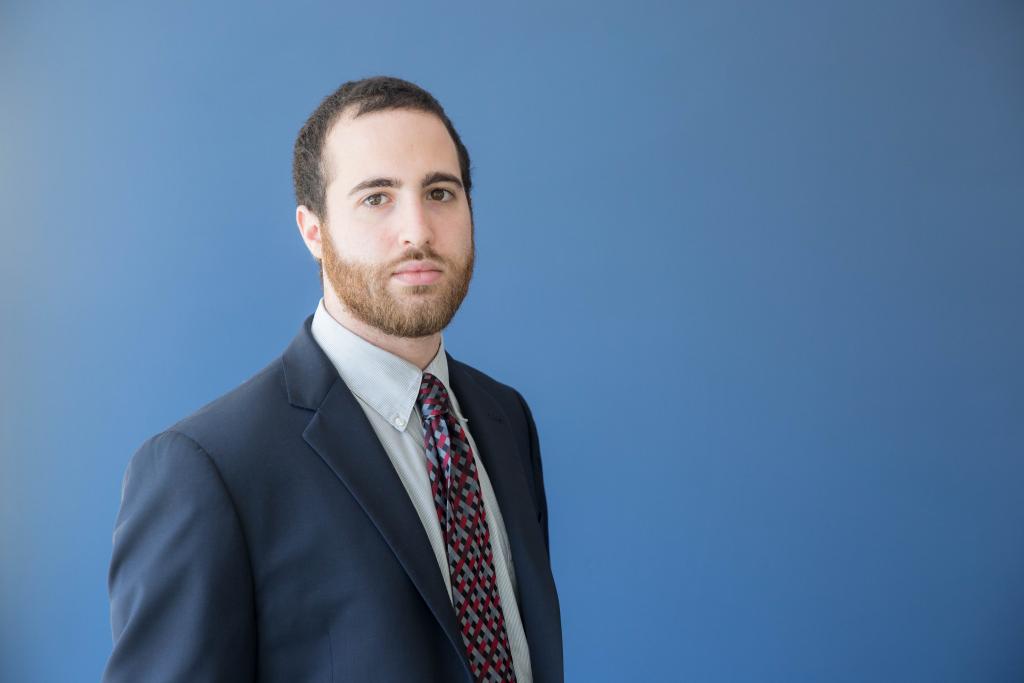
Clifford’s objection isn’t just semantic. He argues that classifying 764 as a domestic terrorism threat carries real costs: it can hand members a kind of perverse status, he has observed some bragging online about being treated as a threat on par with the Islamic State or al-Qaeda, and it risks pulling counterterrorism resources and attention away from groups whose motivations are more clearly political, including the accelerationist offshoots that reject 764’s approach. He isn’t alone in raising the concern. PolitiFact examined the term’s use in an October 2025 explainer and found experts warning against overusing it, and a separate Just Security analysis flagged similar risks that a broad, loosely defined category could distort how law enforcement measures and responds to genuinely distinct threats.
None of this challenges what the defendants in these cases have actually done. The underlying conduct, documented in plea agreements, indictments, and sentencing memos, is a matter of public record regardless of what the network is called. What remains genuinely contested is whether “terrorism” is the right legal and analytical frame for prosecuting it, or whether that framing serves the network’s own members more than it serves the children it targets.
The Laws Used to Prosecute, and Where They Reach Their Limits
Because 764 doesn’t fit neatly into any single legal category, federal prosecutors have built cases from a patchwork of statutes: some written for child exploitation, some for organized crime, and, in one recent case, one written for international terrorism.
The core charges in most 764 cases come from federal child exploitation law: 18 U.S.C. § 2251, which criminalizes producing child sexual abuse material, and 18 U.S.C. § 2252 and § 2252A, which cover its distribution and possession. Spitze’s plea agreement charged him under § 2251(a) and (e) for production and § 2252A(a)(5)(B) for possessing and accessing the material. He was also charged under 18 U.S.C. § 48, the federal animal crush video statute, for abetting distribution of videos showing animals being tortured. Other cases have added 18 U.S.C. § 2422, which covers coercion and enticement of a minor, and 18 U.S.C. § 2261A, the federal cyberstalking statute used against Erik Madison.
Two recent cases mark genuine legal firsts. In the Chavez case, prosecutors used 18 U.S.C. § 1962, the RICO statute best known for prosecuting organized crime syndicates, one of the first times racketeering law has been applied to an online child exploitation network. In the Baron Martin case, prosecutors charged 18 U.S.C. § 2339A, conspiracy to provide material support to terrorists, a statute historically reserved for cases involving foreign terrorist organizations and never before brought against a 764-linked defendant.
That legal improvisation reflects a real gap. Steve Grocki, chief of the Justice Department’s Child Exploitation and Obscenity Section, has said publicly that coercing a minor into self-harm or into harming someone else “is not necessarily criminalized in an easy way,” forcing prosecutors to build cases from statutes that were not written with this conduct in mind. Part of the reason the Justice Department reached for a terrorism statute in the Martin case is structural: the United States, unlike some of its allies, has no standalone federal domestic terrorism offense at all.
That gap looks different from abroad. In December 2025, Canada became the first country to formally designate 764 a terrorist entity, a status that gives Canadian authorities tools, including asset freezes and material-support prosecutions, that American law does not offer in the same form. The arrests of two alleged 764 Inferno leaders, Prasan Nepal in North Carolina and Leonidas Varagiannis in Greece, coordinated through the Justice Department’s Office of International Affairs, show how far the network’s reach extends and how much diplomatic and extradition work is required to bring defendants located overseas into a U.S. courtroom.
Congressional and federal activity
Congress has moved on this issue, though slowly and unevenly.
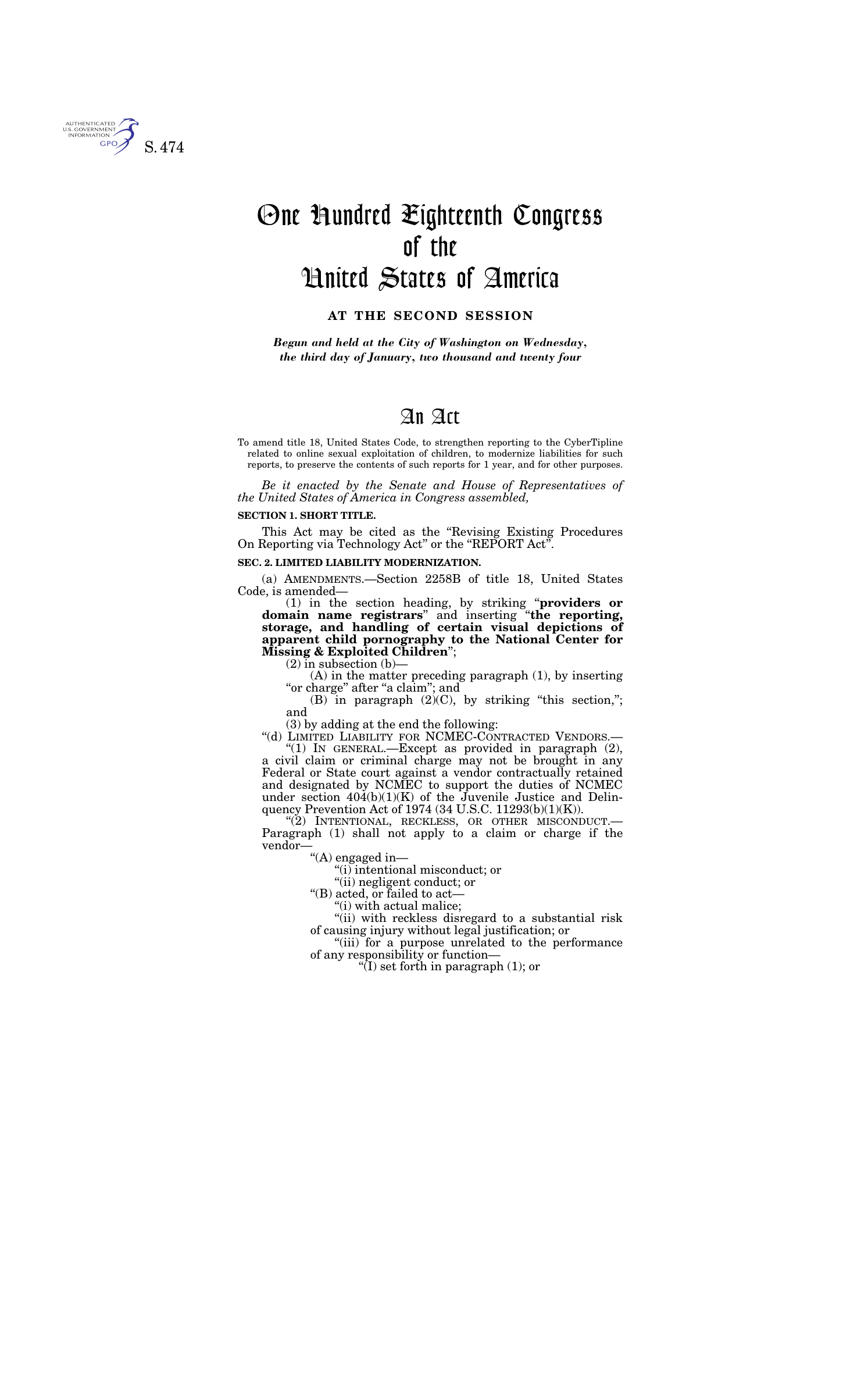
The clearest legislative win so far is the REPORT Act, signed into law in May 2024 and authored by Senators Marsha Blackburn and Jon Ossoff. For the first time, it requires online platforms to report suspected online enticement and child sex trafficking, not just child sexual abuse material, to the National Center for Missing and Exploited Children’s CyberTipline. It also extended how long platforms must preserve evidence, from 90 days to at least a year, and raised penalties for platforms that fail to report. According to Thorn’s analysis of NCMEC data, reports of online enticement rose 192 percent in 2024, reaching more than 546,000, a jump researchers credit largely to the new law.
Two other bills remain stalled. The STOP CSAM Act, reintroduced in May 2025 by Senators Dick Durbin and Josh Hawley, would let victims sue platforms that host child sexual abuse material and would further strengthen victim privacy protections and reporting duties. It has advanced through the Senate Judiciary Committee but has not been enacted.
The Kids Online Safety Act, or KOSA, passed the Senate 91-3 in July 2024 but stalled in the House and had to be reintroduced. It would create a legal “duty of care” requiring platforms to take reasonable steps to prevent harm to minors, along with default privacy and safety settings for young users. A House version advanced in 2026, but according to reporting from the Washington Times, it weakened the duty-of-care language, leaving the House and Senate to reconcile competing versions. Civil liberties groups, including the ACLU and the Electronic Frontier Foundation, have raised concerns that both bills, depending on final language, could create censorship or age-verification risks alongside their intended protections.
Separately, in April 2025, Senator Blackburn launched an inquiry with major tech companies after CyberTipline reports from some platforms declined, despite the new reporting law, raising questions about how consistently platforms are actually complying.
What could be done next
Several specific proposals recur among the officials and researchers who track the network.
Justice Department officials have pointed to the gap around self-harm coercion, conduct that current law does not cleanly cover, as a place where a narrowly written statute could close a real hole, rather than forcing prosecutors to reach for terrorism or racketeering law in cases that don’t fit those frameworks.
Advocacy groups including NCMEC and Thorn have pushed for full enactment of the STOP CSAM Act, arguing that private lawsuits against noncompliant platforms would create a financial incentive for compliance that public reporting mandates alone have not delivered. ISD’s research has similarly urged platforms to move toward behavior-based detection, flagging patterns of grooming and coercion rather than relying solely on matching known abuse images, since so much of 764’s activity involves original content and coded communication that hash-matching systems do not catch.
Senator Blackburn’s inquiry into declining CyberTipline reports points to a more basic problem: even strong reporting laws only work if platforms actually follow them. That suggests oversight and enforcement, not just new legislation, may be where the next real gains are found.
Resources for parents and readers
If you believe a child is being targeted or coerced online, the FBI recommends reporting directly rather than confronting the person responsible. You can reach the National Center for Missing and Exploited Children’s CyberTipline at 1-800-843-5678 or CyberTipline.org, and submit a tip to the FBI at tips.fbi.gov. The FBI’s open letter to parents has more detail on warning signs and how to talk with kids about online safety without shutting down communication.
React to this story