

California’s Penal Code 1001.36 was designed to help the genuinely mentally ill avoid unnecessary incarceration. But its legal architecture — a mandatory presumption the prosecution can almost never overcome, combined with a complete erasure of the arrest record on completion — creates a pathway a sophisticated defendant can exploit. Here is how it works, step by step.
California’s mental health diversion law, codified in Penal Code 1001.36, gives defendants with qualifying mental health diagnoses the opportunity to pause their prosecution, enter a treatment program, and — upon successful completion — have their arrest sealed as if it never occurred. The law was designed for people whose untreated illness drove their criminal conduct: the person with schizophrenia cycling through the system, the combat veteran whose PTSD went unaddressed for years.
The law’s mechanics — especially a 2022 amendment that mandates presuming any qualifying diagnosis caused the offense unless prosecutors can disprove it with clear and convincing evidence — have created an alternate route. It’s one that a high-functioning, well-resourced defendant with skilled counsel can navigate intentionally.
A recent Los Angeles case involving a livestreamer known as “Zero Dark Tony,” charged with 26 counts including stalking and child cruelty, illustrates how each step of this pathway functions in the real world.
The full case analysis is published in a companion piece and discussed in depth on the California’s Mental Illness Defense: Lifeline or Loophole? podcast from HeroNotZero Network, as well as What follows is the legal framework that makes it possible.
How the Law Works — The Quick Version
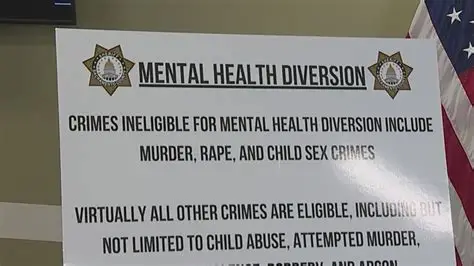
Under PC 1001.36, a defendant with a qualifying DSM-5 mental health diagnosis can have their criminal proceedings suspended and enter a supervised treatment program. If they complete the program satisfactorily over up to two years, the charges are dismissed and the arrest is sealed — legally deemed never to have occurred. The only charges that categorically disqualify a defendant are murder, voluntary manslaughter, rape, and offenses requiring sex offender registration. All other charges, including stalking, child abuse, and repeated restraining order violations, are eligible.
The Six Step Playbook
Step 1: The Retroactive Diagnosis
A defendant does not need to have been previously diagnosed or treated for a mental health condition to access diversion. Under current law, a qualifying diagnosis only requires a mental health evaluation from a qualified expert within the last five years — and, as the California Court of Appeal confirmed in People v. Harlow (2025), that diagnosis does not need to predate the offense. This means a defendant can be arrested for a crime, then seek a mental health evaluation, and use that post-arrest diagnosis to access diversion. The intent of the law was to help people with genuine, long-standing conditions. The mechanism does not enforce that intent. There is no requirement that the defendant have sought treatment before, disclosed symptoms before, or been known to any mental health system prior to the arrest.
Step 2: Negating ‘Willfulness’ Through Hospitalization
California law creates significant consequences for defendants who miss court dates — new criminal charges, bail forfeiture, and felony liability if the original charge was a felony. But those consequences hinge on one word: willful. The prosecution must prove the defendant deliberately chose to evade the court. A documented psychiatric hospitalization — whether an involuntary 5150 hold OR a voluntary admission — makes that showing nearly impossible. Courts routinely vacate bail forfeitures and decline to file new Failure to Appear charges when a defendant can show they were hospitalized around the time of the missed hearing. The timing of the hospitalization relative to the scheduled appearance is not, on its own, something a court can adjudicate. In the Zero Dark Tony case, the defendant missed a pretrial hearing on October 29, 2025. A letter surfaced in a civil proceeding the following week confirming he had been admitted to a Los Angeles hospital on October 30 — one day after the hearing he missed, and his statements confirm he voluntarily went to the hospital before that admission. The public record does not establish whether this was genuine crisis, strategic timing, or both. What the legal framework does establish is that the documentation, once presented, functions as a near-complete defense to willful absence.
Step 3: Triggering the Mandatory Nexus Presumption
Once a qualifying diagnosis is on the table, a 2022 legislative amendment kicks in automatically. The court is required to find that the defendant’s mental disorder was a significant factor in the offense — unless the prosecution rebuts this presumption by clear and convincing evidence. Clear and convincing evidence is a high standard. It requires the prosecution to affirmatively prove the disorder played no meaningful role in the crime — not merely to cast doubt, but to establish its absence with near-certainty. Police reports typically describe what happened, not the defendant’s mental state. Prosecutors who rely solely on arrest records and reports will almost always fail to meet this bar. In LaCour v. Superior Court (2025), the California Court of Appeal held that a trial judge abused his discretion by relying on the absence of mental health evidence in a police report. The message from the appellate courts has been consistent: the law presumes the illness caused the crime. The prosecution must prove otherwise, not the other way around.
Step 4: Steering Charges Below the Super Strike Threshold
The diversion law’s safety valve is narrow. Under current law, a judge can only deny diversion on public safety grounds if the defendant poses an unreasonable risk of committing a “super strike” — murder, attempted murder, or a sexually violent offense. As the Court of Appeal stated plainly in People v. Whitmill (2022), judges are “duty-bound to enforce the law as written,” even if they personally believe the defendant is dangerous. This means the strategy depends on keeping charges off the super strike list. Stalking, child abuse, repeated restraining order violations, arson, fraud, property crime — none of these disqualify a defendant. A skilled attorney who can negotiate charges to this level, or who can credibly threaten the delay, cost, and uncertainty of a full competency restoration proceeding, creates significant leverage toward a resolution that stays below the threshold. Assembly Bill 46 targets this gap specifically, proposing to replace the super strike standard with a broader finding that a defendant will “endanger public safety” if released into the community for treatment.
Step 5: Leveraging Sentencing Mitigation as a Safety Net
If diversion is denied — perhaps because a judge exercises the limited discretion available under current law — the mental health evidence does not disappear. It follows the defendant to sentencing. California Rule of Court 4.423(b)(2) provides that a mental condition that significantly reduces culpability for the crime is a formal mitigating factor at sentencing. A defendant who has already secured a diagnosis and expert report for the diversion hearing can deploy the same materials to argue against a custodial sentence. In jurisdictions like Los Angeles, where systemic pressures and resource constraints have made treatment-based resolutions the path of least resistance for many courts, this mitigating argument carries weight. The practical outcome — formal probation or a residential treatment placement rather than state prison — is often achievable even when diversion is formally denied.
Step 6: Executing Compliance as a Skill
The final step is also the most revealing one. The law does not require a genuine showing of mental health transformation. The program grades on compliance: attendance, treatment adherence, absence of new violations, and positive progress reports. For the person the law was designed to help — someone in genuine psychological crisis, battling untreated illness, navigating homelessness, or struggling with the structure that court supervision requires — compliance is genuinely hard. Missing a session, relapsing, or failing to appear can cascade into new charges and program termination. For a high-functioning defendant who understands the stakes, compliance is not a challenge. It is a skill. Show up. Generate good reports. Wait out the clock. At the end of the program, the law requires the court to dismiss the charges. The arrest is sealed. For most civilian purposes — employment applications, housing, professional licensing — it is legally deemed never to have occurred. A 26-count criminal case can disappear from the public record entirely. The program was built around the assumption that compliance is hard. It did not account for defendants for whom it is easy.
What AB 46 Would Change
Assembly Bill 46, introduced by Assemblymember Stephanie Nguyen (D-Elk Grove) and co-sponsored by district attorneys across California, would close several of these doors — though not all of them.
The bill would replace the super strike threshold with a broader “endanger public safety” standard, giving judges genuine discretion to weigh a defendant’s full record. It would require courts to explicitly consider prior violence and criminal history, past responses to rehabilitation, and victims’ rights under Marsy’s Law. It would also add “conduct disorder that causes or threatens physical harm to people or animals” as a new disqualifying diagnosis — a shift from a diagnostic label toward a pattern of dangerous behavior.
As of March 2026, the bill has cleared the Senate Public Safety Committee on a unanimous bipartisan vote and awaits further action in Sacramento.
Steps 1, 2, 3, and 6 of the playbook above would remain largely intact even if AB 46 passes. The retroactive diagnosis pathway, the hospitalization defense to willful absence, the nexus presumption, and the compliance-as-skill endgame are all features of the statute’s core architecture — not simply the threshold for denial. Closing the remaining gaps would require further legislative action that, so far, Sacramento has not taken.
Related Reading and Listening
• Full article: “The Mental Health Card: How a California Law Meant to Help the Sick Became a Weapon for the Savvy” — the Zero Dark Tony case in full context
• Podcast: California’s Mental Illness Defense: Lifeline or Loophole? — HeroNotZero Network deep dive into PC 1001.36, LaCour, Sarmiento, and AB 46
• Prior reporting: “The Collapse of a YouTuber’s Legal Defense” — the original HeroNotZero report on the Zero Dark Tony case
Hero Light Cody is an independent journalist and founder of the HeroNotZero Network, covering accountability, online harassment, and the intersection of law and digital culture.