

In the courtroom fight over whether California could reach a Louisiana man who had never set foot in the state, Jared Brooks invoked California’s procedure for challenging a judge’s impartiality. The challenge itself appears to have disappeared into a continuance.
This is Part Three in an ongoing series.
Part Two: UPDATE: April 17, 2026 — Same Courtroom, New Wrinkles – HERO / NOT / ZERO
On the morning of June 18, 2026, Slidell, Louisiana was in the middle of a disaster. Post-Tropical Storm Arthur had made landfall overnight, bringing torrential rainfall, suspected tornado touchdowns, and flooding severe enough that residents were paddling kayaks through neighborhood streets. A suspected tornado had tracked through the Eden Isles neighborhood, tearing branches from trees, damaging homes, and striking a local hotel. An 18-wheeler had been overturned on the I-10 on-ramp by wind gusts. Parts of Gause Boulevard were closed. Municipal pumps could not keep up with the volume of rain. Power outages were reported across the area. Governor Jeff Landry had declared a state of emergency for St. Tammany Parish and five neighboring parishes.
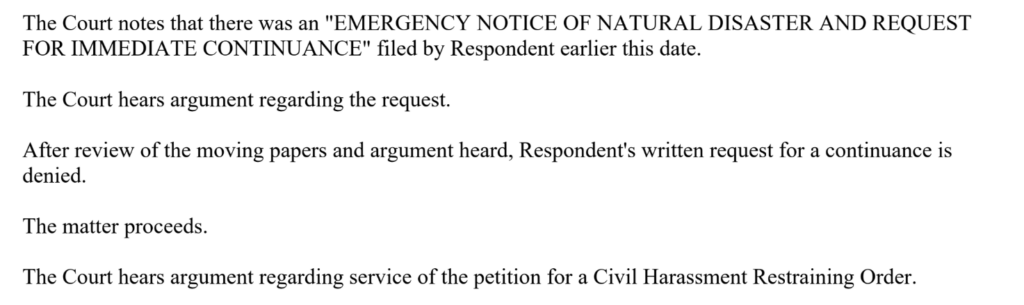
At 8:00 AM, thirty minutes before his scheduled hearing, Jared Brooks filed an Emergency Notice of Natural Disaster and Request for Immediate Continuance. In a declaration signed under penalty of perjury, he stated that his local power grid and internet infrastructure had failed and that he was operating on a cell phone with deteriorating battery backup. He wrote that proceeding with the hearing in his forced absence, caused by an act of God, would constitute a violation of his due process rights. He also noted that opposing counsel had transmitted evidentiary exhibits to him less than twenty-four hours before the hearing.
The minute order from that morning records what happened next in a single sentence: “After review of the moving papers and argument heard, Respondent’s written request for a continuance is denied.” ” D’Amato has repeatedly called Brooks a liar despite evidence to the contrary.


It was the second time in this case that Brooks had asked for a continuance and been turned down. It would not be the last proceeding of the morning.
To understand why a California restraining order hearing was proceeding against a Louisiana man during a state-declared disaster, you have to go back to May 26.
What Happened in May
Jared Brooks has been the respondent in this civil harassment case since March 27, 2026, when Anthony D’Amato, a California YouTuber who streams as ZeroDarkTony, filed a second petition claiming Brooks had subjected him to a sustained campaign of online threats. The first petition filed in 2025 was dismissed without prejudice. Brooks, who streams as Krackhead Kenny, is a Louisiana resident who has never lived, worked, or owned property in California. His central argument throughout restraining order requests has been that a California court has no constitutional authority over him at all.
The May 26 hearing was where that argument was decided. It was the second time the parties had appeared before Judge Holly L. Hancock-Goode. At the first hearing on April 17, the court had noted technical difficulties with evidence presentation and ordered the parties to exchange exhibits electronically before the next date. According to Brooks’ subsequent filing, D’Amato’s team transmitted that evidence to him on May 21 at approximately 5:50 PM, five days before the hearing, over Memorial Day weekend, with his legal support already out of the office until Tuesday. Brooks filed a request to continue the hearing. It was denied.
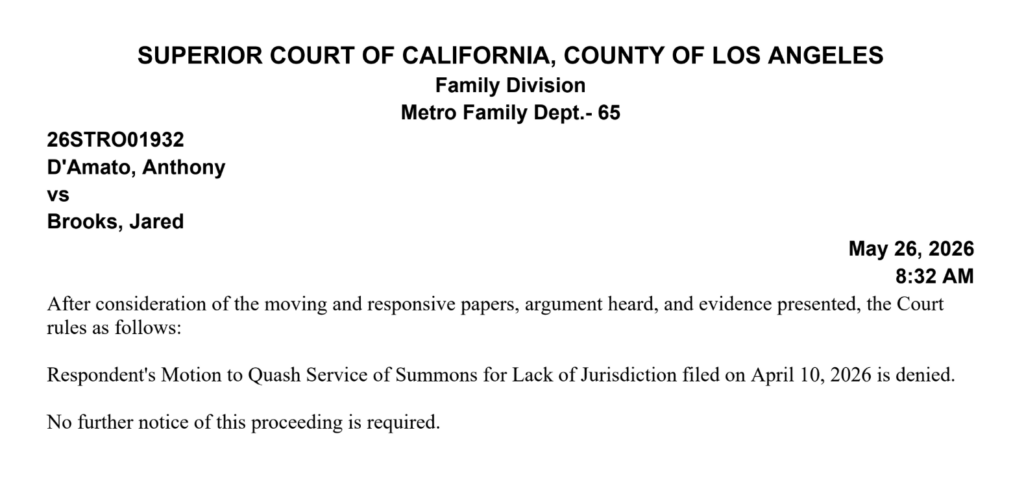
The May 26 hearing proceeded. After argument and the presentation of evidence, Judge Hancock-Goode denied Brooks’ motion challenging the court’s jurisdiction over him and, on D’Amato’s oral request, issued a Temporary Restraining Order against Brooks. The TRO was signed and transmitted electronically to the Los Angeles Sheriff’s Department for entry into the statewide law enforcement database. The minute order records the jurisdictional ruling in a single sentence, with no explanation of what evidence was persuasive or why.
D’Amato’s livestream that evening provided his account of what had moved the court. “We showed some videos today,” he told his audience. “It was rough for me to watch. The judge put a TRO in place because she saw what we all see.”
This is the third piece in our ongoing series covering D’Amato v. Brooks, Case No. 26STRO01932. Our earlier reporting covered the jurisdictional framework and what happened at the April 17 hearing, where the photograph D’Amato offered as evidence of Brooks’ California presence appeared to fall apart under scrutiny.
Disqualification Process to Follow?
TThe morning after his motion to quash was denied, Brooks prepared and signed a Verified Statement of Disqualification to have the judge removed from the case. California law gives every litigant the right to make that kind of challenge, a formal document, signed under penalty of perjury, laying out specific factual grounds for removal, filed at the earliest practicable opportunity after the grounds are discovered.
According to Brooks’ statement, his grounds traced to the hearing itself. He says the judge suggested that because he had chosen to appear through the court’s remote system, she was limited in how fully she could show him the evidence against him, and that he should consider appearing in person. He had explained that he lives in Louisiana and cannot afford to travel to California. By his account, the court proceeded anyway, admitted photographs he had challenged as digitally fabricated, and ruled against him on the threshold question of whether the state had any power over him at all.
California law spells out what’s supposed to happen once a statement like that is filed. Under Code of Civil Procedure Section 170.3, the challenged judge “shall not pass upon his or her own disqualification or upon the sufficiency in law, fact, or otherwise, of the statement of disqualification filed by a party.” A different judge has to decide it. The idea behind the rule is simple: a judge asked to rule on her own removal has an obvious conflict of interest.
An exception is written into the statute. If a disqualification statement is filed too late, or if it doesn’t allege anything that could legally amount to bias on its face, the challenged judge is allowed to strike it herself. But the exception goes only that far. It doesn’t let her weigh whether the underlying claims are true, and it doesn’t let her explain why she believes the case belongs with her. Those questions still belong to someone else.
There was one significant procedural obstacle standing between Brooks and that protection. Judicial disqualification documents are specifically exempt from electronic filing under Los Angeles Superior Court rules. The only way to serve the statement was to physically deliver it to the judge’s chambers at the Metropolitan Courthouse in downtown Los Angeles. For a man in Louisiana who could not travel, that meant hiring a local process server.
Three Trips to the Courthouse
Brooks retained ABC Legal on June 3. The assignment went to a registered process server. What followed over the next nine days is documented in a sworn Declaration of Non-Service with GPS coordinates, timestamps, and photographs, generated by ABC Legal in the ordinary course of business.
On June 4, she went to Department 65 at 1945 South Hill Street. She got past the entrance. According to her sworn declaration, she could see Judge Hancock-Goode inside the courtroom. A courtroom officer told her she could not approach the judge and redirected her to a clerk’s office at 111 N. Hill Street, a different building. She went there and was told the courthouse did not accept paperwork on weekends.
On June 9, she returned to Department 65. A courtroom officer told her the judge was “not available at this time” and that she could not approach.
On June 12, she tried again. A court services assistant told her: “No one will take the paperwork in this building.” The assistant directed her to contact County Counsel and added that even the judge’s own judicial assistant “doesn’t have rights to accept the paperwork.”
Three attempts. GPS logs at each location. A courtroom officer who confirmed on the first visit that the judge was present and still turned the server away. On the final attempt, a court employee stated the building would not accept the document Brooks was legally required to deliver there.
On June 15, unable to complete service through the only channel available to him, Brooks filed an ex parte application, a request made without the other side present, asking for a retroactive extension of time given the documented obstruction. His application attached the process server’s sworn declaration, the GPS logs, the timestamps, and the photographs.
The Ex Parte Application
The application’s central argument was straightforward: under California Code of Civil Procedure Section 1054, a court has broad authority to extend a deadline for good cause, and the three blocked attempts at courthouse service, documented by GPS logs, timestamps, and a process server’s sworn declaration, were exactly that. The application also cited CCP § 170.4(c)(2), describing a filing window of “generally 10 days before a hearing.” That’s not the standard that actually governs a statement like Brooks’. Under CCP § 170.3(c)(1), the statement only has to be filed “at the earliest practicable opportunity” after discovering the grounds, no fixed number of days attached, language Brooks’ own statement quotes directly. That standard measures from one moment: when he discovered Judge Hancock-Goode’s alleged bias, at the May 26 hearing. He signed his statement the next day. What delayed it afterward wasn’t him. It was three blocked attempts to physically get it into her hands.
It came on for review in chambers at 1:30 PM. No appearances were required.
The judge who reviewed it was Holly L. Hancock-Goode.
She crossed out the proposed findings of good cause Brooks had submitted with the application. She stamped it “DENIED AS UNTIMELY.” She added written directives stating that the request for her removal should have been made as a peremptory challenge at the first appearance, and that because she had “heard the salient facts in a motion to quash, the matter remains properly in this court.”
Whether the first part of that ruling was hers to make is its own open question. California law lets a challenged judge strike a statement of disqualification herself, but only the statement, and only on narrow grounds: that it’s untimely or fails on its face to allege facts that could support bias. What was in front of her on June 15 wasn’t a statement. It was an ex parte application asking for more time to file and serve one. Whether her authority to rule on that application alone, ancillary to a disqualification that hadn’t formally reached the court yet, is the same authority is exactly the question Brooks raised in his own writ petition the next day: that she had no jurisdiction to rule on anything connected to her own disqualification, the application included. The second part of her order isn’t a close call either way. “The matter remains properly in this court” isn’t a finding about timeliness. It’s an explanation of why she believes she should keep the case, the kind of decision the law reserves for someone else to make.
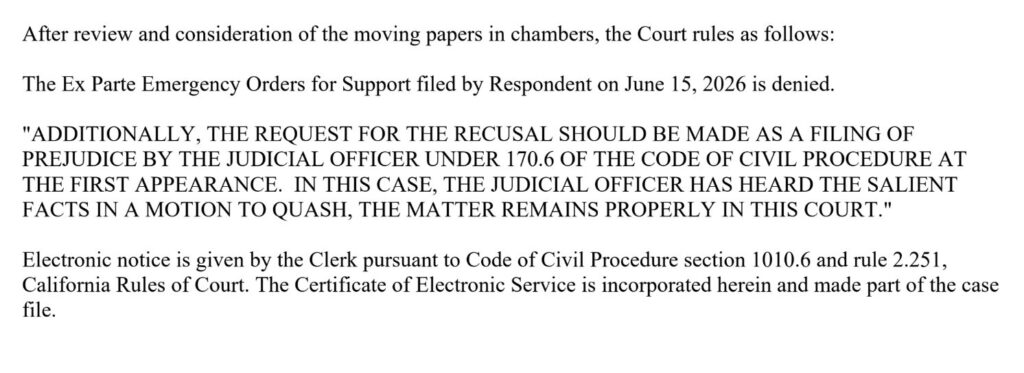
Her reference to a peremptory challenge points to the wrong statute entirely. That’s a separate procedure, governed by its own rule: once a judge has ruled on a contested issue of fact, it’s no longer available. She had done that twice by May 26, denying the motion to quash and issuing the TRO. That path had already closed by the time Brooks identified his grounds, but that has nothing to do with whether the statement he did file, the one she stamped untimely, met the standard that actually governs it. Different statute, different question. Her order answered a question Brooks never asked.
It’s also worth being precise about what existed to rule on that day. The Verified Statement of Disqualification itself, the document laying out Brooks’ actual grounds for removal, hadn’t been served yet. What was before her on June 15 was only the application asking for more time to file and serve it. She denied that application. The Verified Statement of Disqualification didn’t reach the court record until three days later.
D’Amato has called Brooks’ disqualification effort frivolous. The legal record does not support that characterization.
On June 16, with the June 18 hearing two days out, Brooks filed a Petition for Writ of Mandate in the California Court of Appeal, Second Appellate District (Case No. B355288), asking the appellate court to set aside the June 15 order and stay the June 18 hearing. On June 17, the Court of Appeal denied the petition. The docket records it in two successive entries: “Order denying petition filed,” followed immediately by “Case complete.” No written opinion. No opposition requested. No oral argument. Less than twenty-four hours between filing and denial.
Summary denials of writ petitions carry no precedential weight and routinely happen for reasons unrelated to the merits, including that the timeline doesn’t permit meaningful review. The denial doesn’t validate the June 15 order.
It also wasn’t a ruling on disqualification. The June 16 petition didn’t ask the Court of Appeal to decide whether Hancock-Goode was biased. It asked the court to vacate the June 15 order on the ex parte application, arguing the judge exceeded her jurisdiction by ruling on anything connected to her own disqualification before another judge could weigh in. That’s a recognized basis for a writ on its own, separate from whether the underlying bias claim has merit. The court denied it on June 17, a day before Brooks’ actual Verified Statement of Disqualification was even filed.
Whatever ruling eventually comes on that statement, the judge striking it herself or another judge deciding it on the merits, California law makes a writ of mandate the only way to seek review of it. That review hasn’t happened, because the ruling itself hasn’t happened.
Back to June 18
Brooks appeared at the June 18 hearing the same way he had appeared at every hearing in this case: remotely, via LACourtConnect, from Louisiana, during a state-declared disaster. His emergency continuance request had been denied in a sentence. Had this case been venued where Brooks actually lives, the courthouse itself would have been closed for the storm. He showed up anyway. Both minute orders from that morning record his presence.
Two separate proceedings were held that morning.
One addressed the civil harassment petition and Brooks’ disqualification request. After conferring with the parties regarding the June 15 ex parte application, the court continued the entire matter to June 22, 2026 at 1:30 PM on its own motion. The TRO remains in full force and continues to carry Brooks’ name in the statewide law enforcement database.
What the minute order doesn’t contain is a ruling. Section 170.3 requires one of two outcomes once a disqualification statement is filed: the challenged judge strikes it as untimely or legally insufficient, or the question goes to a different judge to decide on the merits. The June 18 order records neither. It notes that the court and parties “confer regarding Respondent’s Ex Parte Request for recusal/disqualifcation of Judge Hancock-Goode…” however, the Ex Parte Request is for a time extension, not the disqualification.
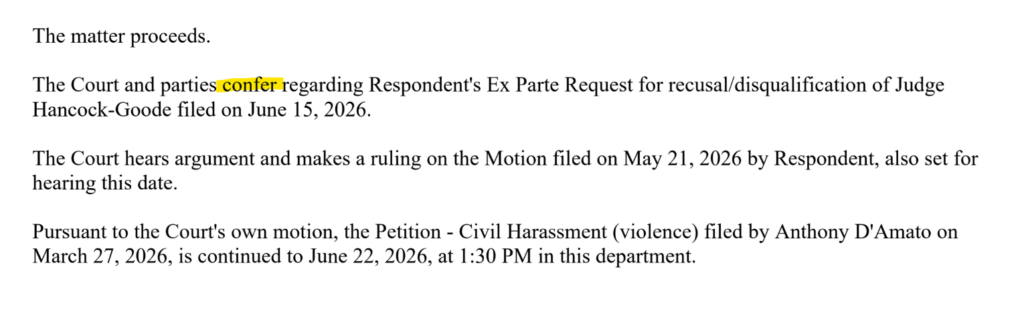
She then moves the whole case, TRO included, to June 22. The Verified Statement of Disqualification carries a June 18 file stamp. Whatever the court was actually referring to, the record doesn’t show what happened to it. The statement itself, a seven-page filing laying out Brooks’ grounds for removal, is now part of the court record. What happens to it next is not yet clear.
The other minute order addressed a motion Brooks had filed on May 21 seeking to quash service of process, dismiss the petition, order a mental health evaluation of D’Amato, and impose sanctions for the late evidence disclosure. The service challenge sat at the center of it.
D’Amato had already been describing that service to his audience before the hearing took place. On streams on June 2 and June 7, he said Brooks had been approached on April 1, asked to confirm his identity, and had denied being himself, and that the denial was what made the service legal. “It’s legal in Louisiana,” he told viewers. He also said a video existed of the moment: “We have the video that he recorded himself of getting served.” Neither detail, an in-person identification and denial, or footage of the encounter, appears anywhere in the process server’s own April 7 sworn declaration, which describes simple personal service with no mention of either.
Brooks had argued that the original petition was never properly served on him. According to his filing, the process server D’Amato’s team used to serve the petition at his Slidell address on April 1, 2026, a contractor with Knox Attorney Service, declared under penalty of perjury that his work location was in California, but was not registered or licensed as a process server in California and operated his business out of New Orleans, Louisiana. Brooks further stated that rather than personally delivering the documents, the process server had left them on top of a milk crate on the side of his house.
The two arguments don’t carry equal weight. California’s process-server registration requirement governs servers doing business inside California, and the petition was served in Louisiana under California’s rule for personal service out of state, which doesn’t turn on where the server happens to be licensed. The stronger question is the one about what actually happened at the door. Personal service means exactly what it sounds like: the documents usually handed to the person being served. Leaving them on a milk crate, without more interaction, doesn’t satisfy that on its own.
D’Amato’s team brought him to the June 18 hearing to testify and defend the service. He was sworn, testified regarding the service of the petition, and was cross-examined by Brooks. Three exhibits were marked for impeachment purposes: an audio clip from a fifty-two minute livestream, a photograph of a man in a blue shirt standing on a residential street, and a photograph of a man in a blue shirt walking away from the camera. Given the context of his testimony about serving Brooks at his Slidell home, the photographs appear to be his own documentation of the April 1 service attempt, offered to rebut Brooks’ account.
On his stream that evening, D’Amato offered a third version of what happened that day. He said the process server testified that Brooks chased his car and nearly rammed it twice, that police had to be called, and that the process server “had pictures” of the incident. That account, like the two he gave before the hearing, doesn’t appear in the process server’s sworn proof of service, filed with the court on April 7, 2026. It makes no mention of any altercation. If a confrontation significant enough to involve police had occurred during the service attempt, it would ordinarily appear in the proof of service affidavit. It does not. The court record contains only his original sworn statement of personal service at 7:08 PM on April 1, 2026.
That’s three different accounts from D’Amato of what happened at Brooks’ door: an in-person identification and refusal that made the service legal, a video recording of the moment, and a car chase that ended with police involvement. None of the three appears in the sworn declaration the process server filed six days after the fact, under penalty of perjury, the document that’s actually part of the court record.
After the process server was excused, the court denied Brooks’ motion in its entirety.
In every recent civil and criminal proceeding in which D’Amato has been a party, continuances have moved through with approvals. Attorneys needed time. Schedules conflicted. Cases stretched. In cases where D’Amato was the respondent in civil harassment matters, the proceedings have dragged on with continuance after continuance. In this case, where he is the petitioner, the respondent’s two requests to continue a hearing outright, each citing documented, verifiable circumstances, were denied in single sentences. A third request for more time, the ex parte application to extend the filing deadline, fared no better. It got a written order instead of a one-line denial, crossed-out findings of good cause and a citation to a peremptory-challenge statute that no longer applied.
The next hearing is June 22, 2026 at 1:30 PM in Department Metro 65.
The court that will hear this case on June 22 has still not been shown a record that has so far stayed entirely outside the courthouse: that D’Amato filed this petition 91 days into active criminal probation that included an explicit no-threats condition, entered after a plea to violating a court order that a minor had obtained against him; that a $500,000 bench warrant was issued in his criminal case on October 29, 2025, the day after his first civil harassment case against Brooks was dismissed, after a judge found he had continued to violate a criminal protective order while on bond; that a Slidell police officer in October 2025 watched a D’Amato video and independently documented his threats against Brooks and his wife, a video that was later deleted from YouTube; and that in January 2026, twenty-seven days into his probation, D’Amato addressed Brooks’ wife by name on a monetized livestream and described with explicit anticipatory language the prospect of serving her with legal papers at her workplace and suing her for her pension.
This is Part Three in an ongoing series. Part One, “Same Court, Same Problem,” covered the jurisdictional framework and the first dismissal. Part Two, “Same Courtroom, New Wrinkles,” covered the April 17 hearing and the State Bar meeting evidence. Part Four will cover the documented record outside the courtroom that the court has not been shown.
Court documents referenced in this article are on file with the Los Angeles Superior Court (26STRO01932) and the California Court of Appeal, Second Appellate District (B355288). The June 18 minute orders and proof of service were obtained from the court record. The process servers’ declarations, GPS logs, and photographs were reviewed directly. Livestream statements are sourced to D’Amato’s broadcasts on June 2, June 7, June 18, and June 19, 2026. Legal analysis in this piece draws on Code of Civil Procedure sections 170.1, 170.3, 170.4, 170.6, and 1054. Storm coverage sourced to NOLA.com, WWL-TV, Fox 8, and WWNO. This article is a journalistic review of public court records and does not constitute legal advice.