
A Los Angeles Superior Court judge has revoked the probation of livestreamer Anthony D’Amato, and while that sounds final, it isn’t. Here is what actually happened, what the law requires next, and why the odds may not be in his favor.
LOS ANGELES, Calif.
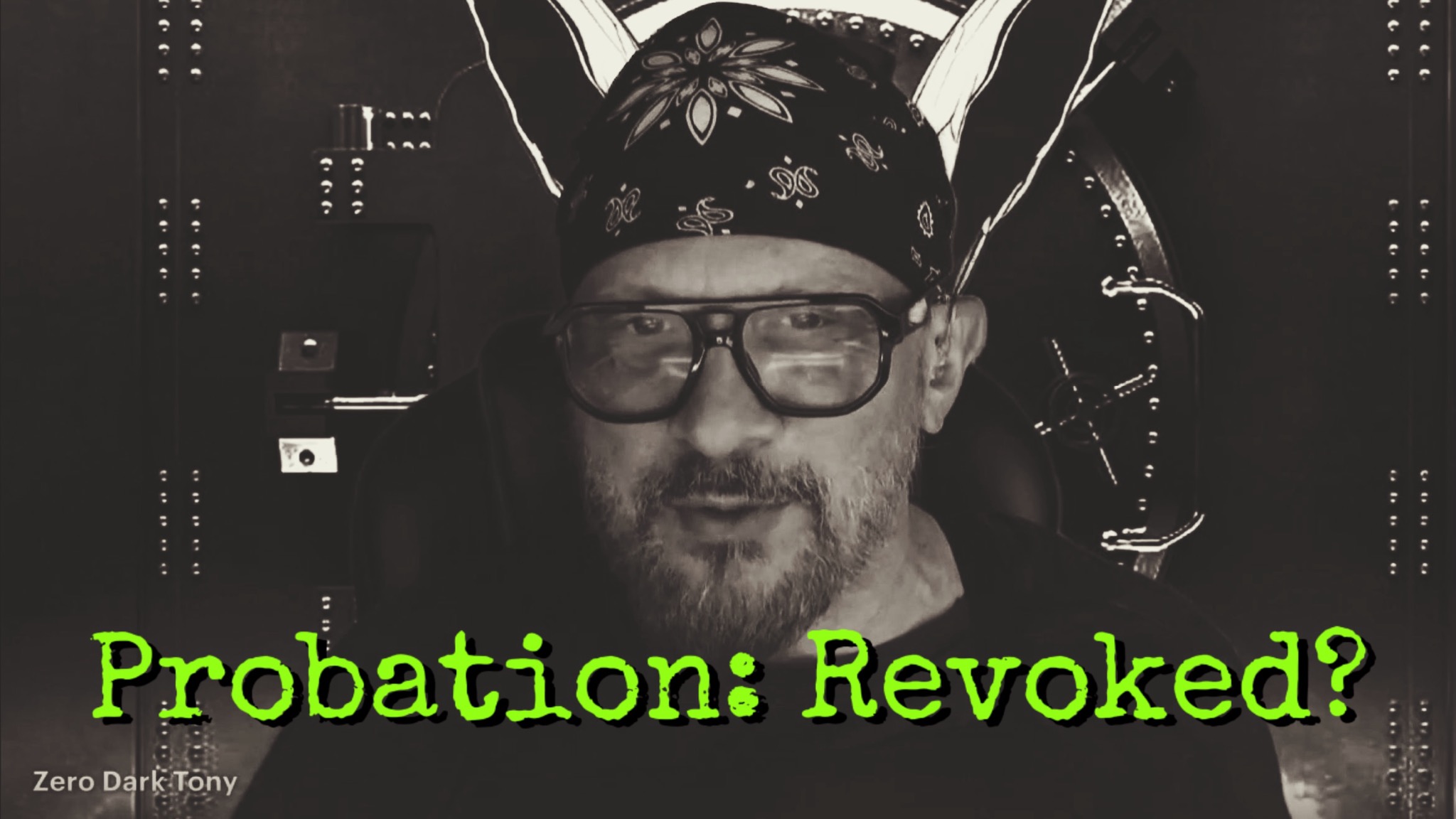
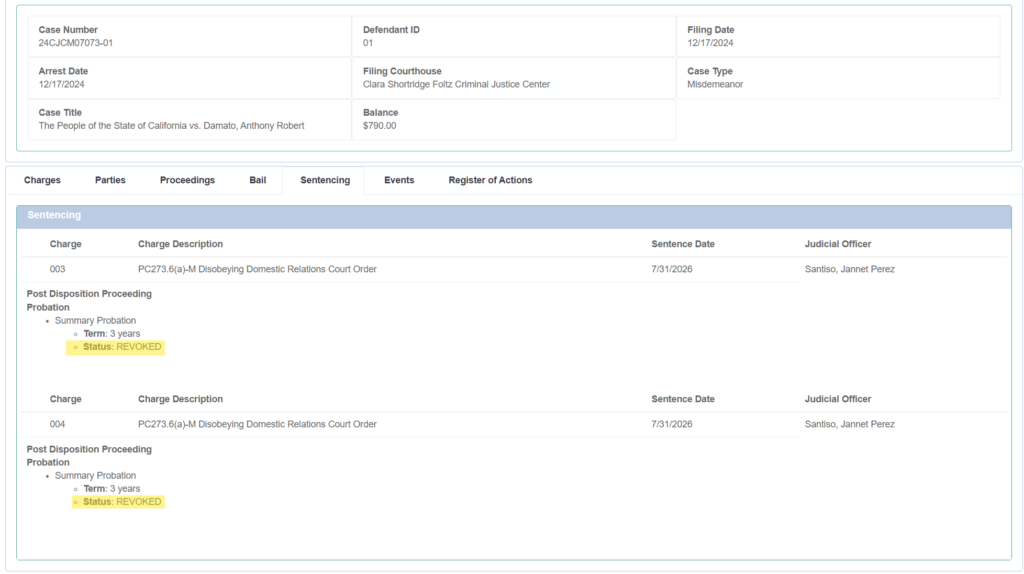
A Los Angeles Superior Court judge revoked the probation of Anthony Robert D’Amato, Jr., known online as Zero Dark Tony, on July 31, according to court records, setting up a hearing on Aug. 27 that will determine whether months of documented livestreamed conduct finally catches up with him in the form of jail time.
The case, The People of the State of California v. Damato, No. 24CJCM07073-01 (court captions render the defendant’s name without the apostrophe or suffix), has moved through the Clara Shortridge Foltz Criminal Justice Center in downtown Los Angeles since D’Amato’s arrest in December 2024 on a 26-count complaint. That complaint included at least two counts of stalking under Penal Code 646.9(a), numerous counts of disobeying a domestic relations court order under Penal Code 273.6(a), and counts of willful cruelty to a child under Penal Code 273a(b).
How he got here
During the roughly year-long pretrial phase, prosecutors say D’Amato violated the arraignment court’s orders “dozens of times,” posting about the protected victims on social media and threatening other people online with violence, including rape and death. The City Attorney’s Office built a motion cataloging those incidents, supplemented it as new violations kept surfacing, and provided the court compact discs of video clips. Prosecutors asked that D’Amato be immediately remanded and his bail set at $500,000.
According to the City Attorney’s later filings, D’Amato responded by refusing to come to court or communicate with his attorney, and a bench warrant was issued the same day. He eventually resurfaced. On Dec. 23, 2025, he entered a plea before Judge Shannon Cooley, who was then presiding in Department 51. Most of the original 26 counts were dismissed under Penal Code 1385, which gives judges discretion to dismiss charges “in furtherance of justice,” leaving two counts of disobeying a domestic relations court order as the basis for a three-year grant of summary probation. Judge Cooley, according to the City Attorney’s account, “strongly admonished” D’Amato that his behavior had to stop immediately, “or he would be sentenced to the maximum jail time allowed by law.”
The livestreams prosecutors say continued anyway
That warning did not end things, according to a motion the City Attorney’s Office filed April 24, 2026, titled “Update Regarding Potential Probation Violations Since Last Court Date.” Deputy City Attorney Ethan Greene told the court that prosecutors had learned of further potential violations even before D’Amato’s first post-conviction appearance, alerted Judge Cooley, and were instructed to document any new conduct the same way they had before sentencing.
The filing, under a new set of exhibits labeled PP through AAA, describes a string of livestreams broadcast between February and April 2026 on Rumble and YouTube under the Zero Dark Tony handle. Prosecutors say the streams repeatedly referenced one of the protected victims, Solomon Sassoon, through nicknames that mock a disability D’Amato has claimed Sassoon has, in violation of a protective order barring him from mentioning the victims “directly, indirectly, or by inference.” In one clip, D’Amato is described playing a pre-recorded clip of someone else saying Sassoon’s name. In another, prosecutors say he allowed a stream’s comment section to fill with the victim’s name despite having the ability to moderate or block commenters.
The motion also documents a series of statements prosecutors frame as threats against several other people tied to the case, phrased, they argue, as expressions of “hope” rather than direct threats, a pattern the filing says is meant to avoid criminal liability while still violating the force-and-violence conditions of his probation. Those include a stream in which D’Amato said he hoped a critic would be struck by a bus, encouraged another critic to take his own life, and, separately, threatened to kill his own therapist before adding that he was joking. He is also alleged to have encouraged his audience to pay for the “assassination” of another individual connected to the victims. Prosecutors note that D’Amato has supporters who have previously indicated they would act on his behalf against people he criticizes, which they argue makes his “hopes” more than idle talk.
The motion’s conclusion asked the court to determine whether the conduct amounted to a violation and, if so, to hold a hearing on an appropriate sentence. What happened at the July 31 revocation, including whatever specific findings the court made, is not yet reflected in the records reviewed for this article.
Money, labor, and treatment
A parallel, less dramatic track has run alongside the violation allegations. At a June 26 restitution hearing, Judge Santiso set total victim restitution at $7,757.91, covering a civil attorney’s fees, process-server costs, psychological treatment costs, and the installation of a home security system. D’Amato was referred to the court’s financial evaluator’s office to assess his ability to pay.
At the same hearing, his attorney, Justin Duncan Pitman, asked the court to convert a 128-hour community-labor requirement into community service, citing a physician’s letter describing a physical condition that limits D’Amato’s ability to stand, bend, or lift for extended periods. The request was denied.
Separately, court filings confirm D’Amato has been attending weekly court-ordered treatment sessions since late March, evidence apparently offered to demonstrate compliance with that particular probation condition even as prosecutors were alleging violations of others.
Two standards, and why the gap matters for D’Amato
Everything happening in this case right now runs through a single statute, Penal Code 1203.2, and it applies two very different thresholds depending on the stage.
To summarily revoke probation at a status hearing, the kind of hearing held July 31, a court needs only what California case law describes as probable cause, or “reason to believe,” that a violation occurred. That’s a low bar. It is enough to stop the clock on D’Amato’s three-year probationary term and preserve the court’s authority to act, but it is not, on its own, a finding that anything happened.
To actually find a violation, at the formal hearing the Aug. 27 date is expected to set in motion, the standard rises to a preponderance of the evidence: more likely than not. 51% likely vs 49% unlikely that it was a violation would be enough. That’s still a much lower bar than the reasonable-doubt standard a jury would apply at trial, and the gap between the two is significant for a defendant in D’Amato’s position.
The California Supreme Court, in People v. Vickers (1972) 8 Cal.3d 451, and the U.S. Supreme Court, in Morrissey v. Brewer (1972) 408 U.S. 471, established the due-process floor for hearings like the one coming up: written notice of the alleged violations, a chance to be heard and present evidence, a conditional right to confront and cross-examine adverse witnesses, a neutral judge, and a written statement of the reasons for any revocation. People v. Rodriguez (1990) 51 Cal.3d 437 confirmed the preponderance standard applies. But People v. Arreola (1994) 7 Cal.4th 1144 also confirmed that courts hearing these matters can admit hearsay, including recordings and secondhand accounts, on a lesser showing of “good cause,” without triggering the full confrontation-clause protections described in Crawford v. Washington (2004) 541 U.S. 36, which does not apply to probation hearings at all.
That combination does not obviously favor D’Amato. Much of the evidence described in the City Attorney’s motion consists of his own livestreams, statements he made himself, on platforms he controlled, which are difficult to contest as fabricated or unreliable since he broadcast them under his own handle. Self-generated video evidence paired with a preponderance standard, rather than a reasonable-doubt one, is a materially easier case for prosecutors to make than a new criminal charge would be. And a judge has already found the threshold met once, on the lower probable-cause standard, when she revoked his probation on July 31. He does retain real protections, including the right to counsel and, under People v. Coleman (1975) 13 Cal.3d 867, a form of use immunity if he testifies at his own violation hearing, meaning that testimony generally cannot be used against him in a separate criminal prosecution except to impeach him. But the structural odds at a hearing like the one now being scheduled tend to favor the side making the accusation.
The penal codes at play
- Penal Code 273.6(a): the two counts D’Amato is now on probation for, disobeying a domestic relations court order. A misdemeanor punishable by up to a year in county jail and a $1,000 fine, per count.
- Penal Code 1203.2: the statute governing everything happening now, authorizing summary revocation on the lower probable-cause standard and formal revocation, with consequences, only after a hearing on the higher preponderance standard.
- Penal Code 646.9(a): stalking, charged twice in the original complaint.
- Penal Code 273a(b): willful cruelty to a child, also part of the original complaint, among the counts dismissed as part of the December 2025 plea.
- Penal Code 1385: the mechanism, giving judges discretion to dismiss charges “in furtherance of justice,” used to dismiss most of the original 26-count complaint as part of that plea.
What Aug. 27 is, and what could follow
A “setting” hearing is typically procedural, fixing a date for the actual contested hearing rather than deciding the violation question itself. A source said the Aug. 27 date may also serve as a status check on the separate compliance matters described above, including the community-labor dispute and D’Amato’s court-ordered treatment.
Once the formal violation hearing takes place, the range of outcomes is wide. The court could reinstate D’Amato’s probation on the same or stricter terms, extend the probationary period, or, because his original sentence was suspended rather than imposed, sentence him for the first time on the underlying charges, up to a year in jail and a $1,000 fine on each of his two remaining counts. It is also possible the court finds no violation occurred and reinstates probation without further consequence. Given the standard of proof and the nature of the evidence described in the City Attorney’s own filings, however, reinstatement without any consequence may be the least likely of those outcomes.
This is a developing story and will be updated.