

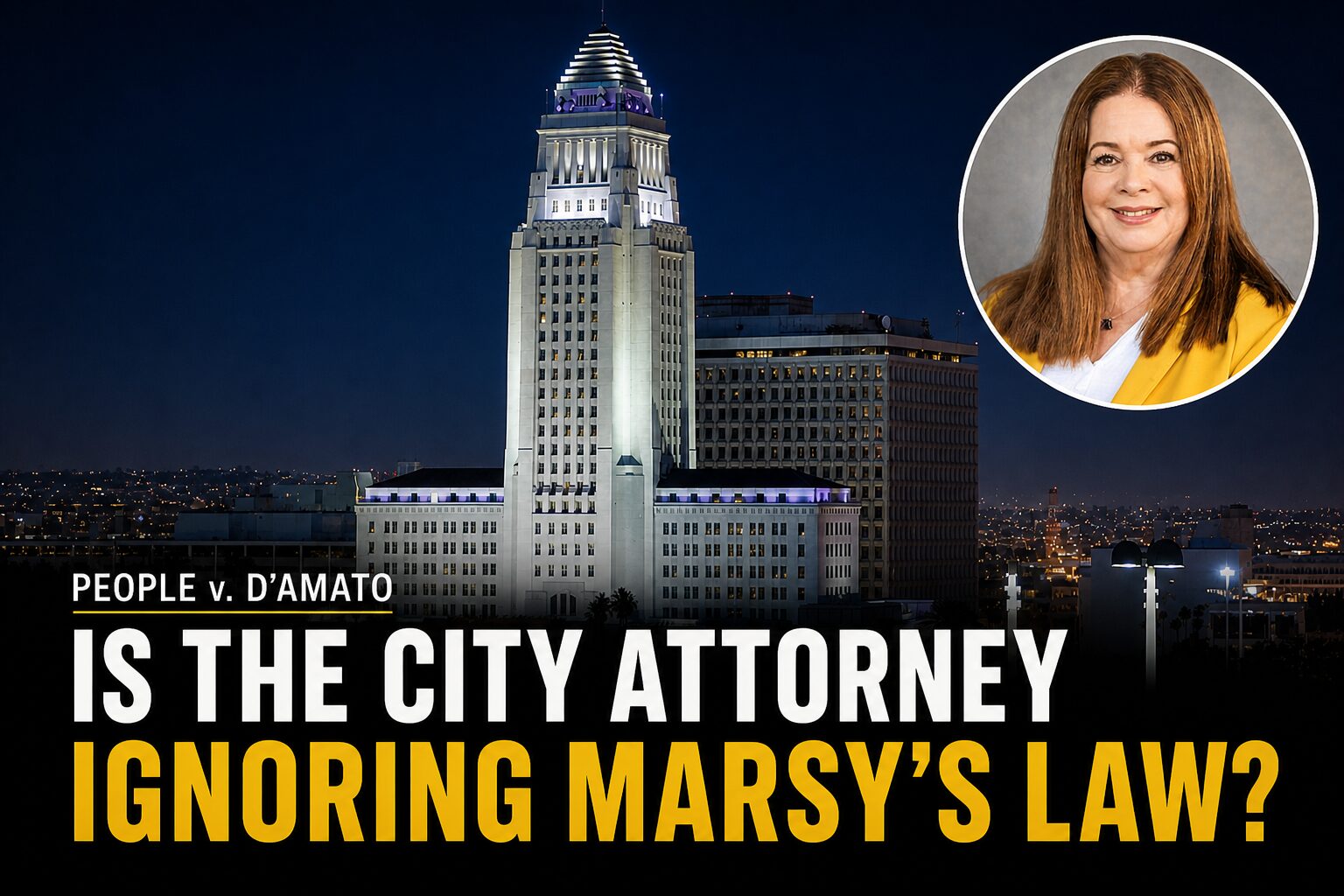
On April 24, 2026, a restitution hearing in People v. D’Amato was supposed to close out a misdemeanor case in Los Angeles. What it exposed instead was a pattern the victims had been documenting for months: constitutional rights that were violated, a prosecution that took no corrective action, and a deputy city attorney who would tell them in a courthouse hallway that there was nothing they could do about it.
The gap between what Marsy’s Law promises crime victims and what the system actually delivers is what the D’Amato case has come to represent.
The case stems from viral protests outside a Scientology recruitment center in Hollywood. Among those present was Solomon, then 16, who documented the demonstrations from a public sidewalk. According to an amicus brief filed by Enri Marini, a named victim who holds a civil harassment restraining order against Anthony Robert D’Amato Jr. (known online as “ZeroDarkTony”), D’Amato targeted critics of the Church of Scientology in an alleged harassment and stalking campaign. Solomon and his mother, Yelena, became primary targets. The conduct directed at them led to a restraining order against D’Amato and, eventually, twenty-six misdemeanor charges including Willful Cruelty to a Child and Stalking.
Those charges were the City Attorney’s responsibility. The Los Angeles City Attorney holds exclusive jurisdiction over misdemeanor prosecutions within the city. This case, from filing to plea to restitution, belonged entirely to City Attorney Hydee Feldstein Soto’s office.
At an October 29, 2025 pretrial hearing, D’Amato failed to appear. His attorney claimed he was hospitalized but could not name a hospital or reach him by phone. Judge Shannon K. Cooley found that D’Amato continued to violate the Criminal Protective Order, relieved his defense counsel, issued a $500,000 bench warrant, and forfeited his bond.
Then the case shifted abruptly.
Less than two months later, on December 23, 2025, the City Attorney’s office, represented by Deputy City Attorney Ethan Greene, resolved the case through a plea agreement. D’Amato pleaded no contest to two counts of disobeying a court order. Twenty-four charges, including Willful Cruelty to a Child and Stalking, were dismissed.
He received three years of probation, community service, and $790 in fines. No jail time. No social media restrictions, even though the office’s own motions had identified social media as D’Amato’s primary vehicle for ongoing harassment.
According to the amicus brief, the victims were never contacted before the deal was struck. They learned the case had been resolved only after the court accepted the plea. When they attempted to assert their rights, the brief states, Deputy City Attorney Ethan Greene responded: “Do you really want to go through court?” and “I don’t work for you.”
On February 18, 2026, according to the brief, the victims returned to court and filed a formal complaint documenting those alleged Marsy’s Law violations. The brief states that Judge Cooley directed the prosecution to file remedial motions. As of the April 24 hearing, prosecutors had filed nothing.
Remedial Motions Remain Unfiled
If the court’s February directive occurred as the brief describes, there was a wide range of available responses. Failing to pursue any of them appears deliberate.
At the most significant end, the prosecution could have moved to vacate the December plea entirely. Under Article I, Section 28 of the California Constitution, victims have a constitutional right to confer with the prosecuting agency before any pretrial disposition of their case. Marini argues in his brief that a plea obtained through an alleged false representation that consultation occurred is constitutionally defective. Vacating it would have reopened the case for trial.
Short of that, prosecutors could have moved to reopen sentencing for victim impact statements. They could have sought to modify D’Amato’s probation to add a social media prohibition; a restriction their own motions had argued was necessary just months earlier. They could have initiated enforcement proceedings based on the CPO violations already documented and delivered to the office. At minimum, they could have filed a corrective notice acknowledging the February complaint.
More than two months passed. Greene filed nothing.
Greene operates under the authority of Feldstein Soto, whose office holds exclusive jurisdiction over this case and every other misdemeanor prosecution in Los Angeles. The victims’ February complaint, according to the brief, was not served only on Greene. It was served on the Office of the City Attorney directly.
The office was on notice. As of the date of the brief, there has been no response.
The April 24 Restitution Hearing
The hearing was presided over by Judge Jannet Perez Santiso, filling in for Judge Cooley. The prosecution entered seven exhibits representing claimed financial harm: attorney bills, invoices, Ring security subscriptions, documentation from a consulting firm, a check, a bill for analysis, and a Trauma Impact Report.
The final exhibit, a Trauma Impact Report, documents ongoing psychological harm that deserves attention. The matter was continued to June 26, 2026, at 8:30 a.m. The minute order is spare: Defendant on Probation. Exhibits marked. Hearing continued. Defendant ordered to return.
What it does not record is everything else that happened that day.
According to observers, the hearing did not unfold as a quiet accounting exercise. When Yelena took the stand, the cross-examination extended well beyond restitution. Defense counsel’s questions were described as repetitive and tangential. Throughout, Greene did not object. Observers say his head remained down during much of the questioning. The judge intervened directly to redirect the examination. The objections came from the bench, not the prosecution’s table.
According to observers, Yelena had not been informed she would be testifying and had not been prepared for it. The amicus brief further alleges she had not been properly notified the hearing was taking place at all; a claim that, if accurate, would constitute an additional Marsy’s Law violation layered onto those already documented in the February complaint.
In the Courthouse
After the hearing, an exchange unfolded in the hallway that would not appear in any minute order.
Observers say that members of the victims’ side, along with a victim’s advocate and a process server, approached Greene about the December plea. What followed reportedly involved raised voices and animated gestures from Greene.
“There are no legal causes of action for violating Marsy’s law,” Greene was quoted as saying by an observer present.
The statement is, in important respects, legally accurate. That is precisely what makes it significant. Marsy’s Law is a state constitutional amendment. It does not create a private right of action. Victims cannot sue the City Attorney’s office for damages when their rights go unheeded. No penalty attaches to a prosecutor who ignores a court directive to file remedial motions. In that technical sense, Greene was describing the law as it currently stands.
What it communicates, intentionally or not, is a prosecutorial calculation: a constitutional guarantee can be disregarded without institutional cost. Victims can file complaints, appear in court, submit documentation, and exhaust every available avenue. The office responsible faces no consequence for inaction.
Courts have not established a clear remedy for Marsy’s Law violations. The rights are enumerated. The remedies, as of now, are not.
What Marsy’s Law Promises
Proposition 9 amended the California Constitution in 2008 to enshrine seventeen specific rights for crime victims: the right to be notified, consulted, and heard. The law traces back to a 1983 murder: Marsy Nicholas, killed by her ex-boyfriend, whose family encountered her killer in a grocery store days later, released on bail without any notice. Her brother, Henry Nicholas, spent decades turning that failure into a constitutional amendment.
What the amendment created was, in theory, a third participant in a system built for two. In practice, honoring those rights depends almost entirely on the willingness of the prosecuting agency to do so voluntarily. In this case, according to the brief and the court record, that willingness was absent from the beginning.
Community Labor and a Continuance
One additional moment from the hearing rounds out the picture. Defense counsel requested that D’Amato’s community service be modified to exclude physical labor, citing a claimed TBI and nerve damage. According to an observer, a doctor’s note was presented in support.
The court denied it. The Referral and Compliance Form, filed April 24, shows D’Amato re-referred for 16 days of community labor, with a progress report due June 26: the same date as the continued restitution ruling.
The case returns to Department 51 on June 26, 2026. The restitution ruling remains pending. The seven exhibits wait to be weighed.
For Yelena and Solomon, the case is now in its sixth month of post-plea proceedings, while related civil litigation has stretched for more than two years, beginning with a restraining order request filed in April 2024 and continuing through today through appeals and additional filings. California law promises a “prompt and final conclusion,” and restraining order proceedings are designed to move in weeks. The record instead shows delay after delay and little accountability for the court decisions that prolonged it.
The minute order for the April 24, 2026 hearing in People v. Damato (24CJCM07073-01) is a public record of the Superior Court of California, County of Los Angeles. The October 29, 2025 minute order is likewise a public court record. The amicus brief filed by Enri Marini was served in person on April 24, 2026. The Referral and Compliance Form is a public court document filed the same date.