
OPINION
On Thursday morning, Oct. 1, in Department 65 of the Metropolitan Courthouse, Judge Holly L. Hancock-Goode will consider a request that Jarred Brooks, known online as “Krackhead Kenny,” pay $23,197.40 to the lawyers who won a restraining order against him.
Anthony D’Amato Jr., better known online as Zero Dark Tony or ZDT, is a Los Angeles-based livestreamer whose broadcasts combine Apex Legends gameplay with commentary on his ongoing legal battles. Over the past two years, he’s become a fixture in local courtrooms, contesting civil harassment restraining orders against him. Most notably, he’s serving three years of probation for violating a restraining order filed against him by a minor.
Brooks lives in Slidell, La. He has represented himself throughout the case and has appeared at every hearing by video. His court fees were waived in April.
This is D’Amato’s second attempt at a restraining order against him. The first, filed in September 2025, ended that October, when a Van Nuys commissioner granted Brooks’s motion to quash and dismissed the case without prejudice. D’Amato filed again in March. Hancock-Goode denied Brooks’s motion to quash for lack of jurisdiction in May. In June she denied a second, broader motion that also sought sanctions and dismissal. At the final hearing on June 22, she found Brooks’s evidence exchange untimely. She then ruled that D’Amato had proven harassment and ordered Brooks to stay away from him for five years.
In August, D’Amato’s lawyers asked the court to make Brooks pay for the case too.
Brooks answered on Sept. 14 with a 16-page memorandum, a sworn declaration and eight exhibits. He asks the court to deny the request “in its entirety, rather than reduce it.” (Opp. MPA p. 15.) The record gives the court solid grounds to do exactly that.
The law allows it. Section 527.6(s) of the Code of Civil Procedure says a prevailing party in a civil harassment case “may” recover attorney’s fees, “if any.” In Krug v. Maschmeier (2009), the Court of Appeal held that the trial court decides whether to award fees at all, not only how much. Nothing requires the judge to award a dollar.
“Counsel expressly refused”
D’Amato has asked a Los Angeles court to shift his legal bills before. He lost.
In 2024, Scott Hochstetter, an online commentator known to his audience as DOA, sought a restraining order against D’Amato. Hochstetter represented himself. D’Amato was represented by attorney Steven M. Tamer. In February 2025, a judge denied Hochstetter’s petition, and Tamer moved for $18,528.75 in fees: 27.45 hours at $675 an hour. (Hochstetter v. D’Amato, LASC No. 24STRO08472, Minute Order, May 27, 2025, pp. 1-2.)
Judge Melanie Ochoa denied every dollar. She asked Tamer whether he had charged D’Amato that amount or could produce any bills showing the fees were incurred. “Counsel expressly refused to do so, claiming that doing so would potentially violate attorney-client privilege,” she wrote. She asked whether he had represented D’Amato for free, and “counsel again refused to answer on the basis of attorney client privilege.” (Id. at p. 2.)
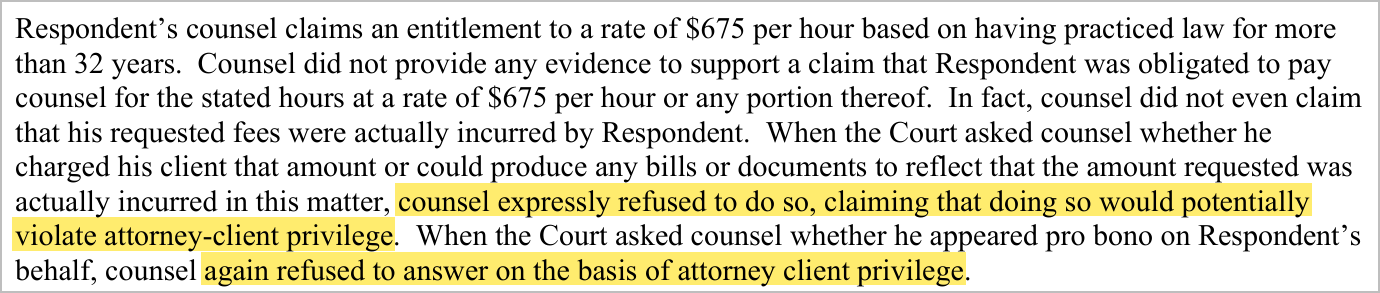
Minute order (ruling on submitted matter), May 27, 2025, p. 2, Hochstetter v. D’Amato, L.A. Super. Ct. No. 24STRO08472. Highlighting added.
Ochoa also read the statute at issue Thursday. She held that section 527.6(s), and its words “if any,” permit “recovery only of fees that are actually incurred, not merely hypothesized.” Because nothing showed D’Amato owed the fees, the statute barred an award. She added that she would have denied fees in any case, because of the gap between Tamer’s requested rate and the rates advertised on his own website. On that point she quoted Serrano v. Unruh: “To discourage such greed, a severer reaction is needful.” She also found that Hochstetter’s petition was not frivolous. (Id. at p. 3.)
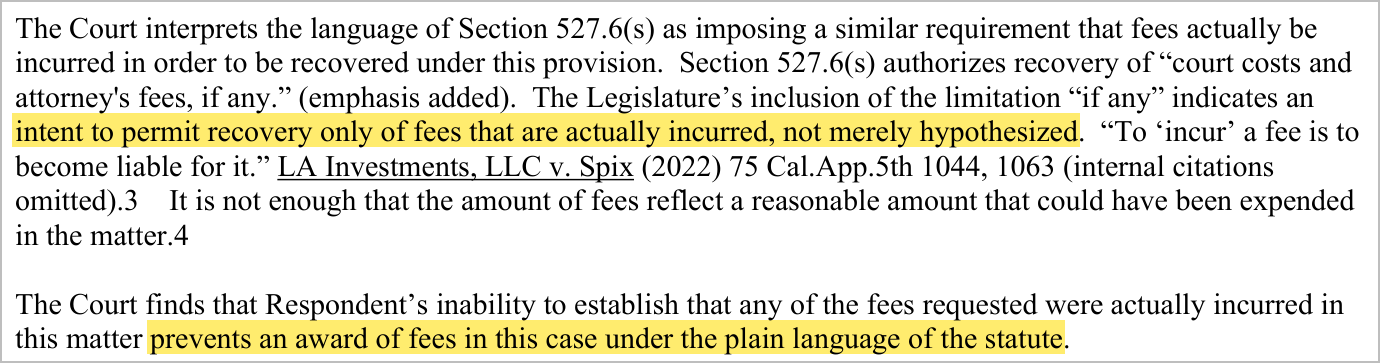
Minute order (ruling on submitted matter), May 27, 2025, p. 3, Hochstetter v. D’Amato, L.A. Super. Ct. No. 24STRO08472. Highlighting added.
Fifteen months later, D’Amato has a different lawyer and a different opponent, but the request has the same gaps:
- a rate supported only by the lawyer’s years in practice, which Ochoa noted came with no “comparable rates for attorneys in the area in this practice area”;
- a day in court billed with travel folded in (Tamer’s request included “eight hours of court on February 7, 2025, including travel time and time waiting in court”);
- no evidence that D’Amato owes the amount requested.
One thing is different. Tamer at least filed itemized time entries. Dunbar’s declaration has none.
Ochoa’s ruling does not bind Hancock-Goode, who is free to read the statute differently. But the question Ochoa answered is the one now before her.
“The minimum hourly estimate”
The request rests on a four-page declaration by attorney Dawn Dunbar, who works in the Encino office of Christopher Chaney, D’Amato’s attorney of record. Dunbar lists her work task by task, from a 1.5-hour client interview to four court appearances. But all but one entry is marked “approximately,” in half-hour increments, and several lump separate tasks into a single block. She attaches no billing records kept at the time, no invoices, no fee agreement, and no evidence of what Los Angeles lawyers charge for restraining-order work. Dunbar signed the declaration Aug. 12, seven weeks after the final hearing, and describes her total of “approximately 35.5 hours” as “the minimum hourly estimate.” (Dunbar declaration, ¶ 18.)
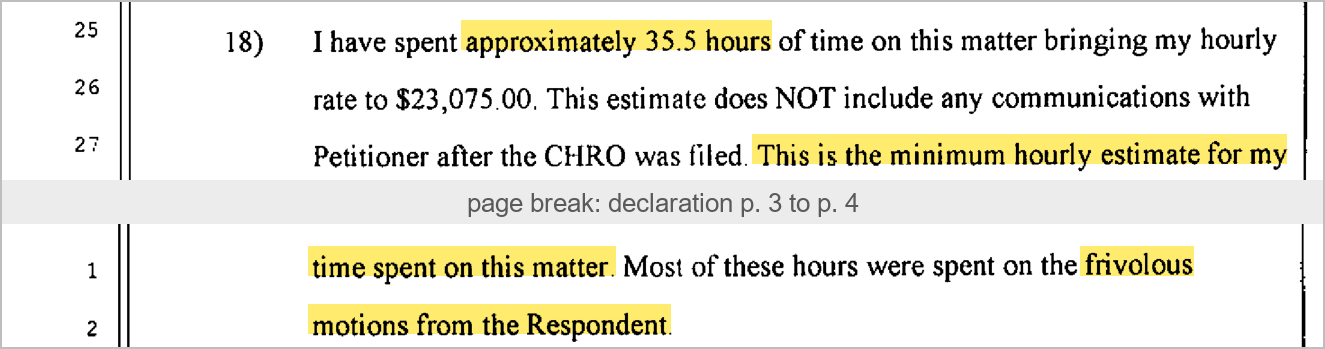
Declaration of Dawn Dunbar, ¶ 18, pp. 3-4, filed Aug. 18, 2026, D’Amato v. Brooks, L.A. Super. Ct. No. 26STRO01932. Highlighting added.
Brooks’s opposition shows where the hours went. Four court appearances, billed at 5, 5, 4.5 and 5 hours, are each described only as time “including drive time.” Together they account for 19.5 hours, or 54.9 percent of the bill. The declaration never says how much of any appearance was spent in court and how much on the road. (Opp. MPA pp. 9-10.) Two more entries fold clerical work into attorney time billed at $650 an hour. One is four hours for “drafting, editing, signing, and e-filing” the petition. The other is two hours that include “emailing with the process server.” (Opp. MPA p. 9; Dunbar Decl. ¶¶ 6, 13.)
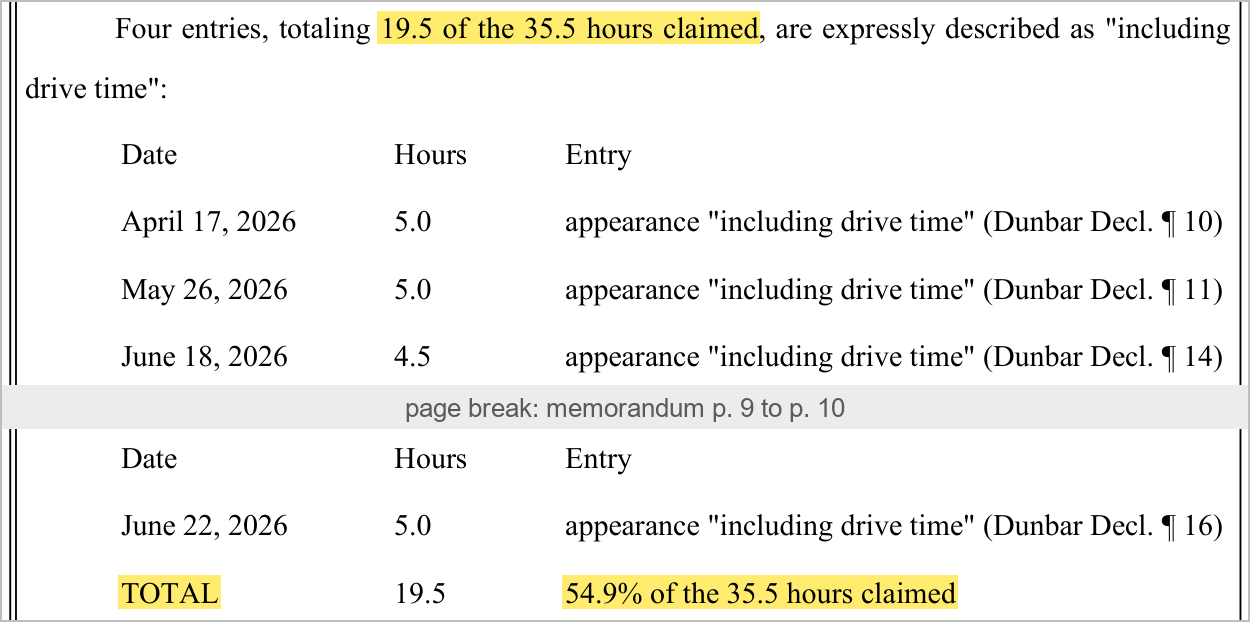
Respondent’s Memorandum of Points and Authorities, pp. 9-10, filed Sept. 14, 2026, D’Amato v. Brooks, L.A. Super. Ct. No. 26STRO01932. Highlighting added.
The rate rests on a single sentence: “My hourly rate is $650 per hour. I have been practicing law for 26 years.” The motion offers no market survey, no declaration from another lawyer, and no earlier award at that rate. Brooks’s brief answers it directly: “Experience may justify placement within a prevailing market range. It does not establish the range.” (Opp. MPA p. 10.)
California law lets a lawyer’s sworn testimony stand in for time records. But the party seeking fees still has to prove that both the hours and the rate are reasonable. Here, more than half the hours cannot be separated from driving, and the rate has no support beyond the lawyer’s own word. As the opposition puts it, “A reasonable rate applied to hours the Court cannot verify still produces a figure the Court cannot verify.” (Opp. MPA p. 10.)
“Order Petitioner to pay the Respondent”
The declaration is the only evidence behind the request, and its errors are visible on the page. One date range runs to “March 26, 2027,” a date that had not yet arrived. The out-of-state service fee appears as “XXX,” a placeholder left unfilled in a document signed under penalty of perjury. (Dunbar Decl. ¶¶ 6-7.)
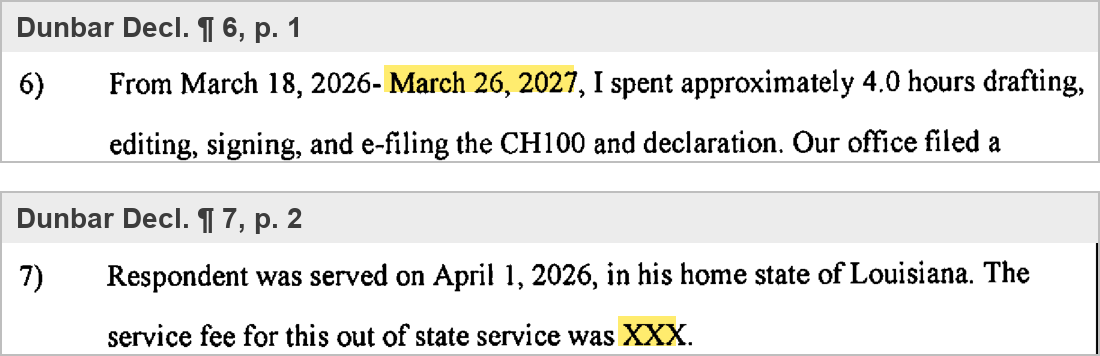
Declaration of Dawn Dunbar, ¶ 6 (p. 1) and ¶ 7 (p. 2), filed Aug. 18, 2026, D’Amato v. Brooks, L.A. Super. Ct. No. 26STRO01932. Highlighting added.
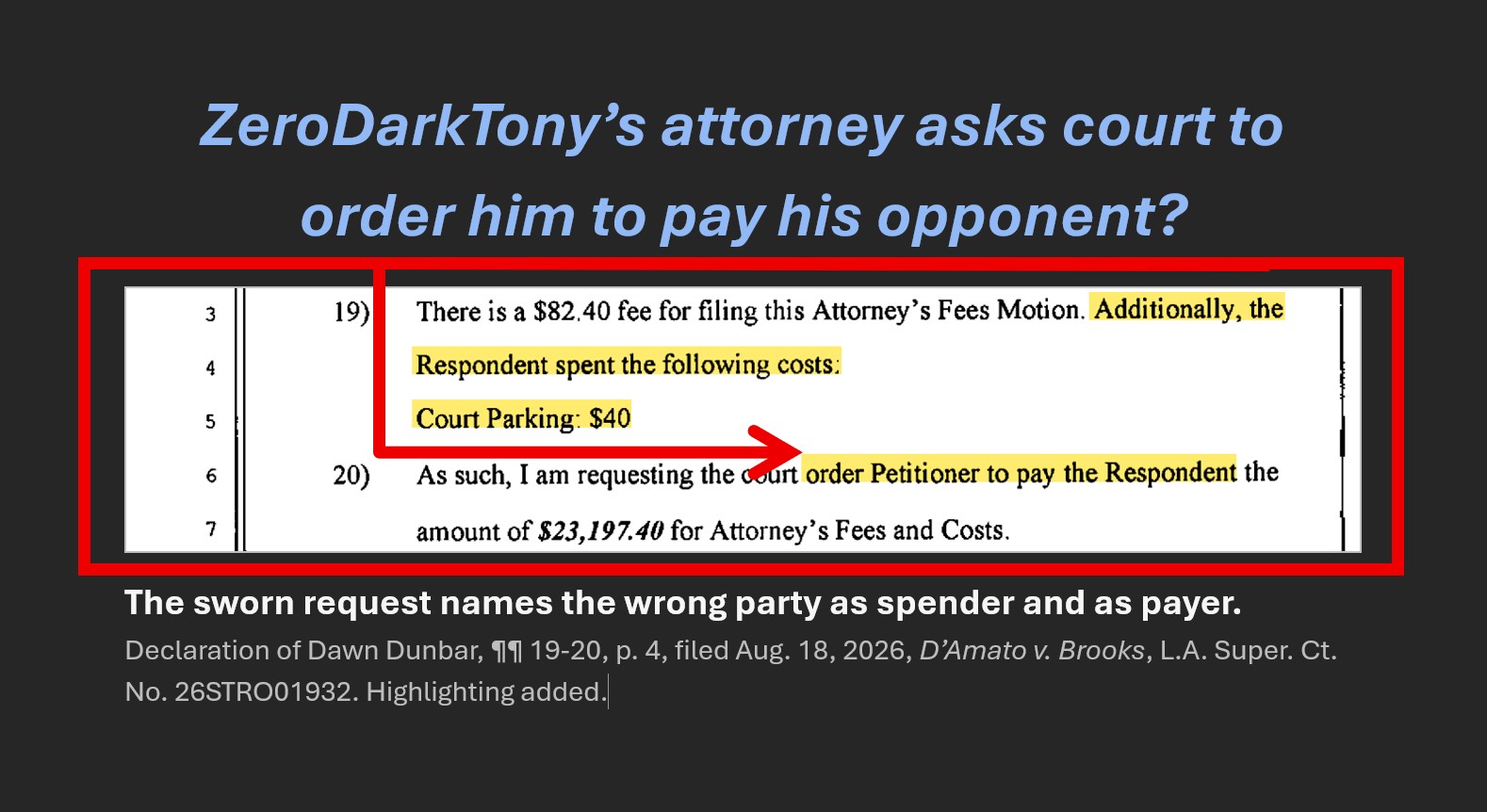
The closing paragraphs are worse. Paragraph 19 says “the Respondent spent” the $40 parking cost that D’Amato wants reimbursed. Paragraph 20, which states the request itself, asks the court to “order Petitioner to pay the Respondent.” That is the reverse of what the motion seeks.
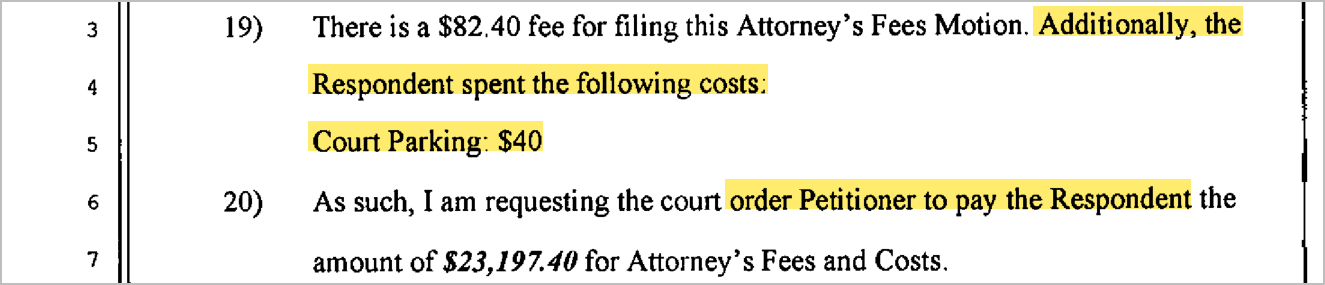
Declaration of Dawn Dunbar, ¶¶ 19-20, p. 4, filed Aug. 18, 2026, D’Amato v. Brooks, L.A. Super. Ct. No. 26STRO01932. Highlighting added.
Brooks raises the errors “without any suggestion of intentional misstatement,” and for a single purpose. A declaration signed without a final read cannot carry a $23,000 request that has no billing record behind it. (Opp. MPA pp. 14-15.)
The parking claim also fails on its own terms. The declaration says Brooks, not D’Amato, spent the money. And in Ladas v. California State Automobile Assn. (1993), the Court of Appeal disallowed attorneys’ routine local travel costs, parking included.
“In the $12,000 area”
The day after the final hearing, D’Amato gave his own estimate of the bill. He posted a video titled “APEX Legends | ZDT COFFEE CHAT: LEGAL FEES, DESPERADO, VIOLATED.” According to the transcript excerpt attached to Brooks’s declaration, he told his audience: “And you know what’s really going to be funny? Garnishing his wages for the legal fees, which will be over $10,000.” Later in the stream he guessed the fees “probably may be in the $12,000 area because of the extra hours that she’s had to put in…” (Brooks Decl. ¶ 10, Ex. H.)
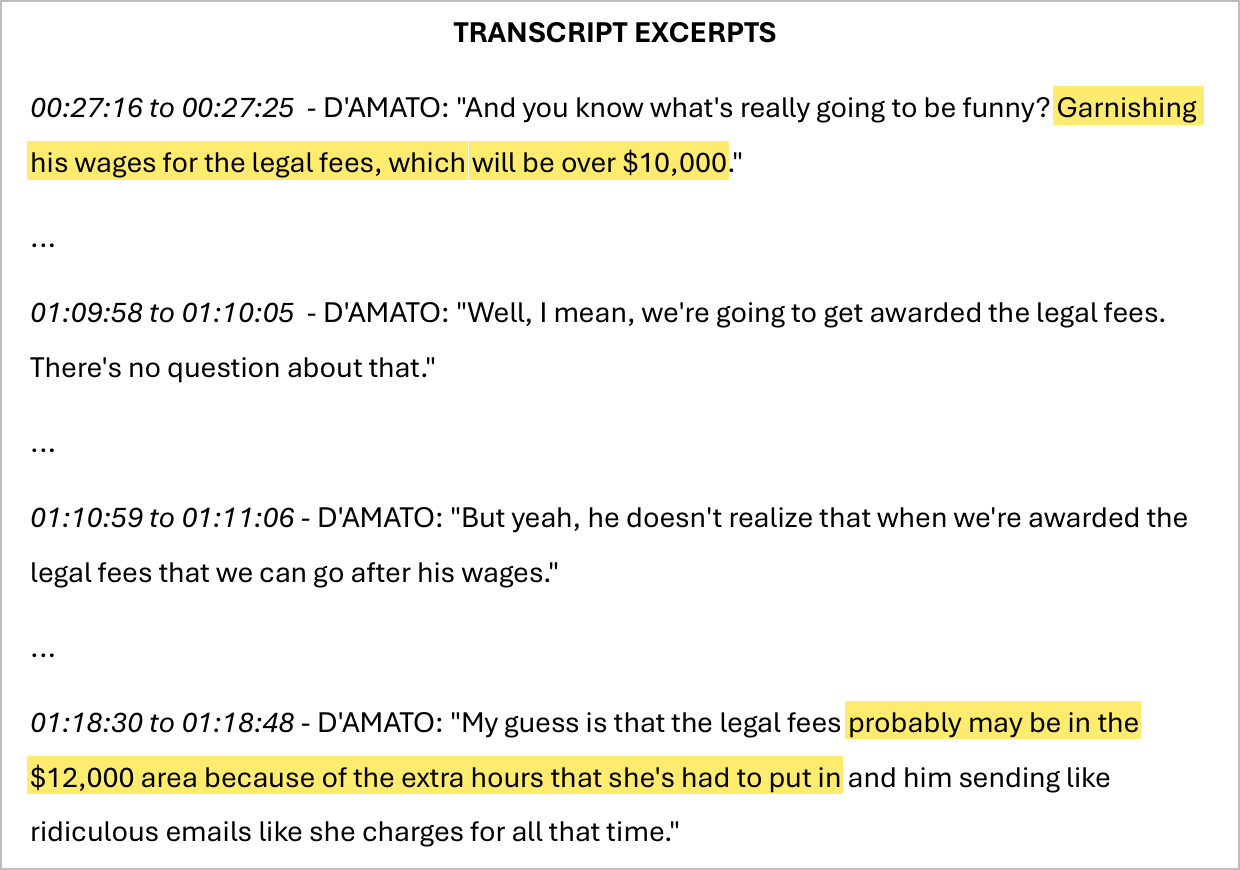
Declaration of Jarred Brooks, Ex. H, filed Sept. 14, 2026, D’Amato v. Brooks, L.A. Super. Ct. No. 26STRO01932. Highlighting added.
Seven weeks later, the sworn figure was $23,075. The opposition points out that D’Amato made his estimate when the work was finished and the hours were fresh. That estimate already factored in the “extra hours” that the declaration would later blame on Brooks’s motions. (Opp. MPA pp. 10-11.)
Brooks frames the point carefully: a client’s guess is not proof of his lawyer’s hours. But the motion offers nothing that explains the gap. It includes no invoice, no retainer, and no statement of what D’Amato has actually been billed or owes. On the question of payment, the declaration says only that “Petitioner hired my office.” (Opp. MPA p. 7; Dunbar Decl. ¶ 4.) The only evidence of the fee is a reconstruction nearly double the D’Amato’s own number. The court has no way to know which figure is closer to the truth.
“Frivolous motions”
Dunbar justifies the size of the bill by writing that most of her hours “were spent on the frivolous motions from the Respondent.” (Dunbar Decl. ¶ 18.) The record does not support that.
The court denied both of Brooks’s motions, in May and June, and made no finding that either was frivolous. D’Amato never sought sanctions under Code of Civil Procedure sections 128.5 or 128.7, the statutes that address frivolous filings. The register of actions shows no written opposition from D’Amato to either motion. (Opp. MPA pp. 6, 12.)
Nor was the challenge baseless. Brooks lives out of state and was served in Louisiana. In D’Amato’s first case against him, a nearly identical motion from Brooks succeeded. In October 2025, a Van Nuys commissioner granted it, citing the venue statute, and dismissed the petition. (Opp. MPA pp. 12-13; Brooks Decl. Ex. E.) A motion that has already won once is hard to call frivolous.

Minute order, Oct. 28, 2025, D’Amato v. Brooks, L.A. Super. Ct. No. 25CHRO01789, filed as Ex. E to the Declaration of Jarred Brooks. Highlighting added.
The declaration also charges Brooks for time that the court’s own record assigns elsewhere. Dunbar attributes the April 17 continuance to “technical issues for the Respondent.” The minute order says the court continued the matter on its own motion because of “technical difficulties with evidence presentation,” so the parties could exchange evidence. It blames neither side. The same order records that D’Amato withdrew his own motion to change the hearing location that day. (Opp. MPA p. 11; Dunbar Decl. ¶ 10; Brooks Decl. Ex. B.)
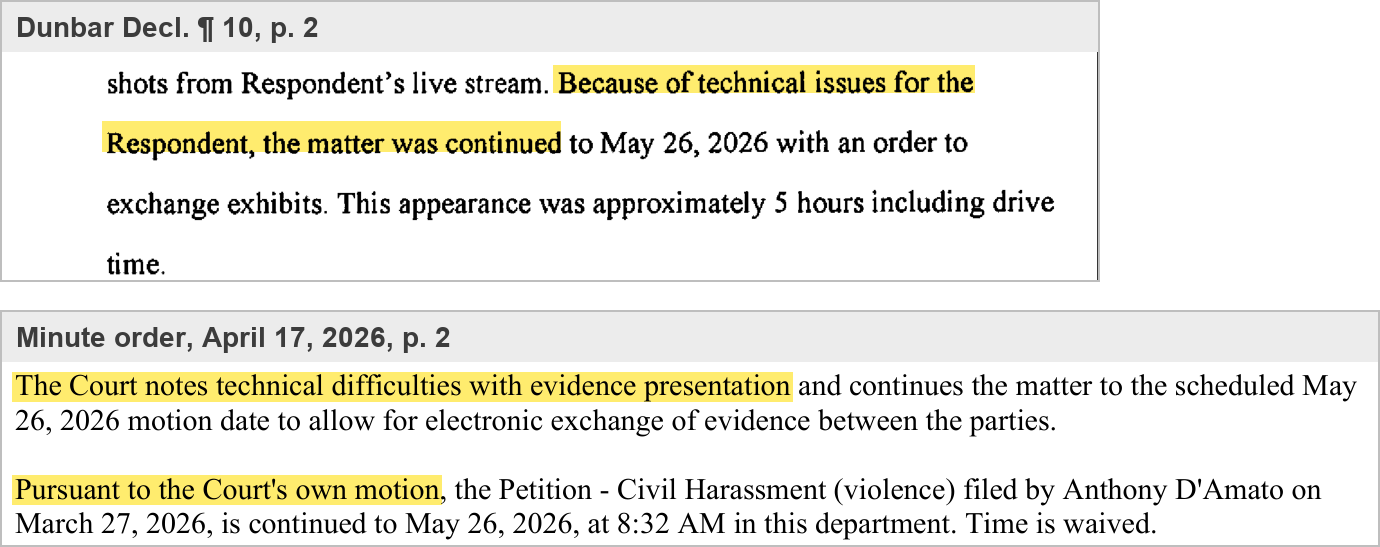
Left: Declaration of Dawn Dunbar, ¶ 10, p. 2. Right: minute order, April 17, 2026, p. 2, filed as Ex. B to the Declaration of Jarred Brooks. D’Amato v. Brooks, L.A. Super. Ct. No. 26STRO01932. Highlighting added.
The evidence exchange that continuance was meant to allow did not reach Brooks for more than a month. According to his sworn statement, D’Amato’s evidence arrived at about 5:50 p.m. on May 21. That was the Thursday evening before Memorial Day weekend: 34 days after the order and five days before the continued hearing. Four new exhibits were first marked at that May 26 hearing. (Opp. MPA pp. 11-12.)
“Or deny one altogether”
Brooks asks for denial rather than a smaller award, and his reasoning is strong. The defects, he argues, “are not matters of degree that a smaller number would cure.” A reduced award “would still require the Court to select a number unsupported by the record.” (Opp. MPA pp. 15-16.)
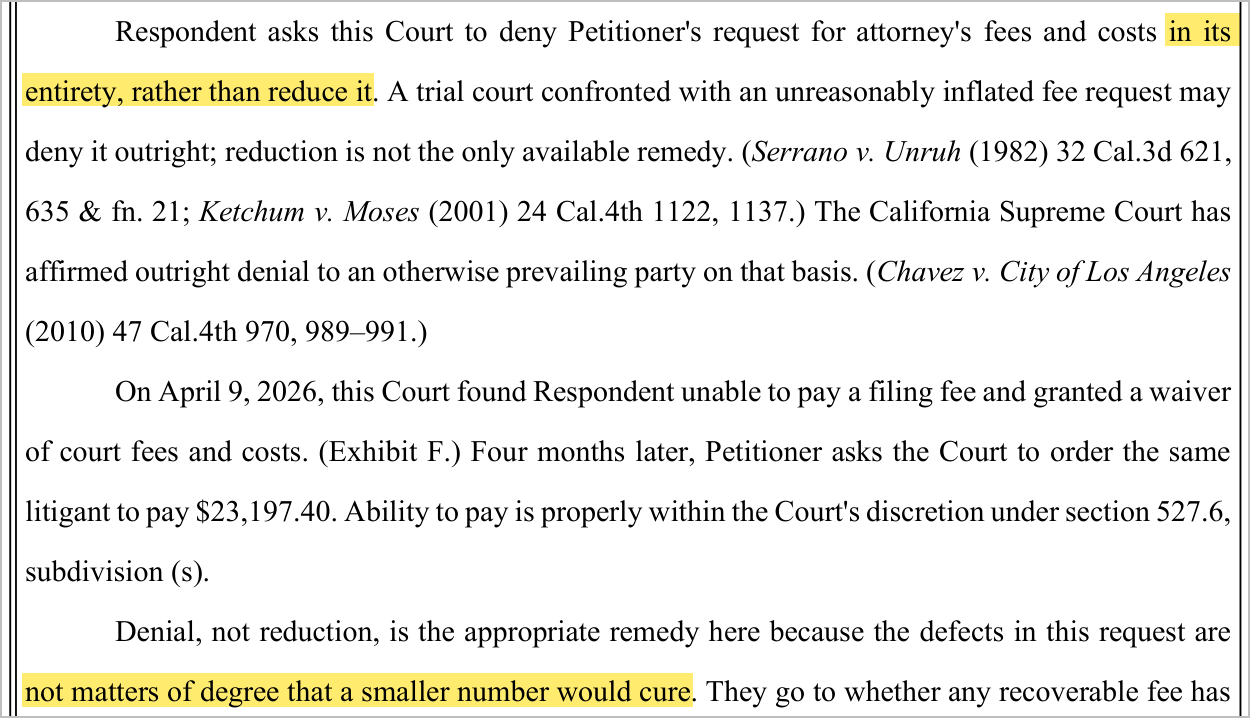
Respondent’s Memorandum of Points and Authorities, p. 15, filed Sept. 14, 2026, D’Amato v. Brooks, L.A. Super. Ct. No. 26STRO01932. Highlighting added.
The law supports that choice. In Serrano v. Unruh (1982), the California Supreme Court held that a fee request that “appears unreasonably inflated is a special circumstance permitting the trial court to reduce the award or deny one altogether.” In Chavez v. City of Los Angeles (2010), it upheld a trial court’s refusal to award any fees in a case where the request was grossly inflated.
Reducing the award would require a reliable starting point, and this record does not have one. To cut the drive time, the court would need to know how much drive time there was. To lower the rate, it would need evidence of the market. The motion supplies neither. Any reduced figure would be the court’s estimate built on an attorney’s estimate, and Brooks would be ordered to pay it.
D’Amato’s side cannot easily fill that gap now. The burden was D’Amato’s to meet in the motion itself. As Brooks’s brief notes, new evidence is generally not allowed in reply papers, which exist to answer the opposition, not to make the case for the first time. An invoice or fee agreement, the brief argues, “is not responsive material. It is the foundation of the motion, and it was available to Petitioner when the motion was filed.” (Brooks MPA, p. 8, citing Jay v. Mahaffey (2013).) Brooks has already objected to any such evidence appearing late, and would need a chance to respond if it does. Judges have some discretion to consider late evidence when the other side gets that chance. But D’Amato can hardly claim surprise. The same missing proof sank his last fee request 16 months ago.
The strongest argument for an award is that Hancock-Goode presided over every hearing on the bill. But what she saw in her courtroom cannot tell her how long Dunbar spent on the freeway, what the drafting hours covered, or what restraining-order lawyers in Los Angeles actually charge.
Brooks also asks the court to weigh his circumstances. On April 9, the court granted him a waiver of court fees. Four months later, D’Amato asks it to order the same litigant, who would not have been asked to pay a filing fee, to pay $23,197.40.
Section 527.6(s) says fees “may” be awarded. Brooks’s opposition, built almost entirely from the court’s orders and the declaration’s own words, gives the court ample reason to award none.
Sources
- Dawn Dunbar, Request for Order and Declaration, D’Amato v. Brooks, Los Angeles Superior Court No. 26STRO01932, filed Aug. 18, 2026.
- Jarred Brooks, Memorandum of Points and Authorities in Opposition, filed Sept. 14, 2026.
- Jarred Brooks, Declaration in Opposition, with exhibits, filed Sept. 14, 2026.
- Minute orders, D’Amato v. Brooks, April 17, May 26, June 18 and June 22, 2026.
- California Code of Civil Procedure section 527.6.
- Cases cited: Krug v. Maschmeier (2009); Serrano v. Unruh (1982); Chavez v. City of Los Angeles (2010); Ladas v. California State Automobile Assn. (1993).
Court records: Hochstetter v. D’Amato, Los Angeles Superior Court No. 24STRO08472
- Minute Order (Ruling on Submitted Matter), May 27, 2025, Judge Melanie Ochoa, denying Respondent’s motion for attorney’s fees.
Prior reporting
- Hero Light Cody, “Judge Rejects Fees in D’Amato Case,” HeroNotZero Network, May 29, 2025 (https://herolightcody.substack.com/p/judge-rejects-fees-in-damato-case).
React to this story