
“Boy I would snap your motherfucking neck if you fucking come up to me and talk that shit. I’d snap your neck like a fucking twig.”
That statement — directed at a man known online as “Krackhead Kenny” — was delivered on the morning of April 8, 2025, during a Rumble livestream titled “The ZDT Morning Show – Brica Brac Rodeo – Dumpster Fire.” The host was Anthony Robert D’Amato Jr., who broadcasts under the handle ZeroDarkTony, or ZDT. The stream ran for more than four hours.
By mid-morning, Slidell, Louisiana police had responded to welfare checks at the address D’Amato had been referencing on air. D’Amato, as if speaking directly to his target says, “It’s not us harassing you, it’s just people are calling.”
That afternoon, the man he had been targeting called police himself, reporting what he believed to be harassment. Three weeks later, D’Amato called the Slidell Police Department again — this time presenting himself as handicapped and afraid.
Hola! If you value reporting that’s documented, accountable, and in the public interest, consider contributing to help cover these costs. Every contribution supports obtaining records, evidence, and the time it takes to do this work right. You are welcome to buy me a cafecito here or tip the website below the article.

Gracias,
Zoey
The sequence is documented in four Slidell Police Department incident reports obtained for this article. But the April 8 stream did not occur in a vacuum. At the time it was broadcast, D’Amato had already been arrested, arraigned, and released on bond in Los Angeles on a 26-count criminal complaint — charges that included stalking and multiple violations of a domestic relations court order. A criminal protective order had been issued at arraignment. He was, in short, in active criminal proceedings, subject to conditions of release, on the morning he told a man in Louisiana he would snap his neck like a twig.
By December 23, 2025, he had pleaded no contest to two of those counts and been sentenced to three years of summary probation. He was also ordered to complete a domestic violence program and prohibited from using or threatening force or violence.
The Stream
D’Amato began the April 8 broadcast with a barrage of insults toward multiple targets. He then began responding to what he described as a coordinated campaign of false accusations against him, including claims that he had made threats of sexual violence.
Timestamp: 00:13:48 – 00:19:23
“They’re saying that I threatened to rape people,” he said. “Where did I do that? Are you kidding me?”
The denial is notable given the context. The Los Angeles criminal case against D’Amato involved, among other things, allegations that he had made repeated sexualized statements during his streams directed at a minor and the minor’s mother — including statements that they should be raped. Those allegations were the backdrop to the criminal protective order he was subject to that morning.
Immediately after denying the rape threat accusations, D’Amato pivoted to reference individuals connected to that same Los Angeles case. He mentioned “Streets” — the online handle of William Gude is Streets LA — who was associated with the minor Solomon, and Solomon’s mother, saying they had gone into a police station and livestreamed it. He named Streets directly before appearing to pull back to change the subject.
“When we unwind this whole thing and we show these fucking pieces of shit went into a fucking police station with these fucking assholes,” he said, “and they live-streamed it… Streets, the fucking garbage pail… he’s gonna get his lesson soon enough anyway. We’ll move on to something else.”
Whether references to Streets in the same breath, and the broader discussion of the police station visit, constituted a violation of that order is a question the record does not resolve. But the stream places D’Amato discussing figures directly connected to the protected victims minutes after denying the core accusations that gave rise to his case.
He then turned to a separate figure he referred to as Dodge, claiming without evidence that Dodge was a criminal under active LAPD investigation, and instructed his moderators to scrub the name from chat. Whatever the basis for that claim, none was offered.
The Targeting of “Krackhead Kenny”
The bulk of the stream was directed at the man D’Amato called “Krackhead Kenny.” D’Amato used the man’s full name, made repeated references to the Slidell neighborhood where he lived, and framed him as a criminal, a coward, and a predator — the last without evidence.
D’Amato made repeated, unverified allegations that KK had inappropriate contact with minors, comparing him to Jared Fogle. No evidence was offered.
Timestamp: 00:38:23 – 00:42:51
D’Amato deployed sustained dehumanizing language. He mocked KK’s finances, his living situation, and what D’Amato characterized as his lack of masculinity.
Timestamp: 00:46:11 – 00:50:48
“Jared loves talking to minors,” D’Amato said, without evidence. He continued: “Shut the fuck up boy. Shut the fuck up boy. Boy — that’s right. That’s what I’m calling you. I’m calling you boy.”
He called KK a “lawn jockey,” a racial slur, and repeatedly addressed him as “boy,” a term with a long history of racial subordination for black men.
Violent Rhetoric
The stream’s most explicit statements came in segments where D’Amato described what he would do to KK in a physical confrontation. His bond conditions at the time prohibited him from using or threatening force or violence.
“Boy I would snap your motherfucking neck if you fucking come up to me and talk that shit. I’d snap your neck like a fucking twig, bitch.”
Timestamp: 00:54:20 – 00:58:42
“Come near my daughter. I’ll execute you,” D’Amato said. He elaborated: “I will absolutely fucking murder you right on the fucking spot.” And then: “Anybody does something to my daughter, you will become the instrument of my destruction and I will kill you.”
These were framed as physical certainties. D’Amato told his audience that KK was physically incapable of defending himself, that he had trained in martial arts for years, and that any confrontation would result in a coma for his opponent. Whether such statements, made during a period when D’Amato was subject to force-and-violence bond conditions in a separate case, raised concerns for prosecutors is not reflected in the available record. What is reflected is that the pattern of threatening language — its specific framing, its audience, its targets — was simultaneously being documented by the Los Angeles City Attorney’s office in connection with the criminal case.
Location References and the “Public Figure” Defense
D’Amato repeatedly referenced where KK lived, worked the street name into the stream, and pointed to identifying details in video footage, including what he said was a street number on a trash can and a visible license plate.
Timestamp: 01:03:12 – 01:04:56
“Public information — all public, public, public,” D’Amato said. “It’s not harmful to say it. How is it harming him?”
He announced that KK should expect a restraining order to arrive by mail — a striking statement from a man who was himself currently subject to a criminal protective order in a stalking and restraining-order-violation case.
The Fight Tape and the Shift to Police Contact
At some point in the stream, D’Amato began reviewing footage he said showed KK throwing a punch at someone outside his home. He played it repeatedly in slow motion and announced he intended to submit it to police.
Timestamp: 01:24:01 – 01:32:21
Timestamp: 01:33:14 – 01:36:28
“I got this recorded and I’m going to send this to the fucking Slidell Police Department because he assaulted somebody,” he said. A few minutes later: “Hold on, I gotta tell the cop. Hold on.”
The Police Records
The Slidell Police Department’s records for April 8, 2025 document three incidents at the address D’Amato had been referencing on air.
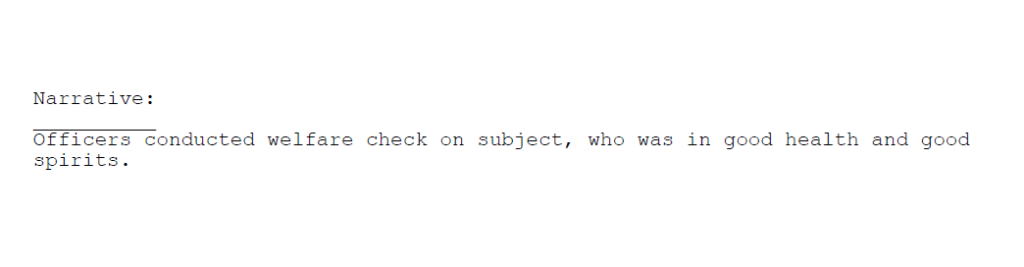
The first, incident 2504-0629, was logged at 10:36 a.m. as a welfare check. Two officers responded and found the subject — identified in the records as Jarred Ryan Brooks — in good health and good spirits. No action was taken. The record lists no named complainant for this call. Whether it came from D’Amato, someone in his audience watching the stream, or an unrelated party cannot be determined from the available documentation.
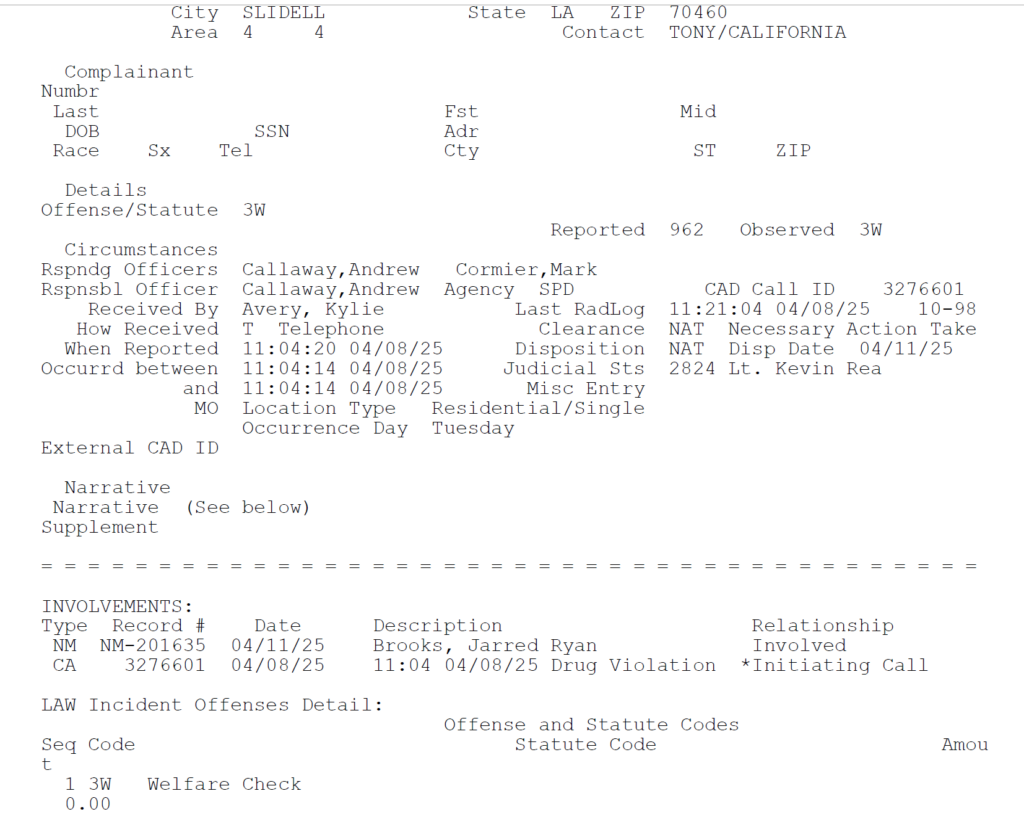
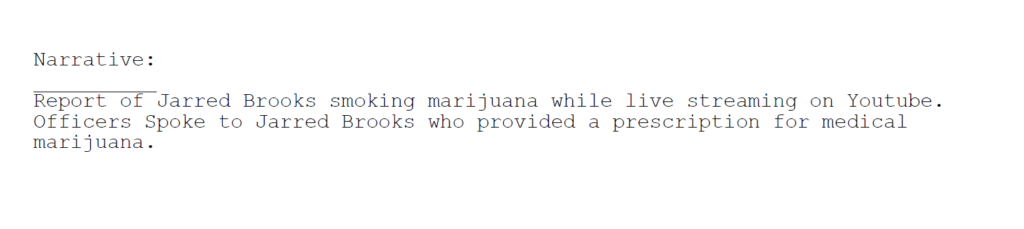
The second, incident 2504-0631, arrived at 11:04 a.m. The contact field reads “Tony / California.” The initiating call is logged as a drug violation complaint. Officers responded and spoke to Brooks, who produced a valid prescription for medical marijuana. No violation was found. The timing of this call corresponds to the moment on stream when D’Amato stepped off-camera and said he was going to contact police. Two items in the radio log were redacted under Louisiana’s law enforcement records exemption.
The third incident, 2504-0648, was logged at 2:35 p.m. This time the complainant was Brooks himself. He called to report harassment. The responding officer’s narrative describes the result: “Officer spoke to subject in reference to what he believed to be harassment, but was determined to be a complaint due to Internet harassment from strangers of his online community.” No violation was found.
April 26: D’Amato Calls Again
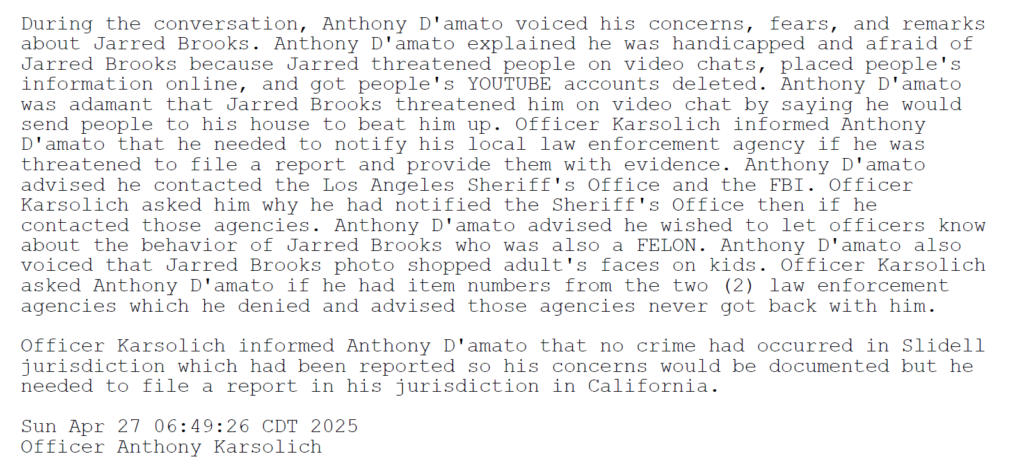
Three weeks later, a man called Slidell Dispatch from California, gave the name Tony, and reported harassment by a male at the same address. The responding officer, Anthony Karsolich, ran checks, went to the location, found no match for the name given, and eventually spoke with the caller directly. He identified himself as Anthony D’Amato.
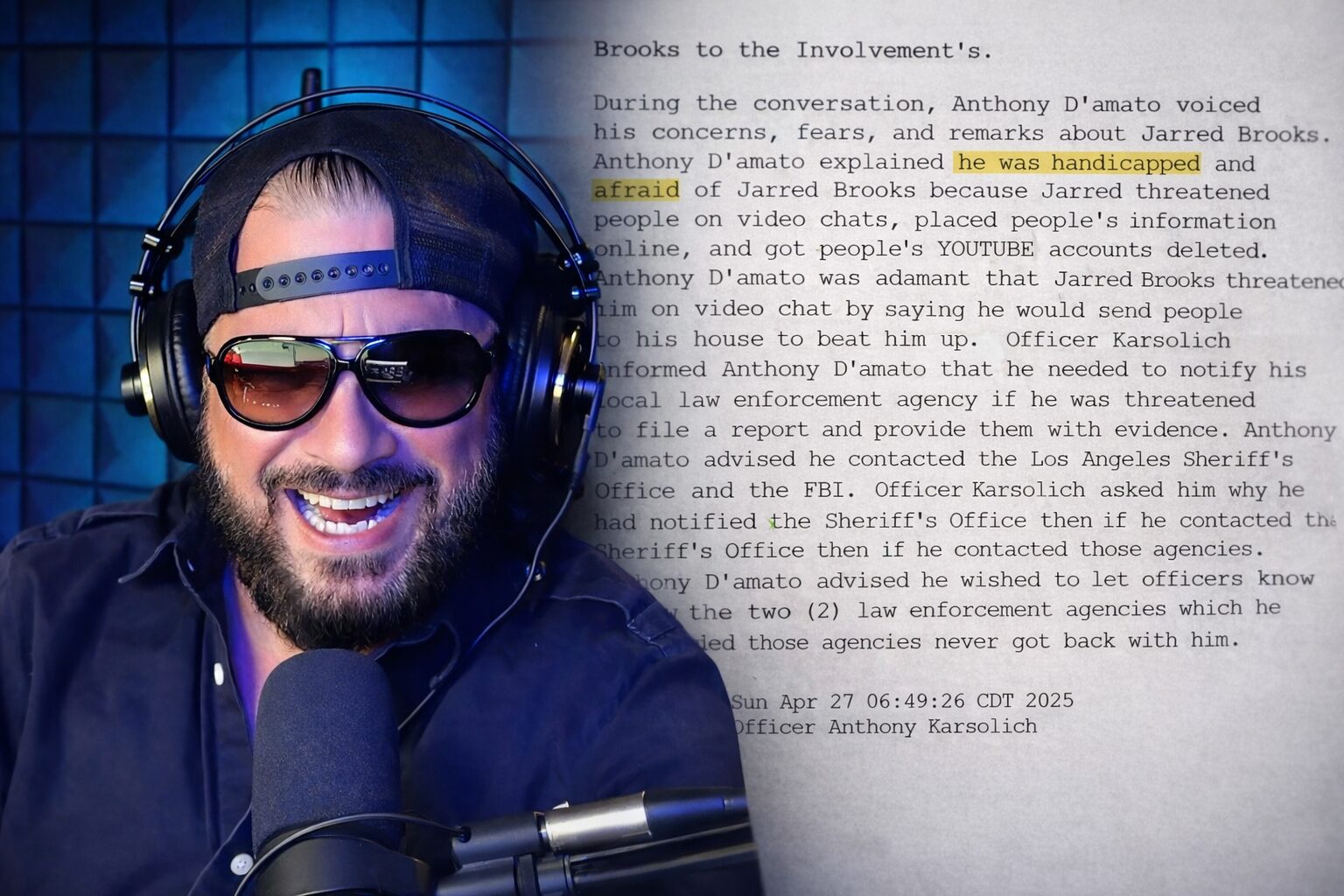
Officer Karsolich’s narrative in report 2504-2179 is detailed. D’Amato said he was handicapped and afraid. He said Brooks had threatened him on video chat, had posted people’s personal information online, and had gotten YouTube accounts deleted. He said he had also contacted the Los Angeles Sheriff’s Office and the FBI, though he acknowledged neither had followed up.
The officer told D’Amato that no crime had occurred within Slidell’s jurisdiction and that he should file a report with his local California law enforcement if he wished to pursue the matter. The incident was closed.
The Contradiction
The contrast with April 8 is clear.
What the April 8 stream shows is a man who spent hours issuing threats, mocking his target’s ability to defend himself, and expressing triumph as a refrain.
Timestamp: 01:54:59 – 02:02:08
Near the end of the stream, D’Amato addressed his former moderator, “DOS,” and his pending legal situation directly.
Timestamp: 02:56:24 – 02:58:36
“I’m not worried about my charges at all,” he said.
The charges he was dismissing were the 26-count Los Angeles criminal complaint — stalking, multiple violations of a domestic relations court order, willful cruelty to a child — filed four months earlier, on which he had been arrested, arraigned, and released on bond. Within eight months, he would plead no contest to two of those counts and be placed on three years of probation with a prohibition on using or threatening force or violence.
Conflict as Content
Throughout the April 8 stream, D’Amato returned to a theme he stated explicitly: that everyone attacking him was only producing material for his channel.
“All he’s done is create more content for me,” D’Amato said. “That’s all these people are doing.”
This logic was consistent across both his Louisiana-focused content and his Los Angeles-focused content. The prosecution in the Los Angeles case would later describe a defendant who used his platform to continue harassing the victims in his own criminal case while out on bond — flagrantly and publicly, in their characterization, even after the court had addressed his conduct at hearings. Prosecutors sought to raise his bail to $500,000 and ban him from social media entirely. Neither request was ultimately granted, as D’Amato entered a mental health facility, which triggers other legal processes under California Law.
See:
The Mental Health Card: How a California Law Meant to Help the Sick Became a Weapon for the Savvy
How to Game California’s Mental Health Diversion Law: A Six-Step Playbook – HERO / NOT / ZERO
The dual use of law enforcement runs through the April 8 stream from start to finish. D’Amato dismissed Solomon and his mother’s visit to a police station as evidence of bad faith. He called the Slidell Police Department himself, on camera, and announced it.
When KK called police hours later, D’Amato treated it as weakness. Three weeks later he called again — this time describing himself, to an officer in another state, as a frightened and handicapped man.
What the Record Shows
The criminal case ended in December 2025 with two convictions on the restraining-order violation counts and 24 dismissed counts. D’Amato was placed on summary probation with conditions that included a prohibition on using or threatening force or violence — the same conduct that had defined his streams for months.
The Slidell records show police dispatched multiple times in response to activity tied to D’Amato’s stream. Officers found no violations. The stream shows him directing threats, referencing a private residence, and contacting police in real time — before later presenting himself as a victim.
And the April 8 stream shows a man who, while out on bond in an active criminal case with a court order prohibiting contact with his victims, spent a morning on Rumble directing slurs, threats, and location references at a different man in a different state — called the police on him live, announced he wasn’t worried about his charges, and said the whole thing was content.
Sources
- Stream Link: https://rumble.com/v6rt4z9-the-zdt-morning-show-brica-brac-rodeo-dumpster-froe.html
- Full SRT Transcript
- Full Text Transcript
- Stream ID: RUMBLE · v6rt4z9