


Victory [ZeroDarkTony] / October 29, 2026 / YouTube / U6H5Fvok6tA
A judge awarded D’Amato’s lawyers less than half of what they asked Jarred Brooks to pay. That evening, D’Amato told viewers “the truth wins again” and said Brooks had been “court-ordered” to a financial assessment office. The minute order says nothing about one.
On Oct. 29, Los Angeles Superior Court Judge Holly L. Hancock-Goode ordered Jarred Brooks to pay $10,725 toward the attorney fees of Anthony D’Amato Jr., who streams as ZeroDarkTony. D’Amato’s lawyers had asked for $23,197.40.
That evening, D’Amato went live on YouTube under the title “Victory.” He was not at the hearing. The minute order lists only Brooks and D’Amato’s lawyer, Dawn Dunbar, both appearing by video.

Brooks lives in Slidell, La. He represented himself and had his court fees waived because he couldn’t afford them.
What the court ordered
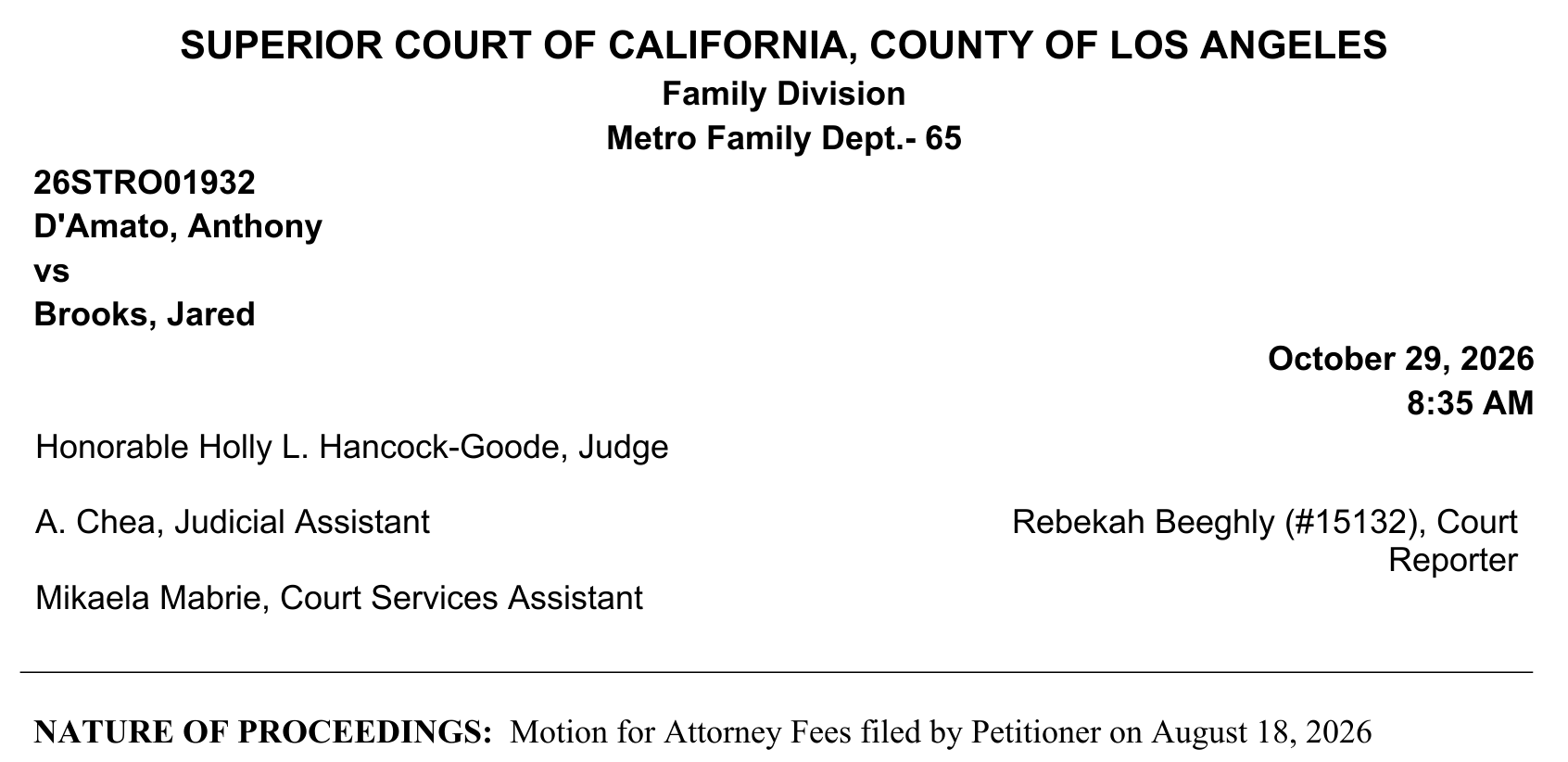
The minute order is one page. The judge reviewed “the moving, responsive, and supplemental documents,” had Brooks affirm that he would tell the truth, and heard “argument regarding income and expense.”

She granted the fee motion in part and awarded $10,725 “for work done related to the motions filed in this case.”

It doesn’t say which hours she counted or what rate she applied. It doesn’t mention the $122.40 in costs D’Amato’s lawyers also sought.
The two sides have 30 days “to meet and confer to establish an agreed upon payment plan.” If they don’t agree, “the total amount is to be due in full forthwith.” D’Amato’s lawyers are to draft the written order.

View the full Oct. 29 minute order
The award rests on one sentence of California law. Section 527.6(s) of the Code of Civil Procedure says the winner of a civil harassment case “may be awarded court costs and attorney’s fees, if any.” It doesn’t say how those fees must be proved.
Exhibit A
D’Amato opens the stream with the result:
“was around $10,700, I think, somewhere in that area.” … “The truth wins again.” … “He has been court-ordered through the financial assessment office.” … “they will determine what he pays per month”
Timestamps: 00:01:39 – 00:03:33 | Open clip in new tab
His figure is close. Later in the stream he gives the exact amount, $10,725.
The rest isn’t in the order. It says nothing about a financial assessment office or anyone deciding what Brooks pays each month. It leaves the payment plan to the two sides.
California counties do have financial evaluation officers. Under state law, they assess whether a person can repay costs owed to the county or the court, such as costs under the Penal Code. Hero Not Zero found no rule or case sending a party to one to set payments on attorney fees owed to the other side.
In the same clip, D’Amato says Brooks “tried to go in there and lie again. Obviously, it was rejected.” The minute order records no ruling against anything Brooks filed, and no finding that he lied. The one request of Brooks’s that the court decided in October, to keep his finances from D’Amato, was granted (see Exhibit B).
He also tells Brooks he could change his mind and sue him, but won’t: “I’m a man of my word.”
Exhibit B
“whatever motion that was filed denied” … “pay up buttercup but you know he’ll pay it off eventually i am very relieved that it’s done so better get your little pay stubs and go over there to the financial assessor”
Timestamps: 00:04:33 – 00:06:27 | Open clip in new tab
The only motion the Oct. 29 minute order decides is D’Amato’s fee motion, granted in part.
The pay stubs connect to a dispute that ran through October. On Oct. 1, the judge said she “needs more information regarding income and expense to make an appropriate ruling.” She ordered Brooks to file and serve an FL-150, the family-law income and expense declaration. That form asks for two months of pay stubs and an employer’s name, address and phone number, and it goes to the other side. Hero Not Zero reported on that hearing.
On Oct. 14, Brooks filed an ex parte application asking to submit his finances confidentially instead, on the fee-waiver form. “No statute or rule requires it in a proceeding under Code of Civil Procedure section 527.6,” he wrote.
Two days later, Hancock-Goode granted it, signing the order Brooks had proposed. Instead of an FL-150, he would give his income and expense information to the court on the fee-waiver form, “for the Court’s review only,” in connection with the fee motion.
The clerk was to keep the form confidential under state law. It would not go in the public file or be available through the court’s online access, and it “shall not be served on Petitioner.” The order kept Brooks’s financial details out of D’Amato’s hands and out of public view.
So when D’Amato tells Brooks to bring his pay stubs, the Oct. 16 order had already settled where Brooks’s finances would go: to the court, and no one else. The order mentions no opposition from D’Amato’s side.
On June 23, the day after he won the restraining order, D’Amato told viewers more than once that he would garnish Brooks’s wages. [CONFIRM against the June 23 video.]
Exhibit C
D’Amato says he’ll attach the ruling to a declaration he’s filing against other critics, who he says are “working with each other.” Then he addresses them:
“now you have just pushed this man into a position where he has to pay over ten thousand dollars”
Timestamps: 00:12:48 – 00:14:43 | Open clip in new tab
The amount is right. The award runs against Brooks alone, and it makes no finding about anyone else.
The written order he describes attaching didn’t exist yet. The minute order directs D’Amato’s lawyers to prepare it, serve it on Brooks “for approval as to form and content” and submit it for the judge’s signature within 30 days.
Exhibit D
“the zdt justice fund is now open for business” … “all he has to do is pay the bill which he is court ordered to do and if he doesn’t he’ll be found in contempt” … “i didn’t for a minute think it was going to be the whole 23 000” … “the full amount $10,725 he has been court ordered to pay”
Timestamps: 00:19:24 – 00:24:22 | Open clip in new tab
Two things here match the record. Brooks was ordered to pay $10,725, and that is less than “the whole 23 000”: about 46 percent of the $23,197.40 requested.
The minute order doesn’t mention contempt. If the two sides don’t agree on a payment plan, it says, the full amount is due “forthwith.”
California treats a court order to pay money as a money judgment. It’s collected the ordinary way, through writs of execution, liens and wage garnishment. The state’s judgment-collection law reserves contempt for judgments “not otherwise enforceable” that way. And the state constitution says a person “may not be imprisoned in a civil action for debt or tort.”
Courts have allowed contempt for child support, spousal support and need-based attorney fees in family cases, which California law doesn’t treat as ordinary debts. The Family Code allows contempt for orders “made or entered pursuant to this code.” This award was made under the Code of Civil Procedure, even though it was heard in a family courtroom.
Hero Not Zero found no case in which a California court used contempt to collect a civil harassment fee award.
In the same clip he asks viewers to give by Cash App to the “ZDT justice fund,” because “we are going to get some more justice.”
The next morning, Oct. 30, he came back to the number on another stream: “since you didn’t have to pay the whole $23,000, that that’s a win, okay?” He told Brooks he now had “a ten thousand dollar” bill on his hands.
What the judge didn’t ask for
D’Amato has asked for fees under the same sentence before. In 2025, after Scott Hochstetter’s restraining-order petition against him was dismissed, D’Amato, represented by a different lawyer, Steven Tamer, asked for $18,528.75. On May 27, 2025, Judge Melanie Ochoa, who also sat in the court’s Family Division, denied it entirely. Hero Not Zero reported on that ruling in September.
Ochoa wrote that the words “if any” permit “recovery only of fees that are actually incurred, not merely hypothesized.” She had asked the lawyer whether he charged D’Amato that amount, or could produce bills. According to her order, he “expressly refused to do so,” citing attorney-client privilege.
This year Brooks made the same argument: that D’Amato hadn’t shown what he owed his lawyers. Dunbar’s request rested on a declaration estimating “approximately” 35.5 hours, which she called “the minimum hourly estimate.” No invoices, time sheets or fee agreement were attached.
Hancock-Goode’s minute orders record no request for D’Amato’s fee agreement or bills. The only document they specifically required was Brooks’s own financial disclosure.
Hochstetter, who attended the Oct. 1 hearing, said on his stream that day that the court “basically said that all the fees looked reasonable for the lawyer.” The minute order records no such finding.
Neither judge’s ruling binds any other judge. No appeals court has decided what “if any” means.
“No question about that”
D’Amato had expected the award. On June 23, he told viewers: “We’re going to get awarded the legal fees. There’s no question about that.” He guessed the total would be “over $10,000.”
The award landed just above that.
This is the first part of a Hero Not Zero series on attorney-fee awards in California harassment restraining-order cases. Next: what the law requires of these requests, what it leaves out, and how the Legislature handled the same question in domestic-violence cases.
Disclosure: Hero Not Zero has covered the dispute between D’Amato and Brooks, and in October received a cease-and-desist letter from a person connected to D’Amato.
Sources
D’Amato’s account of the Oct. 29 ruling comes from his own stream; he did not attend. The court’s account comes from the Oct. 29, 2026, minute order in D’Amato v. Brooks, Los Angeles Superior Court case 26STRO01932, Metro Family Department 65.
- Original YouTube Video
- Full SRT Transcript: for HNZ Supporters
- Full Text Transcript: for HNZ Supporters
- Full Chat Transcript: for HNZ Supporters
- Date: 2026-10-29
- Stream ID: YOUTUBE · U6H5Fvok6tA
- Minute Orders, Oct. 1 and Oct. 29, 2026 (26STRO01932)
- Declaration of Dawn Dunbar in support of Request for Order for attorney’s fees, filed Aug. 18, 2026 (26STRO01932)
- Respondent’s ex parte application to submit income and expense information on form FW-001 instead of FL-150, submitted Oct. 14, 2026, and the order granting it, filed Oct. 16, 2026 (26STRO01932)
- Minute Order, May 27, 2025, Hochstetter v. D’Amato (24STRO08472)
- Code Civ. Proc. §§ 527.6(s), 680.230, 680.270, 681.010, 717.010; Cal. Const., art. I, § 10; Fam. Code § 290; Gov. Code § 27754; In re Fontana (1972) 24 Cal.App.3d 1008
- ZeroDarkTony livestream, June 23, 2026 (_pyG0by3ZZA; transcript: for HNZ Supporters)
- ZeroDarkTony livestream, Oct. 30, 2026 (b81saRz7B5w; transcript: for HNZ Supporters)
- Scott Hochstetter (DOA) livestream, Oct. 1, 2026 (YxGoa4Z3ZJ8)
- Prior reporting: A Judge Tossed ZeroDarkTony’s Last Fee Bill. The New One Has Even Less Behind It.; Judge Holds Off on D’Amato’s $23,197 Fee Request, Orders Brooks to Disclose His Finances; ZeroDarkTony Says Judge Found His Fees Reasonable; Minute Order Shows No Ruling
React to this story